
COCA promises cashback on stablecoin spending. The fine print is where the story is.
 Available in US
COCA is a Visa card you spend from a crypto wallet rather than from a bank account. You load it — by bank transfer, from another card, or with stablecoins — and then pay with it as you would with any debit card, earning cashback back in stablecoins. The card itself is a good idea with real appeal: no annual fee on the App Store listing, a free ATM allowance, and up to 8% back on general spending and 50% back on subscriptions. What stops me recommending it outright is not the product, it is the paperwork. Almost none of the numbers you need to decide are published. I scored it 6.4 out of 10 — and the gap between that and a higher score is mostly missing information, not a proven failure.
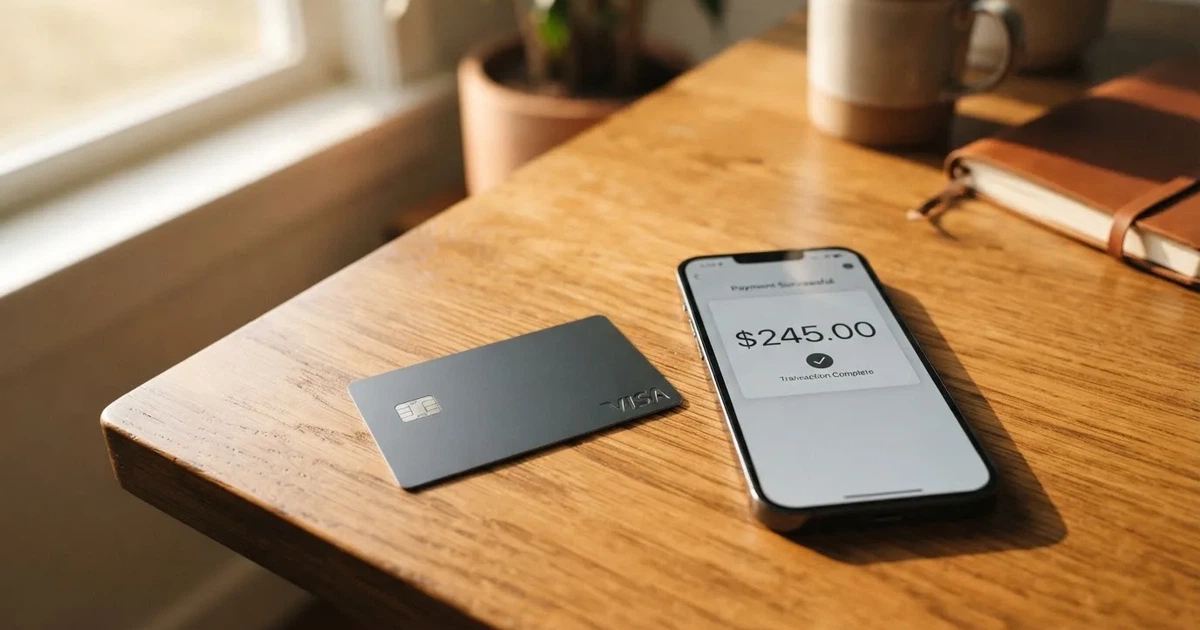
The conditions described on this page are current as of October 28, 2026.
Who it suits: stablecoin holders who already hold most of their money in tokens, want to spend it directly, and care a lot about cashback on subscriptions. Who it does not suit: anyone who needs a card with clearly published fees, clear limits, and a clear route to a chargeback — and anyone whose income or savings is in crypto they would be upset to lose access to for a few weeks.
My score card
Here is how the 6.4 breaks down, and — just as usefully — why each line sits where it does.
| Criterion | Mark | Why |
|---|---|---|
| Who can get it | 8 / 10 | Available across the UK, EEA, Asia, South America, the Middle East and Africa; Afghanistan, Iran, Iraq, Cuba, Syria and others are excluded |
| Cost | 6 / 10 | No maintenance fee on the App Store, but the issuance price is not published; unconfirmed: FX 0.5–1.5% by currency, 0% on USD and EUR, and a physical card reportedly needs a first top-up of EUR 50 |
| Top-up options | 5 / 10 | IBAN in EUR or USD, other cards, or stablecoins — but the coins and networks are never named |
| Reliability and complaints | 4 / 10 | Operated by CCA Labs – FZCO in Dubai, issuer not named, unconfirmed link to Wirex; Trustpilot 2.8/5 from 31 reviews, with complaints about funds inaccessible after an update and accounts closed |
| Everyday use | 9 / 10 | Physical and virtual Visa, unconfirmed Apple Pay and Google Pay, free ATM withdrawals up to $250 a month |
The highest mark is for everyday use, and it is deserved: this is a card that plainly works at a shop, with a virtual version for online payments and an ATM allowance that most of the category would envy. The lowest is reliability, for reasons I will come back to — not because the card demonstrably breaks, but because the public complaint record is poor and the issuer is not identified anywhere on the pages I read.
Who they will give the card to
The card is, in the company’s own words, currently available in the UK, EEA, Asia, South America, the Middle East and Africa. The app is the place to check your own area rather than relying on any list — including this one, which will age. The terms define restricted jurisdictions: Afghanistan, Iran, Iraq, Cuba, Syria and others are closed.
So: this is a broad map, wider than most crypto cards, and it is the single strongest point in the card’s favour if you are outside Europe and North America. It is not, however, an unconditional promise of eligibility. The list is the company’s; the decision sits with the issuer, which the terms do not name, and with the compliance checks that issuer runs.
How to get it
There is a physical card and a virtual card, both Visa. The currency of either is not stated on the pages I read, which matters more than it sounds — see the fees section. The site advertises “no KYC hassles” about the wallet. The terms, meanwhile, require you to cooperate with provider requests, and set the age floor at 18.
That gap is the thing to sit with. The wallet’s marketing language and the card’s actual onboarding are two different subjects, and the card is the part you care about. I could not find the card’s KYC requirements published: not the document list, not the verification levels, not how long it takes, not why a check might be refused. One unconfirmed source (penchan.co, October 2026) describes the process as: choose the country of the ID you are submitting, then pass the issuer’s identity check, with documents unspecified. Delivery time and cost are not stated either; one Trustpilot reviewer called delivery fast, which is one person’s experience rather than a published standard.
My advice is not to treat any of that as settled. Before you rely on this card for something urgent, get the app open, complete verification while you still have alternatives, and ask support directly which documents it wants and how long it takes.
Fees: what it really costs
Here is the honest position: COCA does not publish its price list. The terms say fees are “disclosed at the time you access the Service”, the footer advertises “fee-free swaps”, and the App Store listing says “No maintenance fees” while still leaving the issuance price unstated. ATM fees and spending limits are likewise not stated on the official pages.

The numbers below are what the official pages say, and what unconfirmed third-party sources add, kept in separate columns so you do not mistake one for the other.
| Fee or limit | Official | Unconfirmed (third parties, not confirmed by COCA) |
|---|---|---|
| Card issuance | Not stated; App Store says “No maintenance fees” | Free, no minimum; annual fee US$0; a physical card reportedly needs a first top-up of EUR 50, from which production and shipping are deducted |
| Monthly fee | None, per the App Store listing | Free |
| Conversion / FX markup | Not stated; the footer advertises “fee-free swaps”; a November 2024 press release advertised zero FX for a limited time | 0.5–1.5% depending on currency, 0% on USD and EUR; another aggregator reports 0% FX and a free annual fee. A September 2026 Trustpilot reviewer says the cost is in the spread |
| ATM | Not stated on the terms pages | Free within a monthly allowance, 2% above it, allowance amount not stated; the App Store says free up to $250/month |
| Daily limit | Not stated | One source reports no spending limit; another reports a EUR 30,000 daily limit with unlimited transactions — single source, unconfirmed |
| Cashback caps | Tier caps exist; amounts not published | Cashback claimable of US$15–350 a month by tier |
Three everyday payments, to make this concrete:
A coffee in a country that does not use the euro or the dollar, paid on the physical card. Whatever the conversion fee is — unconfirmed at 0.5–1.5% depending on currency — comes out of your money, and if that percentage is wrong you are the one who finds out after the fact. This is the payment where the missing fee disclosure actually costs you something.
A Netflix subscription. This is the card’s best argument: cashback of up to 50% on subscriptions is the headline, and subscriptions are exactly the payments where nobody notices a conversion spread because there is no visible conversion at all.
A withdrawal from a cash machine. The App Store says free up to $250 a month. Above whatever the real allowance turns out to be, one unconfirmed source says 2%. If you take cash out regularly, this line matters more than the cashback does.
One more thing about the fee structure that you should read as a tier system rather than a rate: cashback depends on how much $COCA you hold in the wallet. The Basic tier is automatic and needs no tokens; higher tiers require holding $COCA, and the rate and the monthly cap depend on both the tier and your region. Above the cap, cashback drops to 1%. The names of the higher tiers, the thresholds, and the caps are not published on the pages I read — the terms point to a separate “Tier System Terms & Conditions” document. App Store notes add that higher-tier members can request increased spending limits.
That is the honest shape of this card’s pricing: the part that is advertised is generous and the part that pays for it is withheld. Ask support for the tier document before you buy tokens to hold.
How to Top up
Top-ups come in three documented forms: an IBAN in EUR or USD, transfers from other cards, or stablecoins. The documentation at docs.coca.xyz names the same three routes. Beyond that, silence: no fees, no minimum top-up, no statement about who pays the network fee, and no list of which coins on which networks are accepted.
That last omission is the one that will bite you. A stablecoin sent on a network the provider does not support, or to an address belonging to a different network, can be lost or need manual support recovery with no guarantee — blockchain transfers are irreversible by design. Two of the complaints in the next section are exactly this. If you intend to fund by crypto, get the network written down in a support ticket before you send, not after.
The terms also say assets are transferred to a third-party linked smart contract wallet for fiat payments. So even money arriving by IBAN ends up passing through crypto infrastructure on its way to the card.
On the way out: the terms describe closing the account by withdrawing assets, confirm the wallet is non-custodial, and state that transactions cannot be cancelled or modified once submitted. If COCA withdraws the wallet, it says it will “endeavor to give” two months’ notice. Fees are not refunded on termination, and withdrawal fees are not stated.
Paying with it every day
Up to 8% cashback in stablecoins on card spend, and up to 50% on subscriptions such as Netflix and Spotify. The Basic tier is automatic; higher tiers need $COCA in the wallet; above the tier’s monthly cap you earn 1%; and a downgrade comes with a 30-day grace period.
On the app side: the iPhone build requires iOS 17.0 or later (plus visionOS 1.0+), version 3.10.0, with an App Store rating of 3.9/5 from 37 ratings as I read it. The Google Play package is com.wirex.wallet, and its rating could not be retrieved. That package name is worth noticing on its own, and I will come back to it.
Apple Pay and Google Pay are not mentioned on the official pages. Two unconfirmed sources (penchan.co, October 2026, and spendnode.io) list both as supported, so treat phone wallets as likely rather than confirmed. Blocked merchant categories are not stated either — which matters if you gamble or buy gift cards, categories that many issuers restrict by policy.
On disputes, the terms are thin in a way that should worry you. They do not mention chargebacks. Disputes are governed by English law, individual claims only, with no time frames stated. A chargeback is a refund the issuer orders to settle a disputed payment, and if the card’s terms do not describe one, you should assume you would be arguing from scratch.
What a Visa payment number means in practice: the first six or eight digits identify the issuing institution, and merchants can look that up and see the issuer country. If it differs from your billing address, some shops apply extra scrutiny. That is the general reason a card issued in one country can look foreign in another, and it is not a defect particular to COCA — but it is a predictable source of declines for a card with an unnamed issuer.
What can go wrong
Start with the operator, because it explains a lot. COCA is run by CCA Labs – FZCO, Dubai Digital Oasis, UAE, registration DSO-FZCO-31557. The card issuer is not named anywhere on the pages I read. The Google Play package is com.wirex.wallet, and a 2024 Trustpilot review describes Wirex accounts moving into the Coca Wallet app. Unconfirmed sources point the same way. Whether that history matters to you depends on how you weigh it, but you should know it exists rather than discover it later.
Now the record. Trustpilot shows 2.8/5 from 31 reviews, with 78% five-star and 16% one-star — most of the low scores from early 2024 wallet reviews. Other country pages show 3.5/5 from 27. The company answers negative reviews, usually by asking for a ticket number.
The specific complaints, from 2026, are the ones to read:
- June 2026: funds and card inaccessible for three months after an app update.
- August 2026: a deposit on the correct network lost, with a ticket open more than a week.
- September 2026: two USDC transfers via X Layer unrefunded.
- September 2026: an account closed after a months-long wait, with only part of the balance returned.
- August 2026: a EUR 20 internal SEPA transfer held for compliance.
- September 2026: a “0% FX” claim said to be hiding a spread.
- Earlier, January 2024: a one-star review about funds lost after a Wirex account moved to the Coca Wallet app; and a two-star review about a EUR 20 SEPA transfer held for compliance confirmation. There are positive reviews too, on spending USDT and on support.
The pattern is not “the card fails”. It is “when something goes wrong, resolution is slow and partial”. That is a support and liquidity story, and it is why I marked reliability at 4. Official incidents: none are stated, so I cannot tell you these were systemic failures or a run of one-offs — only that they are documented by users and unanswered in the way users would want.
Two more things about the security design. The wallet is non-custodial and uses Multi-Party Computation; the FAQ says there is no seed phrase, while the terms refer to a Recovery Phrase and say COCA cannot recover access for you. Those two statements sit together uncomfortably: no seed phrase is a genuine protection, and also the reason nobody can restore your wallet if you lose your device. Swaps carry Flashbots protection. Whether you can freeze the card in the app, and whether there is insurance, are both not stated.
The background risk is the generic one, and it applies to every self-custody design: transfers are irreversible, a stolen key has no recovery path, and you bear responsibility for key loss, phishing, and malware that silently replaces a copied address. Keeping funds with a custodian carries the opposite risk — counterparty failure, with Mt. Gox, Coincheck and Ronin Network as the historical examples. Neither is free.
Finally, tax. I am not going to advise you here, only flag the shape of it: in the US the IRS treats digital assets as property, so spending crypto on goods and services generally produces a taxable gain or loss, measured in local currency at the value on the transaction date. A card funded from crypto can therefore turn every coffee into a separate disposal. Whether that applies to you, and how, is a question for a professional in your own jurisdiction.
What to take instead
Three alternatives came up in the same category, and all three are honest comparisons rather than endorsements — each has gaps of its own.
| Alternative | Score | Availability | Card | Cost and funding |
|---|---|---|---|---|
| Whop Cards | 5.2 / 10 | 31 US states for consumers, 41 for businesses; not supported in Belarus, China (Mainland), Cuba, Hong Kong, India, Iran, Iraq, Israel, Myanmar, Nepal, Nicaragua, North Korea, Russia, Syria, Turkey, Ukraine, Venezuela, Vietnam | Visa, works anywhere Visa is accepted; physical/virtual not stated | Page says “No extra fees” with no amounts; spends from a Whop balance, backed by stablecoin collateral from a linked wallet; 5% cashback at select merchants, currently Uber |
| Stella | 6.5 / 10 | Countries not stated; terms bar users under economic sanctions programmes and route US and European users through affiliates | Virtual and physical VISA, working at “over 40 million VISA merchants globally” | Fees not stated officially; deposit crypto into the account, which automatically tops up a custodial in-app wallet; no cashback stated on the card page |
| UniFi Card | 4.7 / 10 | Not confirmed from official pages; App Store lists send-money routes to the Philippines, Mexico and the eurozone, with release notes mentioning Colombia, Brazil and the UK | Prepaid Debit Visa Card issued by Lead Bank; supports Apple Pay; USD | Fees “may apply”; funding via ACH, wire, SEPA or SPEI, or paid out to a USDC wallet; “3% rewards on balances” claimed, card cashback not stated |
The pattern across all four cards is the same, and that is worth saying plainly: none of these products publishes a complete price list, and most of them leave the issuer unnamed or unconfirmed. COCA is the most widely available of the four and the strongest on everyday use and cashback; Stella edges it on published score; Whop and UniFi are more constrained geographically or less documented. Read the comparison as a set of trade-offs, not a ranking.
Who I would recommend it to
I would recommend COCA to someone already holding stablecoins who wants to spend them without converting through an exchange first, who subscribes to services every month and will genuinely notice 50% back, and who treats the balance as spending money rather than savings. For that person the missing fee details are an irritation, not a risk, because the spend is planned and small.
I would not recommend it as your only card. If your salary lands on it, if you need cash regularly, or if you cannot afford to have your balance frozen while support works through a ticket, the combination of unpublished limits, no stated chargeback process and a Trustpilot record of slow resolution is disqualifying — not because something is proven wrong, but because nothing is promised in writing.
And I would not recommend buying $COCA to reach a higher tier until you have the tier document in hand. Paying for a token to unlock a rate whose cap you cannot see is the wrong order of operations. The one thing I would do for everyone: keep a second card with a bank behind it, so that a wallet upgrade, a lost device, or a support queue is an inconvenience rather than an emergency.
Frequently asked questions
What is the COCA card?
COCA is a Visa payment card you spend from a crypto wallet instead of a bank account. You load it by IBAN transfer in EUR or USD, from another card, or with stablecoins, and then pay in shops and online as with any Visa. It comes in physical and virtual form, and spending earns cashback back in stablecoins — up to 8% generally, and up to 50% on subscriptions.
How does the COCA card work?
You top up a balance, and the card draws on that balance much like a prepaid card, so it cannot overdraw. When you pay, the crypto side is handled through a third-party linked smart contract wallet, which the terms say assets are transferred to for fiat payments. The wallet itself is non-custodial and uses Multi-Party Computation, with no seed phrase according to the FAQ.
Is COCA a bank?
No — it is a card programme from a crypto company, not a bank account, and COCA is not a bank. The company behind it is CCA Labs – FZCO in the Dubai Digital Oasis, UAE, registration DSO-FZCO-31557. The card issuer is not named on the public pages I read, which is exactly why the protections you would get from a regulated bank cannot be assumed here.
Who owns COCA?
The operator is CCA Labs – FZCO, a Dubai-registered company, and the terms carry a date of 4 November 2023. The Android package name is com.wirex.wallet, and a 2024 review describes Wirex accounts moving into the Coca Wallet app. Several third-party sources also point to Wirex as the issuer, but I could not confirm that from COCA’s own pages, so treat it as unconfirmed.
Does the COCA card require KYC?
For the wallet, the site advertises “no KYC hassles”. For the card, the official pages do not state the KYC levels, documents, timing, or refusal reasons — the terms only require you to cooperate with verification and set an age floor of 18. Unconfirmed sources describe choosing the country of your ID and passing the issuer’s identity check, with documents unspecified. Plan on being asked for identification.
Is the COCA card free?
Partly. The App Store listing says “No maintenance fees” and unconfirmed sources report no issuance fee and a US$0 annual fee. But COCA has not published an issuance price, ATM fees, or spending limits, and one unconfirmed report says a physical card needs a first top-up of EUR 50 from which production and shipping are deducted. Free is not the same as fully specified.
How much does COCA charge in foreign currency?
The official pages do not say. A November 2024 press release advertised zero FX fees for a limited time, and the footer advertises fee-free swaps. Unconfirmed sources report 0.5–1.5% depending on the currency with 0% on USD and EUR, while another aggregator reports 0% FX outright, and a September 2026 reviewer says the cost sits in the spread. Ask support directly before relying on it for travel spending.
Is the COCA card safe?
The wallet is non-custodial with Multi-Party Computation and Flashbots protection on swaps, which is a sensible design. Against that, the terms do not mention chargebacks, freeze and insurance are not stated, and the FAQ’s no-seed-phrase claim sits awkwardly beside the terms’ statement that COCA cannot recover access for you. Transfers are irreversible and a lost key has no recovery path.
What are people complaining about?
Trustpilot shows 2.8/5 from 31 reviews, and the company answers negative ones. The 2026 complaints cluster on resolution: funds and card inaccessible for three months after an app update, a deposit on the correct network lost with a ticket open over a week, two unrefunded USDC transfers, and an account closed after months with part of the balance returned. The pattern is slowness, not proven failure.
Is the COCA card worth it?
It is worth it if you already hold stablecoins, spend them regularly, and can afford to treat the balance as spending money — the subscription cashback alone is genuinely strong. It is not worth it as your only card, because the limits, fees and dispute process are unpublished and the complaint record is slow. Check the tier terms before buying $COCA to unlock a higher cashback rate.
How app and neobank cards work – cryptocardsexplained.com
Content created by the «cryptocardsexplained.com» team