
Simple Crypto reviewed: a virtual Mastercard with a shutdown clock on it
 Available in US
The Simple Crypto card is a virtual Mastercard that spends a crypto balance directly, with no monthly fee, no issuance fee, and a fairly generous spending limit for anyone who clears identity checks. On paper it is one of the more practical ways to hold stablecoins and pay with them daily. The catch is not in the fee schedule. It is in the fact that the company’s custodial wallet services are being closed by 30 June 2026, and that the reviews people leave are full of accounts blocked with money stuck inside.
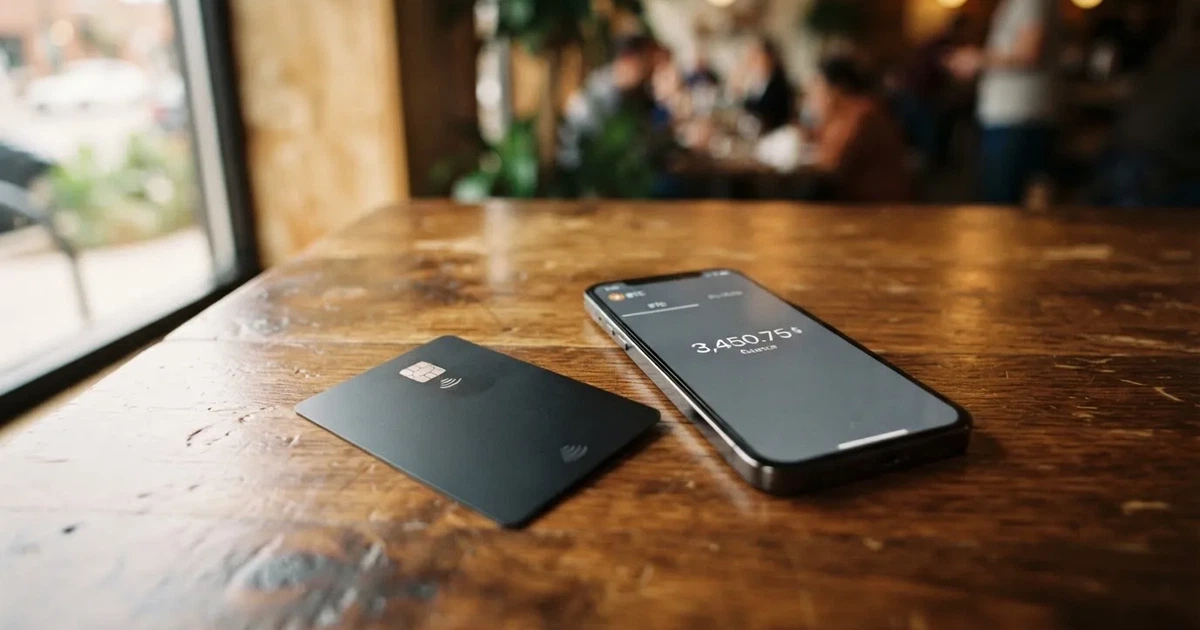
I gave it 6.9 out of 10 overall. If you already keep USDC in a wallet of your own and want to spend it with Apple Pay, the strengths are real and hard to find elsewhere. If you are opening your first card, expect trouble, and if you are in a region that is not on the list below, none of this applies to you.
The conditions described here are current as of October 28, 2026.
Verdict: 6.9 out of 10
Here is how the score breaks down, criterion by criterion, so you can see exactly where the marks come from and disagree with me if you like.
| Criterion | Mark | Why |
|---|---|---|
| Who can get it | 8 / 10 | A help-centre list dated 24 January 2026 opens the card across Europe, Asia-Pacific, Latin America, the Middle East, Africa and the CIS, and the United States |
| Cost | 5 / 10 | Issuance and monthly servicing are free, but international card payments cost 2.5%, ATMs charge 2% after three free withdrawals a month, and card replacement is 20 EUR |
| Top-up options | 9 / 10 | USDT on Ethereum ERC20, Polygon, BNB Smart Chain, Arbitrum and Tron, plus USDC on Ethereum ERC20, Polygon, BNB Smart Chain, Arbitrum and Base, credited instantly |
| Reliability and complaints | 6 / 10 | The card is issued by Unlimit EU Limited in Cyprus, Central Bank of Cyprus licence 115.1.3.7, but the custodial wallet closes by 30 June 2026 and Trustpilot sits at 4.2 out of 5 across 7,046 reviews |
| Everyday use | 7 / 10 | Virtual Mastercard only, physical card still in development, Apple Pay and Google Pay work, ATM limit 500 USDC a day |
Total: 6.9 / 10.
The audience this card suits best is narrow and specific: someone who already holds self-custodied USDC, is comfortable with networks and addresses, and wants a card that spends that balance in a shop without an exchange in the middle. The fee structure rewards exactly that person. Free issuance, free servicing, free domestic card payments, and free first ATM withdrawals each month is a better starting point than most cards in this category.
Who it does not suit is equally clear. If you have never sent crypto anywhere, the network choices are a trap rather than a feature: sending on the wrong network is one of the few genuinely irreversible mistakes available. If you need a physical card in the post, this is not it yet. If your priority is not spending crypto but simply getting a working payment card in a country where the usual banks will not open one, be careful — the custody closure means the thing you are trusting may be in the middle of a shutdown.
Will they give you the card?
They will, if you are in one of the listed places and your documents pass. The card’s help centre carries a region list for the USDC Simplecard dated 24 January 2026, and it is long. I am reproducing the shape of it rather than every name, but the coverage runs from Europe and Asia-Pacific through Latin America, the Middle East, Africa and the CIS, and includes the United States.
Europe in that list includes Andorra, Austria, Belgium, Bulgaria, Croatia, Cyprus, the Czech Republic, Denmark, Estonia, Finland, France, Germany, Gibraltar, Greece, Hungary, Iceland, Ireland, Italy, Latvia, Lithuania, Luxembourg, Malta, Monaco, Montenegro, the Netherlands, Norway, Poland, Portugal, Romania, Slovakia, Slovenia, Spain, Sweden, Switzerland, the United Kingdom and Ukraine. Asia-Pacific runs to Australia, Hong Kong, Indonesia, Japan, Macao, Malaysia, the Philippines, Singapore, South Korea, Taiwan, Thailand and Vietnam. Latin America covers Argentina, Brazil, Chile, Colombia, Ecuador, El Salvador, Mexico and Peru. The Middle East, Africa and CIS group adds Azerbaijan, Bahrain, Georgia, Ghana, Israel, Kazakhstan, Kenya, Moldova, Nigeria, Oman, Saudi Arabia, South Africa, Turkey, Uganda, the UAE and Uzbekistan. Guernsey, the Isle of Man and Jersey are included, and so is the United States.
One thing the card’s pages do not say: whether the test is citizenship or residence. That is not stated anywhere in what I could find, and it matters more than it sounds. If the rule turns on nationality and you hold a passport from somewhere else, being resident in a listed country may not be enough. Check that yourself in the app before you send documents.
Why these countries at all? The reason is structural rather than arbitrary. A card number starts with a six or eight digit issuer identification number that identifies the institution that issued it, and any shop can look that up. That is why a card issued in one country can look foreign to a merchant in another, and why some merchants decline prepaid or foreign-issued cards on sight. Issuers stay inside jurisdictions they know.
How to get it
The application is short. In the Cards section you choose the Virtual card, enter a phone number, complete KYC by uploading Proof of Identity and Proof of Address, and wait. The card’s own words: the review “usually takes a few minutes but can take longer”. Which is a sentence worth sitting with — minutes is the good case, not the promise.
Proof of address has to be dated within the last six months, and the accepted documents are a bank statement as a PDF, an electricity, water or gas bill, an internet or landline bill, a tax bill or government letter, or a utility bill from a government agency. The card is explicit about why applications get rejected: people upload a passport or ID instead of a proof of address, they use a document older than six months, or they send a screenshot instead of a PDF or photo.
So: identity document in one slot, address document in the other, address document less than six months old, as a file and not as a screenshot. That is the whole trick. The card’s pages do not state a minimum age, and they do not describe different KYC tiers — there is one process with one set of documents.
What you get at the end is a virtual Mastercard. The card currency is EUR. A physical card is described as “currently in development”, so if you are visualising a plastic card arriving in the post, that is not part of the product yet. Card delivery is therefore not something to compare — but replacement and reissue are, at 20 EUR, which matters if your phone is lost.
Fees: what it really costs
Zero to open, zero a month, and then the charges appear in specific places. The table below is the whole picture from the card’s fee schedule.
| Fee or limit | Value |
|---|---|
| Card issue | 0 EUR |
| Cardholder management | 0 per month |
| Non-active card maintenance | 0 per month |
| Reissue, renewal or replacement | 20 EUR |
| Card payment, domestic | 0 |
| Card payment, international | 2.5% |
| Cash withdrawal in a currency other than the card currency | 0 |
| ATM withdrawal, domestic | 0 for the first 3 withdrawals per month, then 2% |
| ATM withdrawal, international | 1.75 + 2.5% |
| ATM balance inquiry | 0 |
| Chargeback | 40 EUR |
| Review of an unjustified claim | 40 EUR |
There is no separate conversion line on the fee schedule. The crypto conversion rate is shown on screen at the top-up instead, which is honest but also means the conversion cost lives in a number you see only at the moment you move money — not in a table you can budget from.
Limits: card payments cap at 30 000 USDC daily with a maximum of 15 purchases, 30 000 USDC monthly, 75 000 USDC per three months and 100 000 USDC per six months. ATMs cap at 500 USDC daily with a maximum of 5 withdrawals, and 5 000 USDC monthly. These are per card rather than per KYC level, and the card does not say that different verification tiers get different limits, because it does not describe tiers at all.
Now three everyday payments, which is where this schedule actually bites.
A coffee in your own country costs nothing extra. Domestic card payment is 0, so a 4 EUR pastry is 4 EUR. This is the card’s strongest argument and it is genuinely strong.
The same coffee abroad costs 2.5% on top. On a 4 EUR purchase that is about 10 cents, invisible. On a 200 EUR hotel night it is 5 EUR, and on a 1 500 EUR month of travel it is 37.50 EUR for the privilege of using the same card number you use at home. The 2.5% is the whole reason to keep this as a second card rather than your only one.
An ATM abroad costs 1.75 plus 2.5%, and after three free withdrawals in a month the domestic ones cost 2% too. Take out 200 EUR domestically as your fourth withdrawal of the month and it costs 4 EUR. Take out 500 USDC at an ATM — the daily ceiling — and the international charge is 1.75 plus 2.5% of 500, which is 14.25 EUR on top of the conversion the app does for you. Cash is where free cards stop being free.
One more number to keep in mind before you argue with a shop: a declined authorisation can leave a hold on your funds for several days, typically up to seven. A card that is refused at a till can therefore freeze money you did not spend as well as money you did not manage to spend.
How to top it up
This is the part the card does best, and it is why the top-up score is 9 out of 10.
You top up with USDT or USDC. USDT works on Ethereum ERC20, Polygon, BNB Smart Chain, Arbitrum and Tron. USDC works on Ethereum ERC20, Polygon, BNB Smart Chain, Arbitrum and Base. The card is linked directly to your crypto balance, and the card balance updates immediately — the card’s own phrasing, “your card balance will be updated immediately”.
| Asset | Networks |
|---|---|
| USDT | Ethereum ERC20, Polygon, BNB Smart Chain, Arbitrum, Tron |
| USDC | Ethereum ERC20, Polygon, BNB Smart Chain, Arbitrum, Base |
Two USDC details that trip people up, and neither is the card’s fault. Circle stopped supporting USDC on Tron in February 2024, so “USDC over TRC20” is not a native option even though USDT on Tron is perfectly normal — they are different assets on the same network. And because ERC-20 fees are paid only in ETH, a wallet holding USDT with no ETH in it cannot send anything on Ethereum. Someone on a first transfer sending to the wrong network can lose the funds outright, because blockchain transfers do not reverse and support recovery is manual, slow and not guaranteed.
The card does not state a deposit fee, a minimum top-up, or who pays the network fee — that part is charged by the blockchain, not by the card company. It also does not say what happens to a deposit that arrives late, or what you should do if it never arrives. I would not treat a large first transfer as a test.
If you have no crypto at all, the app lets you buy some with your bank card or your bank account. That is the route for someone who wants a card without touching an exchange account first, though the card’s pages do not spell out the cost of that purchase.
There is also a Withdraw button on the card dashboard, which moves funds to a Custody Wallet or a Self-custody Wallet, executed in cryptocurrency. The fee amounts are not given in the text; the card says they are visible in Card Transaction History, and neither the timing nor what happens to a leftover balance at closure is stated.
Paying with it every day
Everyday use is fine, and in places better than fine. Apple Pay and Google Pay both work, which matters more than it sounds: a virtual card number in a phone wallet is far more practical than a virtual card number you retype into websites, and tokenised payments replace your card number with a device-specific number stored on the device rather than a merchant’s server.
The ATM allowance is 500 USDC a day and 5 000 USDC a month. Spending caps are the ones in the fees table above.
Three things the card’s public pages do not tell you. Whether any merchant categories are blocked is not stated — and with a card issued by an e-money institution, gambling categories in particular are worth confirming yourself, since issuers block them by policy rather than by law and each one has its own list. There is no cashback, because rewards are not stated anywhere. And the site advertises 4.8/5 on the App Store and 4.9/5 on Google Play, which is the company’s own marketing claim, with the number of ratings behind those figures not shown; I read those on 21 October 2026 and I would treat them as a marketing number rather than evidence.
One practical warning about virtual card numbers in general. Some merchants decline prepaid or foreign-issued cards outright, because the BIN lookup reveals the card type and the issuer country. Address verification also tends to be unavailable for foreign-issued cards, which can cause declines on online payments. None of this is a Simple-specific fault, but it is the reason people report “it just gets refused sometimes”.
What can go wrong
The biggest thing on this page is not a fee. It is a date.
The company’s own help centre carries an urgent legal notice: mandatory closure of custodial wallet services by 30 June 2026, with articles under “Cessation of Custodial Services” and a general public announcement of the same name, plus one on moving your wallet to the new engine. So part of this product is in the middle of being switched off on a schedule. That is not a hypothetical risk and it is not something I am inferring — it is the headline in the card’s own help centre.
Then there is the experience of existing customers. On Trustpilot, simple.app stands at 4.2 out of 5 from 7,046 reviews, of which 24 came in the last twelve months as I read them on 21 October 2026. The themes are consistent and they are not flattering:
- Accounts blocked, disabled or suspended with funds stuck, reported across reviews from January 2025 to June 2026, alongside growing demands for verification documents.
- Support that is slow or silent, reported from January 2025 to September 2026.
- Failed card top-ups and transfers, reported in August 2026.
- Scam allegations and an unexpected charge, from April 2025 and September 2026.
- Complaints about fees and rates, from January and April 2026.
- The company does not reply to negative reviews.
Any of these can happen to you. Accounts get frozen when anti-money-laundering checks cannot be completed — that is the rule, not a punishment, and the EU rules require an institution to stand aside when due diligence fails. It is also why “growing verification requests” and “blocked with funds stuck” appear together in the same reviews.
Behind the card there are several companies, and it helps to know which is which. Simple Europe UAB handles Self-Custody Services from Lithuania. Stored Assets Ltd handles Custody Services from Bulgaria, as a wallet provider numbered BB-292 and registered with Bulgaria’s National Revenue Agency. And the Simple Account and the Mastercard are provided by Unlimit EU Limited in Cyprus, licensed and regulated by the Central Bank of Cyprus as an Electronic Money Institution under licence number 115.1.3.7. Three entities, three jurisdictions, one card.
What that licence does and does not mean is worth being precise about. An e-money institution in the EU can issue e-money and payment cards, and it must safeguard customer funds — by segregating them in dedicated accounts or insuring them. But safeguarded e-money is not a bank deposit and is not covered by a deposit guarantee scheme. If you are choosing this card because a bank turned you down, the card is not a bank account, and nobody should describe it as one.
Support is email only. The card’s help centre, “Get in touch” page and complaints page all route to email, and Simple states it never asks for passwords, codes or seed phrases. That last part matters more than usual here, because crypto support scams work by asking for exactly those things. Self-custody users can set spending limits on the wallet; an in-app freeze of the card is not stated.
There is a rule about crypto that catches people out. Self-custody means the funds are yours, which also means nobody can restore them if you lose the seed phrase — typically 12 to 24 words, in an unencrypted form that anyone who obtains can use to restore the wallet and spend it. Transfers are irreversible. A stolen key has no recovery mechanism because the network cannot freeze or return anything.
One last thing that does not apply to this card’s fees but does apply to your money: the tax treatment. Digital assets are treated as property, so exchanging them for goods, services or dollars generally produces a taxable gain or loss measured in local currency at the value on the date of the transaction. Each card payment funded from crypto may count as a separate disposal. That is a fact about how the tax rules work, not advice — talk to a professional about your own situation.
What to take instead
Four other cards in this category, all with the same rough shape of problem. Here is the comparison, unofficial where the card does not publish its own figures.
| Card | Score | Card | Cost basics | Spending fee | Top-up |
|---|---|---|---|---|---|
| Simple Crypto | 6.9 / 10 | Virtual Mastercard | Free issue and servicing, 20 EUR replacement | 0 domestic, 2.5% international | USDT and USDC on five networks each |
| BloFin Wallet Card | 6.9 / 10 | Visa Platinum, virtual/physical not stated | Activation, annual, issuance and dormancy all $0.00 | “1% or lower” by tier, from 1.00% at VIP 0 to 0.00% at VIP 5 | USDT and USDC on Arbitrum and Base |
| Decaf | 6.2 / 10 | Visa, virtual or physical with tracked delivery | Virtual $5 worldwide, physical $10 US / $90 rest of world, no annual fee | No FX fee added; Visa’s rate applies | Pay by card, bank transfer or USDC; coins and networks for top-ups not stated |
| SafePal | 6.2 / 10 | Virtual Mastercard debit | No account or management fees; issuance not stated | 1% FX on non-USD settlement; swaps include a spread | Crypto from 40+ blockchains to USDC or fiat |
BloFin ties Simple on score and beats it on one point that matters: no fees for activation, annual, issuance or dormancy, and no charge at all at the top VIP tier. Against that, its country list is not published on the card page — you select your region in the app, and unofficial starting data lists 35 countries including the US, Australia, Japan, the UAE, Brazil, Mexico, Malaysia and New Zealand. It also has no cashback by design, lowering the spend rate instead. Top-ups are limited to two networks, which is simpler and, if your funds are on Tron, impossible.
Decaf is the one with the clearest published country policy, and it is a restricted list rather than an open one: not issued in Belarus, China, North Korea, India, Iran, Iraq, Israel, Myanmar, Nepal, Russia, Syria, Turkey, Cuba, Ukraine, Venezuela, Vietnam, Nicaragua, Puerto Rico or Nigeria, with restricted US states including Arizona, Delaware, Georgia, Idaho, Louisiana, Maryland, Montana, Ohio, Oregon, Rhode Island, Washington and Wisconsin. Whether that applies by citizenship or by residence is not stated. What makes Decaf interesting is the FX line — it adds no fee of its own and uses Visa’s rate — but its activation fee is a real $5 to $90, and which coins and networks top up the card itself is not stated, which is the first thing you would need to know.
SafePal is the one to consider if network breadth matters most. Crypto from more than 40 blockchains, converted to USDC by default or to fiat, with Arbitrum transactions. Its own bank page advertises crypto top-ups “as low as 0.4%” on the top tier. But there is a 1% FX fee when Mastercard settles a non-USD payment, refund processing costs 1 USD/EUR/CHF/7 CNH, and swaps carry an unquantified spread. Its regions page was empty when I fetched it, which means I cannot tell you where it is available.
Pros and cons, briefly, for the one that was hard to choose:
| Simple Crypto | BloFin | |
|---|---|---|
| Strongest point | Free domestic spending and free first three ATM withdrawals; widest published region list | Tiered spend fee reaching zero; no issuance or dormancy charge at all |
| Weakest point | Custodial services closing 30 June 2026; blocked-account complaints | Top-ups only on Arbitrum and Base; spend fee at tier 0 is 1% |
| Best for | Existing self-custody USDC holder with Apple Pay | Someone who wants a simple Visa with a clear, published fee schedule |
Who I would recommend it to
I would recommend this card to one person: someone already holding USDC in their own wallet, in a listed country, who wants to spend it at a shop or in a wallet and who has already decided they can handle a network dropdown. To that person the card is good value — free to hold, free to spend domestically, 30 000 USDC a month of spending room, Apple Pay and Google Pay on board, and a conversion rate shown before you confirm.
I would not recommend it to you if this is your first interaction with crypto, if you need a physical card in the post, if you are outside the listed regions or hold a nationality the pages do not discuss, or if your main goal is a durable banking relationship. The custody closure on 30 June 2026 is the deciding factor for me. Buying into a card on the understanding that one half of its wallet infrastructure is being switched off is a bet on the other half surviving, and I would rather you make that bet knowingly or not at all.
The complaints deserve a fair hearing too. Four out of five across seven thousand reviews is not a disaster, and 24 reviews in a year is not a flood. But “funds stuck” combined with “support silent” is the specific combination that costs people real money, and it is the combination that recurs. If you take one practical thing from this page: keep an amount on the card you can afford to have tied up for weeks, and get your money out to a wallet you control if the service wobbles. On this card’s own architecture that is not paranoia. It is what the self-custody option is for.
Frequently asked questions
What is the Simple Crypto card?
It is a virtual Mastercard that spends a crypto balance instead of a bank account. You hold USDC or USDT, the app links the card to that balance, and payments draw down what you have loaded. It is issued by Unlimit EU Limited in Cyprus and the card currency is EUR. There is no physical card yet — the company says one is in development.
How does Simple Crypto card work?
You top up with stablecoins, the card converts what you spend, and the remaining balance stays available for the next purchase. Domestic card payments cost nothing and international ones cost 2.5%. Card payments are capped at 30 000 USDC a day and a month. The card works with Apple Pay and Google Pay, so most spending happens from your phone.
Is Simple Crypto a bank?
No, and this distinction matters. The Simple Account and the Mastercard are provided by Unlimit EU Limited, licensed by the Central Bank of Cyprus as an Electronic Money Institution under licence 115.1.3.7. An e-money institution can hold and safeguard funds but does not take deposits, does not lend, and its safeguarded balances are not covered by a deposit guarantee scheme.
Who owns Simple Crypto?
Several companies sit behind it, which is normal for this category. Simple Europe UAB provides self-custody services from Lithuania. Stored Assets Ltd provides custody services from Bulgaria as wallet provider BB-292. Unlimit EU Limited in Cyprus provides the account and the Mastercard. Nobody owns Visa or Mastercard the card is built on.
How do I get the Simple Crypto card?
Go to the Cards section, choose Virtual card, enter your phone number, and upload a Proof of Identity plus a Proof of Address dated within the last six months. A bank statement PDF, utility bill, internet or landline bill, tax bill or government letter all qualify. Review usually takes a few minutes but can take longer. Upload screenshots rather than files and it will be rejected.
Does the Simple Crypto card require KYC?
Yes. There is one identity and address process, not a tiered one, and the card does not publish different limits for different verification levels. Under EU anti-money-laundering rules, if due diligence cannot be completed the institution must decline or stop the relationship, which is why accounts get frozen and why you may be asked for more documents later.
Is the Simple Crypto card free?
Mostly. Issuance is 0 EUR, monthly servicing is 0, inactive card maintenance is 0, and domestic card payments are 0. The charges come later: 2.5% on international card payments, 2% on ATM withdrawals after the first three each month, 1.75 plus 2.5% on international ATM withdrawals, and 20 EUR to replace the card.
How do I top up the Simple Crypto card?
Send USDT on Ethereum ERC20, Polygon, BNB Smart Chain, Arbitrum or Tron, or USDC on Ethereum ERC20, Polygon, BNB Smart Chain, Arbitrum or Base, and the balance updates immediately. Check the network before you send — transfers on a blockchain are irreversible. USDC on Tron is not supported by Circle, and Ethereum transfers need ETH in the wallet for the fee.
Is the Simple Crypto card safe?
It is a genuine Mastercard with a real e-money licence, which is more than some products in this category offer. But the card’s own help centre announces mandatory closure of custodial wallet services by 30 June 2026, and reviews from January 2025 to September 2026 repeatedly mention blocked accounts with funds stuck and slow support. Support is email only, and Simple says it never asks for passwords, codes or seed phrases.
Should I delete my Simple Crypto account?
I cannot answer that for you, but here is what to check first. Whether you have a balance sitting in the custodial wallet, because those services are closing by 30 June 2026 and the card does not state what happens to a leftover balance at closure. Whether you have moved funds to a self-custody wallet. And whether any withdrawal is still pending, since timing is not stated. Settle those three before you close anything.
How wallet cards work – cryptocardsexplained.com
Content created by the «cryptocardsexplained.com» team