
Three virtual cards, one stablecoin, and a company that stays in the background
 Available in US
TapX is a crypto-funded payment card that has been quietly picking up a niche audience: people who hold USDT and want to spend it on subscription services without going through a bank. The product offers three virtual cards (Visa Universe, Mastercard Business, and Visa E-commerce), each priced and verified differently, and each aimed at a slightly different use case. There is no physical card, no metal tier, and the company behind the brand keeps a low profile: no legal entity, no licence disclosures, and a copyright line that just reads “© Copyright TapxCard, 2026.”

That profile is what makes the card interesting and, at the same time, what gives a careful reader pause. On the one hand, the offer is simple and the on-ramp is fast. On the other, the things that the regulated parts of the industry usually publish (issuer name, jurisdiction, complaint history) are not stated. The score in this review reflects both: a product that is easy to start using, weighed against the missing information you would normally expect.
Conditions are current as of October 28, 2026.
Verdict
TapX earns 5.1 out of 10 in this review. That number does not mean the card is bad at what it does; it means the package is uneven once you compare it with alternatives. The cost line drags the score down, the missing public-facing company information pulls trust down, and the everyday-use features pull it back up. The audience that fits best is narrow but real: someone who already holds USDT, wants a virtual card to pay for online services (subscriptions, ad accounts, cloud bills, app stores), and is comfortable with a brand that has not yet published the paperwork other issuers put on their websites.
Here is how the criteria break down.
| Criterion | Mark | Why it sits there |
|---|---|---|
| Who can get it | 8 / 10 | The card page says it “works globally” with no country list and no Russian or Belarusian carve-outs. |
| Cost | 2 / 10 | Issuance ranges from 30 to 199 USDT, top-up fees run 3.0% to 3.5%, and an authorisation fee adds on top. |
| Top-up options | 5 / 10 | USDT is the confirmed starting point. Other tokens and networks are mentioned in starting data but not on the public page. |
| Reliability and complaints | 4 / 10 | No legal entity, issuer or licences are named; the domain was recently registered and the WHOIS record is hidden. |
| Everyday use | 7 / 10 | Apple Pay and Google Pay on Universe and Business, a card aimed at online services, and three tiers to pick from. |
| Total | 5.1 / 10 | A useful but under-disclosed product for one specific user. |
If your main goal is to pay Google, Microsoft, OpenAI or similar services from a USDT balance, this card does that quickly. If your priorities are a known issuer, transparent fees in fiat, or any kind of physical card, look elsewhere.
Who TapX will give the card to
The card’s landing page says “Every card is crypto-friendly, works globally” and stops there. There is no list of supported countries, no list of excluded countries, and no separate policy for citizens or residents of Russia or Belarus. In practice that means the card does not publish the geographic fence that most issuers build into their terms. Whether you can actually use it from your country is something you only find out by signing up and going through verification.
The three cards come with three different KYC levels, and that is the part that is on the page. The Visa E-commerce card asks for a phone number only. The Mastercard Business card asks for a phone number and an international passport. The Visa Universe card asks for all of that plus a face photo. Age and proof of address are not stated, which is unusual: most regulated issuers publish at least 18+ and ask for a utility bill or bank statement. The card does not state what happens if it rejects you, either.
If you are in a country where ordinary bank cards are hard to get, the “works globally” line is exactly the part that will draw you in. The trade-off is that the same line is doing a lot of work, because nothing else on the page confirms it.
How to get it
The signup path is short, and that is one of TapX’s selling points. You pick a card, complete the verification the card requires, pay the issuance fee in USDT plus a 10 USDT starting top-up, and the virtual card is delivered to your account within 2 minutes for the Universe and Business tiers. The E-commerce card is the lightest of the three, with the smallest KYC and the lowest entry price.
The actual onboarding happens through a dashboard, a web app, and a Telegram bot. Native mobile apps are not stated on the public page, and there are no app-store ratings to read. For someone who already lives in a Telegram-based workflow that is a plus. For someone who would prefer an iOS or Android app from a named publisher, it is a gap.
Because all three products are virtual, there is no delivery step. No courier, no address check, no customs form. That is also why the E-commerce card can skip a passport: the issuer is taking on less identity risk on a card that is meant to spend only with specific online services.
The card currency is shown as USD on the fees page, with prices quoted in USDT. Multi-currency support (paying in EUR, for example) is not stated. If you spend in a currency other than USD, you are at the mercy of the network’s FX path, and the card does not publish what that path costs.
What it really costs
TapX’s pricing is where the card has to be read carefully. Issuance is the headline number, but the running fees are what you will feel in practice. The table below puts the whole fee schedule in one place so the numbers are easy to compare.
| Fee or limit | Visa Universe | Mastercard Business | Visa E-commerce |
|---|---|---|---|
| Issuance | 199.00 USDT | 50.00 USDT | 30.00 USDT |
| Initial top-up | 10.00 USDT | 10.00 USDT | 10.00 USDT |
| Monthly fee | None | None | None |
| Top-up fee | 3.0% | 3.5% | 3.5% |
| Authorisation fee | 0.50 USD | 0.50 USD | 0.10 USD under 1 USD, free above |
| Apple Pay commission | Not stated | 0.20% | Not stated |
| 3DS fee | Not stated | Not stated | 0.03 USD |
| High-decline penalty | Not stated | Not stated | 0.80 USD if declines > 10% |
| FX fee | Not stated | Not stated | Not stated |
| ATM withdrawal | Not stated | Not stated | Not stated |
A few everyday scenarios make the schedule feel less abstract. If you buy the E-commerce card for 30 USDT, top it up with another 10 USDT, and then put 100 USDT through it over the month, you have paid 30 USDT to enter, 3.5 USDT to load, and 0.10 USD per authorisation under 1 USD (free above). If you push that same 100 USDT through Universe, you have paid 199 USDT up front, 3 USDT to load, and 0.50 USD per authorisation. The Universe card is more expensive to acquire, but the per-transaction drag is lower; that is why it is positioned as the everyday card and Business sits in the middle.
The costs section also has things the card does not publish. There is no stated ATM fee, because the cards are virtual and there is no card to insert into a machine. There is no stated FX fee, even though Universe and Business work with Apple Pay and Google Pay across borders. There is no stated fee for paying in a currency other than USD, and there is no stated fee for refunds or disputes, because disputes are not addressed at all on the public page.
The high-decline penalty on the E-commerce card is the one number worth pausing on. If more than 10% of your E-commerce transactions are declined, you start paying 0.80 USD per decline on top. For a card aimed at online subscriptions, where a failed renewal or a card-test by a fraudster could push you over that line quickly, it is a fee structure that punishes noisy spending patterns.
Top up and funding
Topping up the card starts with USDT. The card’s public page lists USDT as the starting balance; nothing else is confirmed on the page. Starting data, which the card itself has not published, mentions USDT, USDC, ETH and BTC, but the networks those tokens arrive on, and whether they all go through the same dashboard, are not stated.
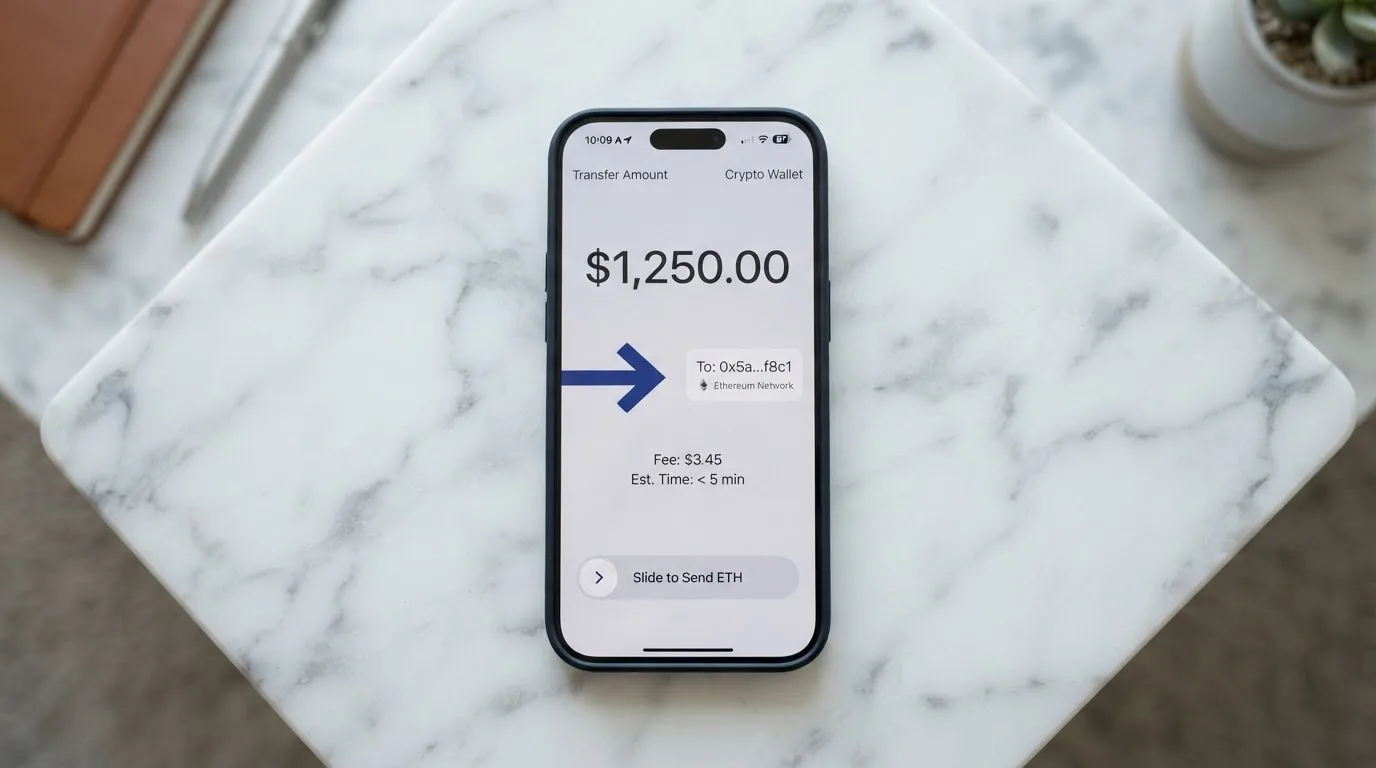
The top-up fee is between 3.0% and 3.5% depending on the card (see the table above). On top of that, you will pay the on-chain network fee, which is charged by the blockchain itself rather than by the card provider, and that fee varies wildly by network. The minimum top-up is the 10.00 USDT initial load, and that is the only number on the page. There is no stated maximum top-up, no stated withdrawal option, and no stated way to cash the balance back out to a bank account.
Two practical points are worth raising. First, a USDT transfer on Ethereum needs ETH to pay the gas, on Tron it often uses bandwidth, and on other networks it works differently. If you only hold USDT and the card’s top-up address is on a network that requires a native token, you will need that token as well. Second, blockchain transfers are irreversible, and if you send USDT on a chain the dashboard does not support, recovery is at the provider’s discretion and there is no guarantee. Those two points are true for any crypto card, but they bite harder on a card that does not tell you which chains it supports.
Withdrawal is not stated. If you need to move money off the card, the public page does not describe how.
Paying with it every day
The day-to-day experience is where TapX has its strongest points. Two of the three cards (Universe and Business) work with Apple Pay and Google Pay, which means you can tokenise the virtual card into a phone wallet and pay at any contactless terminal that takes Visa or Mastercard. The E-commerce card is positioned differently: it is marketed for paying online services such as Google, OpenAI, ChatGPT, Microsoft, Meta, Shopify, AWS, Telegram and TikTok. That is a specific list, and it tells you what kind of user the card is being aimed at.
The Universe card also claims “favorable conditions for commissions and conversion”, which is marketing language rather than a published rate. There is no stated cashback, no stated rewards programme, and no stated staking requirement. Blocked merchant categories are not stated either, so it is worth assuming that the standard card-network blocks apply (gambling, adult content in some regions, and so on) without knowing for sure.
The dashboard, web app and Telegram bot are the user interfaces. Native mobile apps and their store ratings are not stated. 3-D Secure is supported on the Business card, which is the standard identity check on European online payments, but the Universe and E-commerce cards do not list it in the same way. Disputes (chargebacks, refunds, fraud claims) are not stated on the public page. If something goes wrong with a payment, there is no published path for escalating it.
Support is the one channel that is clearly visible: the card’s social links point to a Telegram bot, Instagram, X and Facebook. There is no email address, no help-centre, and no live chat. For a card you might depend on for monthly subscriptions, that is a thin support surface.
What can go wrong
A balanced review has to spend time on risks, and TapX has more than its share of them.
The first risk is the company itself. The only line on the page is “© Copyright TapxCard, 2026”. There is no legal entity name, no registered address, no issuer name, and no licence number. In a regulated card programme, the issuer is a bank or an e-money institution, and the card brand usually names that issuer on its website. TapX does not. If the programme is shut down, there is no published regulator to complain to, no named issuer to file a chargeback with, and no legal counterparty to sue.
The second risk is the domain itself. Unofficial data, as summarised on a third-party crypto-cards page, flags the TapX domain as recently registered with hidden WHOIS information. That does not mean the card is a scam, but it does mean the kind of due diligence that a registered business in a known jurisdiction would have on file is not available. Confirmed scam reports are not in the public record, and a search for TapXCard on Trustpilot or Reddit returns no pages about this brand. Trustpilot has no TapXCard page at all.
The third risk is the cost structure. The 3.0% to 3.5% top-up fee is high by the standards of mainstream crypto cards, and it compounds every time you reload. The high-decline penalty on the E-commerce card is a fee that can show up unexpectedly when a service you pay monthly fails once and triggers a retry loop. The 0.50 USD authorisation fee on Universe and Business applies to every transaction, including failed ones, which can rack up quickly if you are testing the card or a merchant is retrying.
The fourth risk is the wallet and custody model. The card is custodial: the dashboard holds the balance, and you do not control a private key. That means the usual custodial risks apply (the platform can be hacked, the platform can freeze withdrawals, the platform can be ordered to seize funds) and the usual self-custody advantages (you cannot be locked out, no one can freeze your wallet) do not apply.
The fifth risk is sanctions and regulatory drift. If the card’s issuer turns out to be in a jurisdiction that changes its rules, or if a sanctions list adds the country you are in, the card can stop working without notice. The card’s “works globally” line is reassuring, but it is also the one line that gives the issuer the most room to act.
What to take instead
Three alternatives cover the ground TapX covers, each with a different trade-off. None of them is a perfect substitute, and the table below makes the differences easier to scan.
| Card | Score | Card form | Funding | Standout feature | Main gap |
|---|---|---|---|---|---|
| TapX | 5.1 / 10 | Virtual only (3 tiers) | USDT confirmed; other tokens unofficial | Apple Pay and Google Pay on two of three tiers; fast issuance | High top-up fees; no named issuer |
| Cardex | 5.6 / 10 | Virtual and physical; VERVE, Visa, Mastercard, UnionPay | USDT, USDC, BTC | 200+ countries, AI-priced conversion at payment time | App Store listing is Naira-focused; fees not published |
| TakeCard | 5.5 / 10 | Virtual everywhere; physical in Bolivia only | Takenos balance; USDC/USDT via Polygon, BSC, Tron or Ethereum (unofficial) | 1% per purchase, USD payments at 1:1 | Physical card limited to Bolivia; conflicting issuance prices |
| OkiCard | 6.0 / 10 | Virtual, with a physical card mentioned | USDT on BSC, Ethereum, Tron, Solana; USDC “soon” | 3% load fee, 0% transaction fee in USD | Issuance fee disclosure conflicts across pages |
Cardex is the closest in spirit to TapX: a multi-network card that converts at the moment of payment, with USDT, USDC and BTC as starting points. Its score is slightly higher because it publishes more about the conversion mechanism, but its fees are not stated on the site, and the App Store listing frames it as a Naira product, which is a clue about where the team is based.
TakeCard is the cheaper alternative if you can live with its footprint. The virtual card is USD 5, the per-purchase fee is 1%, and USD payments clear 1:1. The catch is that the physical card is Bolivia-only and the articles even disagree about the issuance price (USD 10 in one place, USD 20 in another), which is the same kind of disclosure problem TapX has, just on a smaller scale.
OkiCard is the alternative with the clearest pricing logic: 3% to load, 0% to spend in USD, no hidden exchange spread, and a published list of networks for USDT (BSC, Ethereum, Tron, Solana). The pages contradict each other about the issuance fee, which is a flag, but the funding and fee story is more complete than TapX’s.
The honest summary: if you specifically need to pay online services from a USDT balance and you want a card that ships in two minutes, TapX is one of the few that does that today. If you can spend a day setting up an account and you want a published fee schedule, OkiCard is the safer bet. If you want a card with a physical form factor, none of the three alternatives match it in every market; TakeCard does it in Bolivia and Cardex does it in Nigeria and a few other places.
Who I would recommend it to
I would recommend TapX to a narrow but clear reader: someone who already holds USDT in a self-custody wallet, wants to use it for online subscriptions and ad spend, and does not need a physical card or a published regulator. If that is you, the Universe card is the most usable of the three (Apple Pay and Google Pay, the lowest per-transaction drag), the Business card is the middle option (lower entry price, slightly higher fees), and the E-commerce card is the right pick if your spending is almost entirely with the named services and you want to spend the smallest amount to start.
I would not recommend it to someone who needs a card for in-person shopping abroad, who wants a USD-or-EUR card with transparent FX, who is uncomfortable with a custodial balance, or who needs a published issuer to file a dispute with. For those readers, the alternatives above are better fits, and a mainstream crypto card from a named bank or EMI is a better fit still.
The single most useful thing you can do before signing up is to check the public page for your country of residence and your country of citizenship, and to test the support channel with one question before you pay the issuance fee. The fact that the card does not list either is the gap that should determine whether you take the risk or not.
Frequently asked questions
What is the TapX card?
TapX is a crypto-funded virtual payment card sold in three versions: Visa Universe, Mastercard Business, and Visa E-commerce. All three are virtual, all three are priced in USDT, and all three are aimed at spending a USDT balance rather than holding a multi-currency wallet.
How does the TapX card work?
You buy a card tier, pass the KYC that tier requires, and pay the issuance price in USDT plus a 10 USDT starting top-up. The card is delivered to your account in 2 minutes. To spend, you load USDT (the only token the public page confirms), pay the top-up fee, and the balance is available to spend online or through Apple Pay or Google Pay for the Universe and Business cards.
Is TapX a bank?
TapX does not say it is a bank, and it does not name a bank or e-money institution as its issuer. The only line on the page is the copyright notice. In a regulated card programme, the issuer is usually a licensed bank or EMI, and TapX does not name one.
Who owns TapX?
The card’s website shows “© Copyright TapxCard, 2026” and lists social channels on Telegram, Instagram, X and Facebook. No legal entity, no parent company, and no licensing information are stated on the public pages.
Is the TapX card available in my country?
The card’s page says it “works globally” and does not publish a list of supported or excluded countries. The only way to find out for sure is to sign up and run the verification. The card does not publish a separate policy for Russian or Belarusian citizens or residents.
Does the TapX card require KYC?
The KYC level depends on the card. Visa E-commerce asks for a phone number, Mastercard Business adds an international passport, and Visa Universe adds a face photo. Proof of address and minimum age are not stated.
How do I top up the TapX card?
The starting balance is USDT; the public page does not list other tokens or networks. You send USDT to the address the dashboard gives you, and the balance appears after the on-chain confirmation. The top-up fee is 3.0% on Universe and 3.5% on Business and E-commerce, and you also pay the blockchain’s network fee on top.
How do I add the TapX card to Apple Wallet or Google Pay?
The Universe and Business cards are described as ready for Apple Pay and Google Pay. The E-commerce card is positioned for online services and does not list wallet support. Adding a card means opening the wallet app, choosing to add a card, and entering the virtual card details from the TapX dashboard.
Is the TapX card safe?
The card is custodial, so the balance sits on the card provider’s side rather than in your own wallet. The card does not publish an issuer, a regulator, or a complaints process, and the brand has no public reviews on Trustpilot or Reddit. That is not the same as a confirmed scam, but it is a thinner public record than most regulated cards have.
How do I delete my TapX account?
The card’s public page does not describe an account-deletion process. The Telegram bot and dashboard are the only interfaces mentioned; the practical path is to ask support through the Telegram bot and to withdraw any remaining balance before closing the account, since withdrawal options are not published.
How virtual cards work – cryptocardsexplained.com
Content created by the «cryptocardsexplained.com» team