
CoinJar card review — an Australian prepaid Mastercard that spends your crypto, with some clear limits
 Available in US
If you have crypto sitting in a CoinJar account and you live in Australia, the CoinJar card lets you spend that crypto wherever Mastercard is accepted, through a prepaid card that converts at CoinJar’s exchange rate. That is the basic pitch, and it is straightforward. What is less straightforward is who can actually get the card, what it costs in the situations you will actually use it, and how the experience holds up when something goes wrong. This review walks through what the card’s own documents say, where the public information is thin, and what the trade-offs look like in practice.
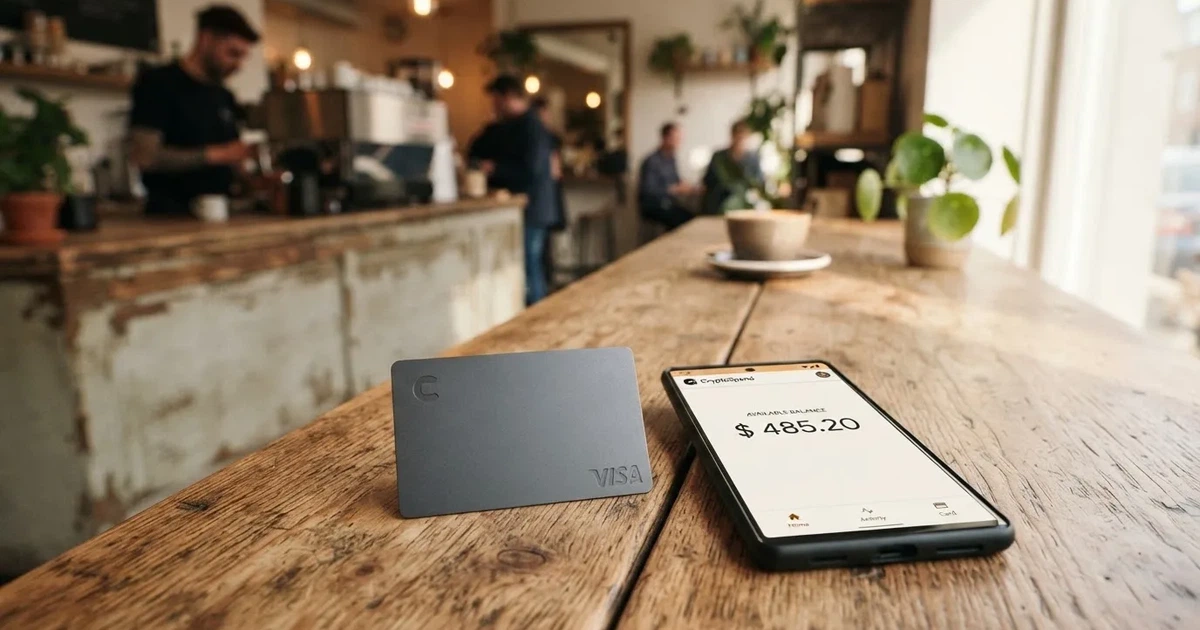
The conditions described here are current as of October 28, 2026.
Verdict
The CoinJar card scores 5.5 out of 10. The everyday experience is genuinely good: a free physical and digital Mastercard, Apple Pay and Google Pay, a 1% purchase fee that comes back as Rewards points, and a 1% ATM fee. The problem is access. CoinJar is pitched as a global exchange, but the card itself is tied to an Australian Product Disclosure Statement that requires you to be an Australian resident with a verified CoinJar account, and the card page does not spell that out. Once you are past the gate, the fees on foreign transactions are heavy, the supported cryptocurrencies are not listed, and the dispute fee is $27.50 per unsuccessful claim. The result is a card that suits a specific reader, and underserves everyone else.
This card makes sense for an Australian resident who already keeps crypto in CoinJar, who mainly pays in Australian dollars, and who is comfortable with a custodial setup. It makes less sense if you travel, if you live outside Australia, or if you want a card that publishes its supported coins and its top-up fees up front.
| Criterion | Mark | Reason |
|---|---|---|
| Who can get it | 3 / 10 | The card page does not state eligibility; the AU PDS restricts it to 18+ Australian residents with a verified CoinJar account. |
| Cost | 5 / 10 | Issuance and replacement are free; 1% on purchases, 2.99%+ on foreign transactions, 1% at ATMs, $27.50 dispute fee. |
| Top-up options | 5 / 10 | You pick a crypto as your Spend account and the card auto-converts at CoinJar’s rate; the list of supported coins is not published. |
| Reliability and complaints | 7 / 10 | Issued by a regulated Australian e-money issuer; the exchange’s Trustpilot is 3.3/5 across 2,549 reviews, with only one card-specific complaint found. |
| Everyday use | 9 / 10 | Free physical and digital Mastercard, Apple Pay, Google Pay, ATM withdrawals, 1% Rewards rebate on purchases. |
| Total | 5.5 / 10 |
Who will give you the card
The card’s own marketing page does not say who is eligible. You only find that out by reading the Australian Product Disclosure Statement, which the card page links to in the small print. The PDS is blunt: you must be 18 or older, an Australian resident, and hold a verified CoinJar account.
That is a narrower rule than the CoinJar exchange, which has historically served customers in other countries. The card does not. The card page never names a country, never says “available in,” and never lists the documents you will be asked for. If you are not an Australian resident, the card is, in practice, not available to you, even if CoinJar the exchange is.
A few related facts are also left unstated on the card page: which documents CoinJar asks for at sign-up, how long verification takes, and what reasons can lead to a rejection. The PDS confirms verification is required but does not detail the levels. If you are weighing this card, the practical test is simple: can you open a CoinJar exchange account as an Australian resident and complete identity verification there? If yes, you can almost certainly get the card. If not, you cannot.
The one thing the documents do not hide is the issuer. The card is issued by EML Payment Solutions Limited, an Australian e-money institution holding Australian Financial Services Licence number 404131, with CoinJar Australia Pty Ltd acting as its authorised representative. That is the entity actually behind the card programme, and it is the one you would deal with in a complaint.
How to get it
The signup flow has three stages, and the order matters.
First, you need a CoinJar account. This is a standard exchange sign-up: email, password, identity verification. The card page does not describe this process, because the card sits on top of an existing account. The PDS simply states that the card requires a verified CoinJar account.
Second, once your account is verified, you order the card in the CoinJar app. There is a digital card you can use immediately for online purchases, and a physical card that is posted to you. Both are free. Replacement cards are also free if yours is lost, stolen, or damaged, which is unusual among crypto cards.
Third, you choose which cryptocurrency will act as your Spend account. The card does not hold a balance of its own; it draws on the AUD value of your Spendable Balance inside the CoinJar Everyday Account. When you pay, CoinJar converts your chosen crypto at its own rate, and the merchant sees an Australian-dollar transaction. Refunds come back into the Everyday Account in AUD, not in the original crypto, which is worth noting if you are keeping careful track of your cost basis.
Delivery countries and delivery times are not stated on the card page, which makes sense given the card is only for Australian residents. Processing time for the digital card is effectively instant; for the physical card, you will need to wait for Australia Post.
One practical note: rejection reasons are not published, and the documents CoinJar asks for are not listed. If you have been through KYC on other Australian financial platforms, the process will feel familiar; if you have not, expect to be asked for a government photo ID and a proof of address.
Fees: what it really costs
The card has no monthly fee, no annual fee, and no issuance fee, which is a clean starting point. The fees it does charge depend on how you use it. Here is the full picture from the PDS fee table.

| Fee or limit | Value |
|---|---|
| Card issue | Free |
| Replacement card | Free |
| Purchases in Australia | 1% (returned as Rewards points) |
| Foreign transaction fee | 2.99%+ on top of the Mastercard rate |
| ATM withdrawal fee | 1% of the withdrawal |
| ATM operator fee | Charged by the ATM, on top of the 1% |
| Disputed-transaction fee | $27.50 per unsuccessful dispute |
| Maximum in-store / online transaction | $5,000 |
| Daily point-of-sale limit | $5,000 (including ATM withdrawals) |
| Daily ATM limit | $1,000 |
| Minimum ATM withdrawal | $20 |
| Maximum single ATM withdrawal | $1,000 |
A few of these numbers deserve a second look, because the small print is where this card gets expensive.
A $50 grocery run in Sydney. You tap your card or insert the chip. The merchant sees an AUD transaction. CoinJar charges 1%, which means $0.50, and gives you that $0.50 back as a Rewards point you can offset against future trading fees. The net cost is zero, as long as you actually use the points. This is the card at its best.
A $200 hotel booking on a US website. Mastercard converts USD to AUD at its wholesale rate, and CoinJar adds 2.99%+ on top. That is at least $5.98 on a $200 booking, before you count the 1% purchase fee, which comes back as Rewards. The “plus” in “2.99%+” is the part the documents do not define; the published number is a floor, not a ceiling.
A $100 cash withdrawal from an ATM. CoinJar takes 1%, or $1. The ATM operator will also charge its own fee, often $2 to $3, which CoinJar does not control. On a small withdrawal, the operator fee is the bigger half of what you pay.
The $27.50 dispute fee is the figure that hurts the most. If you dispute a transaction and lose, you pay $27.50 on top of whatever the disputed charge was. That makes it expensive to test a dispute you are not sure about, which is the moment a chargeback is most useful.
The PDS does not publish a free ATM allowance; there is no “first $X free” tier. Every dollar at an ATM costs you 1%.
Top up: how to fund the card
The card does not have a top-up button in the usual sense. You do not transfer money to a card number. Instead, you fund the underlying CoinJar account, and the card draws on it.
The flow is this. Inside the CoinJar app, you choose a cryptocurrency to act as your “Spend” account. The card then spends the AUD value of that crypto’s balance in your CoinJar Everyday Account, converted at CoinJar’s exchange rate. When you make a purchase, CoinJar sells the chosen crypto, applies its normal trading fee on that conversion, and the merchant receives Australian dollars.
This design has a few consequences worth understanding.
First, the coins supported as Spend accounts are not published. The card page does not list them. A 2021 press release at launch said 30 digital currencies, with a flat 1% conversion, but the current list, the current conversion rate, and any coin-specific exceptions are not stated on the card documents. If a particular coin matters to you, the only way to find out is to log in to a CoinJar account and check.
Second, the exchange-rate spread and the trading fee are both layered costs. The card page does not show them as separate line items; they are baked into the rate at which your crypto is sold. You will see them as the difference between the spot price you might check on CoinMarketCap and the AUD amount that lands at the merchant.
Third, there is no card top-up fee in the PDS, no minimum top-up, and no published list of supported networks for deposits. The blockchain network fee is paid to the network itself, not to CoinJar, and is not a CoinJar fee.
To withdraw the card’s remaining value, you cancel the card. The balance is paid into your CoinJar Everyday Account in AUD, once no pending authorisations remain. You can cancel the card yourself at any time. The issuer can also cancel with 14 days’ notice, or immediately if it suspects misuse or false information.
Paying with it every day
Once the card is in your wallet, day-to-day spending is smooth. You can pay in stores with the physical card or with a phone, online with the digital card, and at any ATM that accepts Mastercard.
Apple Pay and Google Pay both work, and the card tokenises inside the wallet in the usual way: the merchant never sees the real card number, and each payment uses a one-time code. The contactless limit under $100 is mentioned in the documents, which is standard in Australia.
The Rewards programme is the quiet upside. You earn 1 CoinJar Rewards point per Australian dollar spent, and those points offset the trading fees on future buys and sells on CoinJar, or can be redeemed in the Rewards Store. On a $1,000 month of spending, that is $10 back in fee credits, which more or less cancels out the 1% purchase fee. On a $5,000 month at the daily point-of-sale limit, it is $50, but you will have hit the daily cap by then and need to wait until the next day.
The CoinJar app is where you manage the card. You can hold and unblock the card, change the PIN, and view the transaction history. Official app store ratings are not consistently available; third-party trackers report an App Store rating around 4.1 out of 5 from roughly 123 reviews and a Google Play rating around 3.91 from about 2,600 ratings, but these are unofficial figures and not confirmed by the card.
If something goes wrong with a transaction, the dispute process follows the Mastercard scheme. You notify the issuer, EML, as soon as possible. The general time limit is 90 days from the transaction, and you have 10 days to provide extra information or the chargeback may be reversed. EML aims to resolve complaints within 5 days, and otherwise within 30 days, after which you can escalate to the Australian Financial Complaints Authority. If your dispute is unsuccessful, the $27.50 fee applies.
Blocked merchant categories are not listed in the card documents, so it is not possible to say in advance whether, for example, gambling transactions will go through.
What can go wrong
The card is custodial: your crypto sits in a CoinJar account, and the card issuer is a separate regulated entity. That structure is normal for this category, but it comes with the usual counterparty considerations.
A few specific things to weigh.
Identity re-checks and account freezes. User reports on Trustpilot over the past year describe accounts being frozen pending additional verification, sometimes for weeks. This is not a card-specific complaint, but it is the most common theme on the exchange’s reviews, and it would affect the card too, because the card depends on the underlying account.
Travel Rule holds. Several recent reviews describe crypto transfers being held “under review” for several days under Travel Rule compliance. This is a feature of the regulatory environment, not a CoinJar-specific choice, but if you need to move funds quickly into the Spend account, a multi-day hold is something to plan around.
Slow support. The third most common Trustpilot theme is slow responses from support. The card has a separate issuer support channel at EML, which may respond faster than the exchange.
One card-specific complaint was found: a user in October 2026 reporting that their virtual Mastercard had “constantly having technical issues”. That is a single data point, not a pattern, but it is the only card-specific complaint in the public reviews at the time of writing.
CoinJar replies to 100% of negative Trustpilot reviews, which is unusually thorough, and the exchange’s overall TrustScore sits at 3.3 out of 5 across 2,549 reviews, with 17% one-star ratings. The card has not generated its own wave of complaints on that scale, which is a quiet positive.
On security, the card is protected by the usual app-based safeguards: hold and unblock, PIN change, transaction history, tokenised mobile wallets. Insurance and safeguarding of customer funds are not stated in the card documents, which is a gap compared to the kind of disclosure some competitors publish. The card is issued by a regulated e-money institution, but that does not by itself mean customer balances are insured.
What to take instead
If the CoinJar card does not fit, three other options in the same category are worth a look. None of them is a perfect swap, because each has a different mix of strengths.
MSX scores 6.4 out of 10. The card’s own details — eligibility, fees, and funding options — are not stated on an official page that is easy to read, which is itself a flag if you want clarity. MSX is the highest-scoring alternative, but the lack of published terms makes it hard to recommend without a deeper look.
Bybit Card scores 6.0 out of 10. It is the most fully documented of the three. It supports Argentina, AIFC (Kazakhstan), Georgia, Kazakhstan, Australia, Mexico, Brazil, Peru, and the broader Asia Pacific region, and explicitly bars European Economic Area customers. It offers both virtual and physical cards on Mastercard or Visa depending on region, with a credit-style structure in some markets. The 0.9% crypto conversion fee over the One-Click Sell rate is competitive, and the rewards programme is tiered up to 10% cashback. The downsides are the regional availability list, the rule that only crypto-funded transactions earn rewards since October 2026, and the layered fees on foreign transactions in some regions.
MEXC scores 5.6 out of 10. It offers a virtual card only (no physical yet), with an issuance fee around 20 USD and unclear pricing details. Cashback is tiered by M-Score, up to 10% for Elite users, with a cap of 800 USDT per month. The supported countries include the Philippines, Taiwan, and Thailand, among others, with a full list behind a Details link. The card is more of a niche product than a daily driver, and the limited public information on fees makes it a weaker substitute for the CoinJar card.
If you are an Australian resident with a CoinJar account, the alternatives are useful context but not direct replacements: Bybit’s Australia product is more expensive at issuance, MSX does not publish its terms, and MEXC is not aimed at AUD users. The honest answer is that the CoinJar card is in a thin competitive position in its own home market, and the alternatives are stronger for readers outside Australia.
Who I would recommend it to
Pull the threads together. The CoinJar card is a free prepaid Mastercard that spends your crypto at the point of sale, with a 1% purchase fee that you get back as Rewards points. It is the right card for a specific kind of reader: an Australian resident, 18 or older, who already keeps crypto on CoinJar, who pays mainly in Australian dollars, and who is comfortable with the custodial model.
It is the wrong card for a reader who travels and pays in foreign currency, because the 2.99%+ foreign transaction fee is steep. It is the wrong card for a reader who wants published support for a long list of coins, because the supported cryptocurrencies are not listed on the card page. It is the wrong card for a reader who lives outside Australia, because the PDS restricts it to Australian residents. Finally, it is not a good choice for frequent chargeback tests, given the $27.50 fee for an unsuccessful dispute.
For readers who fit that profile, the card works as advertised and the costs are low. For readers who do not, the gaps in the published information and the regional restriction are reasons to look elsewhere, starting with the alternatives above.
Frequently asked questions
What is the CoinJar card?
The CoinJar card is a prepaid Mastercard that lets you spend cryptocurrency held in your CoinJar account at any merchant that accepts Mastercard. It comes as both a physical card and a digital card, both free, and supports Apple Pay and Google Pay.
How does the CoinJar card work?
You choose a cryptocurrency in your CoinJar account to act as your Spend account. When you make a purchase, CoinJar converts that crypto to Australian dollars at its own rate, and the merchant receives AUD. The 1% purchase fee is returned to you as Rewards points.
Is CoinJar a bank?
No. CoinJar is a cryptocurrency exchange. The card is issued by EML Payment Solutions Limited, an Australian e-money institution holding AFSL 404131, with CoinJar Australia Pty Ltd acting as its authorised representative.
Who owns CoinJar?
The card is issued by EML Payment Solutions Limited, an Australian-licensed e-money institution. CoinJar Australia Pty Ltd is the authorised representative of EML for the card programme and operates the exchange.
Is the CoinJar card available outside Australia?
Based on the Australian Product Disclosure Statement, the card is restricted to Australian residents. The card page does not state this clearly, but the PDS is the binding document, and it requires Australian residency and a verified CoinJar account.
How do I get a CoinJar card?
Open and verify a CoinJar account, then order the card from inside the app. The digital card is available immediately for online use; the physical card is posted to you for free. Both are free, and replacement cards are also free.
Does the CoinJar card require KYC?
Yes. The PDS requires a verified CoinJar account, which means the same identity verification as the exchange: government photo ID and proof of address. The card page itself does not list the documents required.
How do I top up the CoinJar card?
You do not top up the card directly. You fund the underlying CoinJar account with crypto, choose which crypto to designate as your Spend account, and the card draws on the AUD value of that balance. The list of supported coins and networks is not published on the card page.
Can I use the CoinJar card with Apple Pay or Google Pay?
Yes. The card tokenises inside both Apple Pay and Google Pay, so you can pay in stores with your phone or watch. The card number is never shared with the merchant.
Is the CoinJar card worth it?
It depends on where you live and how you spend. For an Australian resident paying mainly in AUD, the 1% purchase fee is rebated as Rewards points, and the card is essentially free to use. For anyone outside Australia, anyone spending heavily in foreign currency, or anyone needing a published list of supported coins, the card is a weaker fit, and the alternatives are worth considering.
How exchange cards work – cryptocardsexplained.com
Content created by the «cryptocardsexplained.com» team