
A crypto card from a major exchange, but the missing issuer name and patchy country list mean you have to read the small print
 Available in US
Gate card sits in an odd spot. It is a payment card from a crypto exchange most people have heard of, and at first glance it offers the things you would expect: a virtual card in minutes, a physical card if you want one, a 0.90% conversion fee and up to 8% cashback at the higher tiers. Look closer and the picture is less tidy. The card page never names the bank that actually issues the plastic, the country list is hidden behind a phrase that says “non-restricted countries or regions”, and outside help the public information is thinner than you would want before you tie your spending to it. This review walks through what is on the public record, what is missing, and what that means for you in practice. I have not used the card myself; everything below comes from Gate’s own card pages and Help Center, with a few unofficial sources clearly marked as such.

The conditions described here are current as of October 28, 2026.
Verdict
Gate card lands at 6.8 out of 10. That is a respectable middle-of-the-pack score for a crypto card. The low conversion fee (0.90% on the Standard card) and the free issuance, free monthly fee and free inactivity fee are genuine positives. So is the cashback ceiling of up to 8% if you climb the tiers. The score loses ground because the country availability is opaque, the issuer is not named on the card page, and the public complaint picture is patchy: a 1.5/5 Trustpilot for the exchange overall, and a handful of card-specific reports on cashback pauses and delayed replacements.
The card suits you if you already keep funds on Gate and want to spend USDT, BTC, ETH or GT directly without first cashing out to a bank. It suits you less if you are outside the unofficial 24-country European footprint, if you are in the US, the UK, Germany, France or Canada, or if you need the comfort of a named, regulated bank on the front of your cardholder agreement.
| Criterion | Mark | Why |
|---|---|---|
| Who can get it | 6 / 10 | The card page only says “non-restricted countries or regions”; unofficial sources list 24 European countries for the Classic tier and treat the US, UK, Germany, France and Canada as missing. |
| Cost | 8 / 10 | Standard card: virtual and physical issuance are free, no monthly or inactivity fee; conversion is 0.90%, FX is 1.00% outside USD, ATM 2%; replacement is 25 USD. |
| Top-up options | 7 / 10 | Instant Spend Mode supports USDT, BTC, ETH and GT; prepaid mode widens the choice but the networks and full list are not on the page. |
| Reliability and complaints | 5 / 10 | No issuer name on the card page (unofficial sources say Stanhope Financial UAB for EEA and Lead Bank for the US); Trustpilot for the exchange is 1.5/5, with card-specific complaints about cashback pauses and slow replacements. |
| Everyday use | 8 / 10 | Virtual card available almost immediately, physical card follows, ATM 2%, and the Help Center has an article on adding the card to Google Pay and Apple Pay; unofficial sources say some tiers are Google Pay only. |
| Total | 6.8 / 10 | Strong on fees and cashback ceiling, weaker on transparency about the issuer and the country list. |
If you are a Gate exchange user who already holds USDT, BTC, ETH or GT, the card is a reasonable way to turn those balances into everyday spending. If you are not, the case for opening a Gate account just to get this card is harder to make, especially when alternatives below have clearer footprints.
Will they give you the card
The short answer is: probably, if you live somewhere Gate is willing to serve and you pass Level 2 KYC. The longer answer requires reading the small print.
The card page uses the phrase “Gate Card is only available to users in non-restricted countries or regions”. It does not list those countries. Citizenship versus residence is not addressed either. In practice, Gate treats this as a residence question — the application asks for your country, and your address has to be supported for the physical card to ship.
Unofficial sources do a bit of the work Gate itself does not. According to one crypto-card directory, the Classic card is listed in 24 European countries: Belgium, Bulgaria, Croatia, Cyprus, Czech Republic, Denmark, Estonia, Finland, Greece, Hungary, Iceland, Ireland, Italy, Latvia, Liechtenstein, Lithuania, Luxembourg, Norway, Poland, Portugal, Romania, Slovakia, Slovenia and Sweden. The same source lists the United States, the United Kingdom, Germany, France and Canada as not currently supported for that variant. A second directory lists Austria and Spain and omits Italy and Lithuania, so even the unofficial list is not in agreement on the edges. The point is not to memorise the list; the point is that the official page will not give you one.
To qualify at all, you need a Gate account, a linked email and a linked phone number, and you must complete Level 2 identity verification. Some card types also ask for a proof of address from the past three months. The minimum age is not stated on the card page; for regulated cards in this category the practical rule is 18+, but if you are under that you should expect to be turned away.
How to get it
The process is what you would expect from a crypto exchange that has built a card on top of its app.
You start with a Gate account. If you do not already have one, the sign-up is an email and a password, followed by a phone number and the basic identity checks. The card itself cannot be applied for until KYC is at Level 2: the same identity documents, the same facial check, the same address details as for any other regulated product on the platform. The card application has to use the same ID as your Gate KYC; you cannot apply for a card on behalf of someone else, and you cannot borrow a friend’s clean KYC.
Once KYC is done, you choose a virtual or physical card in the Gate app (or Gate Pay, where supported). Virtual card applications are typically reviewed within 3 to 5 minutes. Physical cards take longer, with the Help Center putting delivery at “around 7 to 45 days” depending on country; an unofficial source narrows that to 15–45 days where supported. If 45 days pass with nothing in the post, the advice is to confirm your address with support and use the “Resend” option.
What you actually get: a virtual card and a physical card are both available, and the page says Gate “primarily supports the Visa or Mastercard network”. The card currency is not stated on the public page; in prepaid mode the funds are converted to the corresponding fiat currency at the moment of payment. A metal variant is not mentioned. Issuance is free for both virtual and physical on the Standard card, and replacement is 25 USD.
Fees: what it really costs
The headline numbers on the Standard card are good. The full fee picture needs a bit more unpacking.

| Fee or limit | Amount (Standard card) |
|---|---|
| Virtual card issuance | Free |
| Physical card issuance | Free |
| Monthly fee | Free |
| Inactivity fee | Free |
| Crypto conversion | 0.90% (2 USD or more); 0.05 USD below 2 USD |
| Foreign exchange (non-USD) | 1.00% |
| ATM withdrawal | 2% of the amount |
| ATM daily limit | 5,000 USD (up to 10 withdrawals) |
| ATM monthly limit | 15,000 USD (up to 100 withdrawals) |
| ATM yearly limit | 50,000 USD (up to 1,000 withdrawals) |
| ATM per-transaction cap | 5,000 USD |
| Spending limit (all tiers T0–T4) | 50,000 USD daily; 990,000 USD monthly |
| Replacement | 25 USD |
| Chargeback | 30 USD (the disputes page says 25 USD; the fee table wins) |
A few caveats. The spending limits above are identical across tiers T0 to T4 — there is no higher cap for being a bigger spender, except by writing to [email protected]. Per-tier perks and a metal card option are not stated on the pages I read. The card page also notes that “the issuing institution’s review” may add fees of its own, which is a way of saying that the table above is not necessarily the last word.
A receipt on a café table is a good way to think about what hits you in practice. If you pay 4 EUR for a coffee in a country whose currency is not USD, the path is roughly: 0.90% to convert the crypto you spent into the card’s working currency, then 1.00% FX because the merchant is in euros and the card settles in something else. On a 4 EUR purchase that is fractions of a cent; on a 1,000 EUR hotel bill it is around 19 EUR in fees. The ATM is simpler but harsher: 2% on top of whatever the ATM operator charges. For example, if a foreign ATM adds an unofficial 3 EUR surcharge of its own, you lose that 3 EUR plus 2% plus FX. (Note: 3 EUR is an unofficial estimate, not confirmed by Gate.)
A prepaid variant reported by an unofficial source — and not confirmed by Gate’s own documentation — adds a 0.9% top-up charge, a 10 USDT minimum on first load, a 2% refund charge, a 1 USD reversal fee, a 35 USD chargeback fee and a 0.10 USD Apple Pay authorisation charge, plus a 2 USDT virtual-card fee below VIP 5 unless waived. These figures are not on the official card page, and I am quoting them only so you know there are variants with a different fee shape, not so you can plan around figures that may already have changed.
Top up: how to fund the card
A phone showing a stablecoin transfer screen captures the starting point well: topping up the Gate card starts with a transfer to the right network. The rest depends on which mode the card is in.
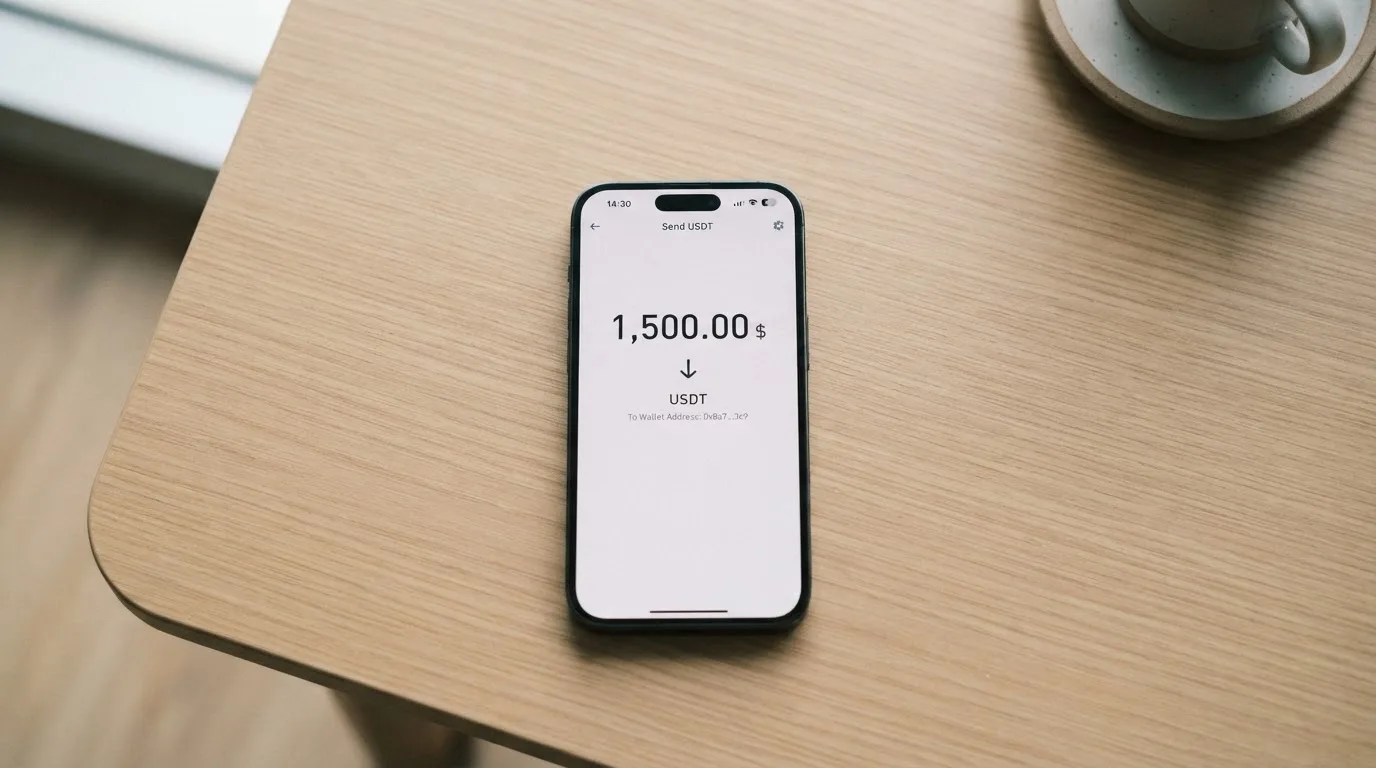
There are two modes on the public page. Instant Spend Mode lets you pay directly from USDT, BTC, ETH or GT without a separate top-up step; the conversion happens at the moment of the transaction. Prepaid Mode is the more conventional “load it up” model: you convert funds from Gate Pay or your Spot wallet into fiat, sit on a balance, and the card spends that balance. Prepaid mode advertises a wider coin selection, but the exact list, the supported networks and the per-coin minimums are not on the card page I read.
The Standard card’s published conversion fee is 0.90% for transactions of 2 USD or more, and 0.05 USD for transactions below 2 USD. That second rate exists because at small amounts a percentage would round to zero. A separate top-up fee is not listed; a separate minimum top-up is not listed.
Card balance withdrawal is a different operation from spending. The card page links to a “Card Balance Withdrawal” announcement, which I have not read, and your card balance is linked to a Gate Pay payment account. Closure of the card and what happens to stranded balances are not described on the public page. If you plan to stop using the card, that is the detail you want answered by support before you begin, not after.
Paying with it every day
The everyday mechanics are simple, which is the point of a payment card. Virtual card in your phone for online purchases; physical card for cash, terminals and the occasional restaurant that still asks to see the plastic. The card page does not list blocked merchant categories, so policy is not visible at that level.
Mobile wallets are the most useful everyday feature. The Help Center has an article titled “Add Your Gate Card to Google Pay & Apple Pay” (the article body I did not read in detail). Unofficial sources split the picture: the Classic tier FAQ reportedly supports Google Pay only, while Standard and Signature help pages are said to support both Apple Pay and Google Pay. If you specifically need one of the two, check the help article for your tier before you apply, because the answer may differ by product.
Cashback is the other everyday carrot. The card page promises “up to 8%” cashback depending on tier, with rewards issued as points redeemable for USDT or GT. The same page also carries a banner referring to BTC, ETH, USDT and USDC; the inconsistency is on Gate, not on me. Caps and conditions are not on the public page. Unofficial reporting for the Classic tiers gives a useful benchmark: monthly spend 0 USDT unlocks tier T0 with 1% cashback capped at 5 USDT, climbing to 10,000 USDT and 5% / 250 USDT, with the top tier T5 at 15,000 USDT and 8% / 400 USDT. Points convert at 100 points to 1 USDT and reportedly do not expire. Treat those numbers as a third-party reading, not as a contractual promise.
Disputes follow the standard shape. Contact the merchant first. If that fails, open a chargeback through Gate with proof that you tried. The fee for opening a chargeback is 30 USD on the fee table, while the disputes page mentions a 25 USD processing fee regardless of outcome; the fee table is the more specific document, and that is the number I would plan around. Time to resolution can run up to three months. Pre-authorisation holds (the temporary block a hotel or rental car places on your card) are released after the service ends, which can feel like a long wait if you are watching your balance.
What can go wrong
It is worth separating the things Gate has put on the record from the things people have reported.
On the official side, the card page is unusually quiet. There are no incident notices I could find, no named issuer, and no licences listed. Gate describes the product as “a digital assets credit card offered by Gate”. The exchange says it has joined the Mastercard Crypto Partner Program, which is a marketing programme for crypto partners, not a regulatory licence. Unofficial reporting names an EEA issuer (Stanhope Financial UAB, a Bank of Lithuania e-money institution, licence reference LB002039) and a US issuer (Lead Bank, with Bridge as programme manager). If those names are right, the underlying bank licences exist; if you want to be sure, that is the kind of question to put to Gate support before you load the card with non-trivial sums.
The complaint picture is uneven. Trustpilot for gate.com runs at about 3.5/5 from around 121 reviews, mostly about non-card services; the gate.io exchange page is at about 1.5/5 from around 1,000 reviews, with complaints about accounts restricted without explanation and deposits or trading suspended. A third-party report aggregates Trustpilot for the broader brand at 1.5/5 from around 1,400 reviews, 77% one-star. None of these is a card-specific Trustpilot page, so reading the exchange reviews as if they applied directly to the card would be unfair — but they do tell you what the company is like to deal with when something goes wrong.
Card-specific reports are smaller in number but more pointed. The same third-party source documents a 2024 cashback pause, cards retained by ATMs with delayed replacement, card funds reported as inaccessible for six days, merchant refund delays, chargeback responses taking five to six weeks, and cards being frozen after small purchases. Those are anecdotes from a small sample, not statistics, and the official disputes page already covers chargeback as a slow process; but the pattern matches what you would expect when a card programme is operated from a single app with limited visibility into the underlying bank.
There are also a few security footnotes. You can freeze a lost or stolen card temporarily; PIN can be changed in the Gate Card app; multiple wrong PIN entries tend to freeze the card; a negative card balance “will risk having your card getting permanently blocked”. 2FA, custody arrangements, insurance against unauthorised transactions and similar details are not stated on the page. A proof-of-reserves report from 22 June 2026 is cited by unofficial sources at 8.182 billion USD with 115% coverage; that is the exchange’s overall reserves, not a guarantee about your card balance, and the snapshot is a moment in time, not a permanent floor.
What to take instead
If Gate is not for you, here is how the obvious alternatives stack up. None of them is a clone; each leans on its exchange brand and on different trade-offs.
| MSX | Bybit Card | MEXC | |
|---|---|---|---|
| Score | 6.4 / 10 | 6.0 / 10 | 5.6 / 10 |
| Who can get it | Not stated on the official page I could read. | Argentina, AIFC (Kazakhstan), Georgia, Kazakhstan, Australia, Mexico, Brazil, Peru, and an Asia Pacific roll-out. EEA customers are explicitly excluded. | The Philippines, Taiwan, Thailand, plus a “Details” link to a longer list. |
| Card form | Not stated officially. | Virtual and physical; physical not available in Peru; Visa in Brazil/Peru/Asia Pacific, Mastercard in Argentina/AIFC/Georgia/Kazakhstan/Australia/Mexico. | Virtual only; physical cards not yet available. |
| Cost | Not stated. | Virtual card free “until further notice”; physical card 29.99 USD in Australia, 5 USD in Argentina, 29.99 USDT in Georgia, 29.99 USDT in Kazakhstan (AIFC), 5 USDT in Asia Pacific, free in Brazil and Mexico; no annual fee. | Issuance 20 USD; service fee 0%. |
| Conversion / FX | Not stated. | 0.9% crypto conversion (0.5% in Argentina); FX 2% (Australia, Asia Pacific, Georgia, Mexico), 7% in Argentina, 1.5% in Brazil, 1% in Peru. | Not stated on the public page. |
| Funding | Not stated. | No card balance of its own; draws on Funding Account and Flexible Easy Earn; crypto sold at One-Click Sell rate plus the conversion fee; supports BTC, ETH, XRP, USDT, USDC, GRAM. | USDT to a Fiat account, then to the card; networks not stated. |
| Cashback | Not stated. | From 5 October 2026, only crypto-funded transactions earn points or cashback; up to 10% at the Infinite tier; welcome offer 10% up to 110 USDT in the first 30 days. | 4% Standard cap 100 USDT/month, 6% Premier cap 300, 10% Elite cap 800. |
Three quick reads. Bybit Card is the most explicit about where it operates and what it charges, and that is worth a lot by itself; it is also the most explicit about not serving EEA customers, which is useful to know up front. MEXC is virtual-only and cheaper to start, but the cost and FX details are not on the public page, so you have to ask. MSX sits between the two on the score sheet and has even less public detail, which is itself a finding.
Who I would recommend it to
I would point you at the Gate card if you already use Gate as your main crypto exchange, you keep balance in USDT, BTC, ETH or GT, and you want a card that lets that balance do double duty as a day-to-day spend account. The 0.90% conversion, the 1.00% non-USD FX fee and the 2% ATM fee are competitive; the free issuance, free monthly fee and free inactivity fee remove the standard excuses your bank would have to charge you; the 8% top cashback tier is real if you are spending enough to climb there. The all-tiers $50,000 daily and $990,000 monthly spending cap is generous for almost any personal use.
I would steer you away from it if any of the following is true. You live in the US, the UK, Germany, France or Canada and the unofficial lists treat those as not supported today. You cannot get a clean answer from support about which bank actually issues your card. You need a metal or a clearly tiered product and the per-tier perks are not on the page. You are uncomfortable with the exchange’s Trustpilot score and the small but consistent card complaints about cashback pauses and replacement delays. You want Apple Pay and the help article for your tier turns out to be Google Pay only.
If your situation is somewhere in the middle — you are in a country the card might support, you have some USDT, but you are not yet a heavy Gate user — the practical move is to apply for the virtual card (free, three to five minutes), fund it with a small amount, and use it for a month before you commit to the physical card and a larger balance. That is the cheapest way to find out whether the issuer, the country coverage and the cashback tiers work the way you need them to, before you have anything at stake.
Frequently asked questions
What is the Gate card?
It is a payment card from the Gate crypto exchange, available as a virtual card and a physical card. The card page says it “primarily supports the Visa or Mastercard network”. In prepaid mode the funds are converted to the corresponding fiat currency at the moment of payment; in Instant Spend Mode you can pay directly from USDT, BTC, ETH or GT.
How does the Gate card work?
You complete Level 2 KYC on Gate, apply for a card in the app, and either top up a fiat balance from your Spot wallet or Gate Pay, or switch on Instant Spend Mode so each transaction converts your crypto at the point of sale. The Standard card’s published conversion fee is 0.90% for transactions of 2 USD or more, and 0.05 USD for smaller ones.
Is Gate a bank?
No. Gate is a crypto exchange; the card is a card product the exchange offers. The bank that actually issues the card is not named on the public card page. Unofficial sources point to Stanhope Financial UAB in the EEA and to Lead Bank in the US, but you should confirm the issuer directly with support if it matters to you.
Who owns Gate?
Gate Group operates the gate.com and gate.io brands; the specific ownership structure is not stated on the card page. If you need the corporate chain, that is a question for Gate’s corporate pages or for support, not for the card documentation.
Is the Gate card available in my country?
The card page only says “non-restricted countries or regions” and does not publish a list. Unofficial sources put the Classic card in 24 European countries and treat the US, UK, Germany, France and Canada as not currently supported. The safest test is to start the application: if your country is unsupported the form will tell you.
How do I get the Gate card?
Open a Gate account, complete Level 2 KYC, choose a virtual or physical card in the app, and submit the application. The virtual card is usually reviewed in 3 to 5 minutes; the physical card takes 7 to 45 days to arrive according to the Help Center, or 15 to 45 days per an unofficial source. If the physical card does not arrive, confirm your address with support and use “Resend”.
Does the Gate card require KYC?
Yes. You need a Gate account, a linked email and phone, and you must complete Level 2 identity verification with the required documents before you can apply for a card. The card application has to use the same ID as your Gate KYC.
How do I top up the Gate card?
In Instant Spend Mode, no top-up is needed: the card spends USDT, BTC, ETH or GT directly. In prepaid mode you convert funds from Gate Pay or your Spot wallet into fiat on the card, and the card spends that balance. The card page does not list minimum top-ups or supported networks for prepaid mode.
How do I add the Gate card to Apple Wallet or Google Pay?
The Help Center has an article titled “Add Your Gate Card to Google Pay & Apple Pay”, but tier coverage differs in unofficial reporting: the Classic tier is reported as Google Pay only, while Standard and Signature help pages are said to support both. Check the help article for your specific tier before relying on either wallet.
Is the Gate card safe?
The card offers the standard safeguards: app-based card management, temporary freeze for loss or theft, PIN change in-app and 3-D Secure on online payments. Custody, 2FA, insurance and segregated client funds are not described on the card page. The exchange has a proof-of-reserves snapshot from June 2026 cited at 8.182 billion USD with 115% coverage, but that is the exchange’s overall reserves and not a guarantee of any specific cardholder balance.
How exchange cards work – cryptocardsexplained.com
Content created by the «cryptocardsexplained.com» team