
An unprecedentedly quiet fee schedule meets an equally quiet card
 Available in US
The Kolan card is a virtual USD card that draws on crypto deposited into a linked wallet, converted to dollars and loaded as spendable balance. It is aimed squarely at people who want to pay for online services with a US-dollar virtual card and who have run into the usual walls — a home-country card declined abroad, a subscription that will not take a local payment method, a merchant that wants a card with a US billing address. In exchange for solving that one problem, Kolan discloses very little about how it works, what it charges, or who stands behind it. That silence is the central finding of this review, and it shapes every section that follows.

The conditions described in this review are current as of October 28, 2026.
Verdict: a targeted tool with an open-book file on costs
Kolan scores 5.7 out of 10. That is not a card I would tell a reader to rush into; it is a card I would tell them to approach only with a specific problem in mind and a willingness to accept that the price of the payment is not published. For someone who pays for online services with a virtual USD card and who cannot get that from a normal bank, the utility is real even though the disclosure is thin. For everyone else — a person who wants a physical card, a debit card tied to a bank account, a card with a published cash withdrawal fee, or a card with a documented customer protection scheme — Kolan does not meet the bar.
The score breaks down by criterion, with the reasoning behind each mark:
| Criterion | Mark | Why |
|---|---|---|
| Who can get it | 8 / 10 | Starting data says 100+ countries; unofficial profiles describe non-US individuals in over 50 countries |
| Cost | 5 / 10 | Officially undisclosed; an unofficial directory description says “no hidden FX fees” |
| Top-up options | 5 / 10 | Crypto goes to a Kolan account, sits as USDC in a linked wallet, converts to USD; networks not named |
| Reliability and complaints | 6 / 10 | Hurupay Inc. (DBA Kolan); unofficial sources say US-based and MSB-registered, in Circle’s grant cohort; issuer not named; employees at Cursor write that such cards “often have issues” |
| Everyday use | 3 / 10 | Virtual USD card only; unofficial source notes a card freeze exists, Apple Pay and Google Pay not disclosed |
Total: 5.7 / 10
Two of those marks deserve a word before anything else. The 8 out of 10 for eligibility is the highest mark in the table and it comes almost entirely from breadth of countries rather than from ease: a wide geographic reach is only useful if the reader is actually in one of those countries. The 3 out of 10 for everyday use is the lowest, and it is the one most likely to end your interest, because it reflects a card that exists only as a virtual USD card. If you were hoping for something in your wallet that taps at a café, this is not it.
The honest summary is that Kolan has a specific purpose and does not advertise beyond it, and that what it does not advertise includes its fees, its issuing institution, its identity checks, and its app. The last part of that sentence is what makes it hard to recommend without hesitation: a card you load before you spend, held by a company you cannot examine, with a card network you cannot confirm.
Will they give you the card?
The short answer is: probably, if you are outside the United States — but the card’s own pages do not say that plainly, and you will not find a country list.
The official position is this: the card’s public pages do not state its eligibility rules. There is no published country list, no stated exclusions, and no named issuer. What the starting data does say is that starting data points to 100+ countries.
The unofficial picture is more specific and more useful, but it comes from third-party profiles rather than from Kolan itself. Hurupay, the company behind Kolan, is described in an account-availability context as offering accounts to users in “more than 100 countries” — that is an account availability figure, not a statement about card eligibility, and the distinction matters. Separately, Kolan profiles in listings such as Alchemy and au-startups (2026) describe the service as aimed at non-US individuals in over 50 countries.
The gap between those two numbers, “more than 100” for accounts and “over 50” for non-US individuals, is the kind of gap that should make you pause rather than reassure you. An account that exists in a country is not the same as a card that can be issued to a person in that country. Non-US individuals is also a narrower population than “anyone in 100 countries” — it is a description of who the product is aimed at, which is a signal about where the authorisations and the risk appetite sit.
If your country appears in a third-party list, treat that as a lead to check with Kolan directly rather than as a green light. And if you are a US citizen or resident, the unofficial profiles suggest the card is not aimed at you at all, though the official pages do not say so either way.
How to get it
Getting a Kolan card means opening an account with Hurupay and then obtaining a virtual card from it. How much of that process you can verify before starting is where this section becomes thin.
The card’s public pages do not state what identity checks are required — whether there is KYC at all, what documents are needed, or whether checks happen at signup or at first funding. They also do not state what the card physically is: an unofficial Alchemy listing (2026) describes a USD virtual card for online spending, while the card network is unknown, and Cursor staff writing about the topic suggest it “could work if it’s a Visa or Mastercard.” That is speculation about a card network, not a confirmation.
Delivery is virtual only, and the card’s public pages do not state how you receive it — no plastic is coming, and whether a physical option exists is not disclosed.
So the realistic picture: you create an account, you get a virtual card. Whether you will be asked for documents before or after that is not something the public pages answer. Anyone who tells you the process is instant and frictionless is filling in the blank themselves.
Fees: what you will and will not learn before you pay
This is the section where the lack of disclosure matters most, and I want to be plain about it: Kolan does not publish its fee schedule. The card’s public pages state no issuance fee, no monthly fee, no conversion fee, no foreign-exchange fee, no cash withdrawal fee, no daily limit and no monthly limit. None of those numbers is available to you from the card itself.

The one unofficial data point in circulation is a directory description (2026) saying “no hidden FX fees.” Read carefully, that is not the same as “no fees.” It says nothing about the cost of converting crypto into the dollar balance that the card spends, and it says nothing about a spread applied elsewhere in the chain. It is also not a promise made by Kolan.
Here is the full picture of what is and is not disclosed:
| Fee or limit | What the card says |
|---|---|
| Issuance fee | Not stated |
| Monthly fee | Not stated |
| Conversion fee (crypto to USD) | Not stated |
| Foreign exchange fee | Not stated officially; unofficial directory says “no hidden FX fees” |
| Cash withdrawal / ATM | Not stated |
| Daily spending limit | Not stated |
| Monthly spending limit | Not stated |
| Card currency | Not stated officially; Hurupay offers virtual USD, EUR and GBP accounts (Alchemy listing) |
Three ordinary payments illustrate what this means. A subscription you renew monthly: you pay whatever the merchant charges, on top of whatever the crypto-to-dollar conversion costs you at the moment you load, because that conversion rate and any fee attached to it are not published. A purchase priced in euros or pounds: if the card is a USD card, the conversion from your own currency into dollars happens somewhere in the chain at a rate you cannot check in advance; the card’s pages do not state the FX treatment, and the unofficial “no hidden FX fees” line is the only guidance anyone has, and it comes from a directory rather than from the card. A purchase from a merchant that will not accept prepaid cards: nothing in the fee table covers this, but it is the real cost that matters most — a payment that is declined at checkout has no fee attached to it at all, and you have gained nothing.
The practical advice is arithmetic, not investigative: before you commit, price one small real payment from start to finish, and divide the total cost by the amount of goods you bought. That number is your true exchange rate on that transaction. Do it for a payment you can repeat rather than for a large one you cannot undo.
Top up: crypto in, dollar balance out
Kolan is not a debit card attached to a bank account. It is closer to a prepaid card, and understanding the funding path tells you what kind of card you are actually holding.
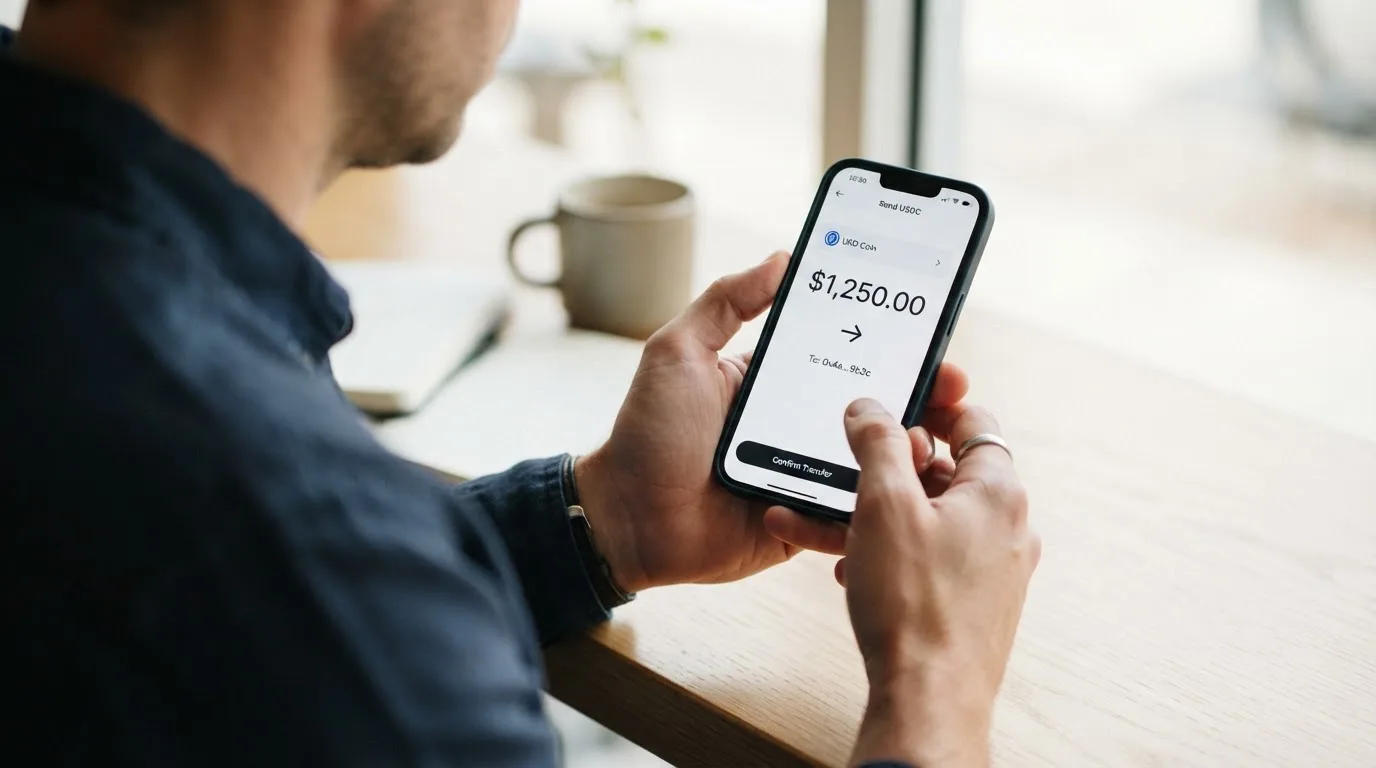
The funding model, from the starting data: crypto is deposited into a Kolan account, held as USDC in a linked wallet as collateral, and converted to USD to load the virtual card. Networks are not stated. Which chains are accepted, what the deposit address looks like, whether a wrong-network transfer is recoverable — none of that is on the card’s public pages.
The absence of named networks is the sharpest practical risk in this section, and it is not a technicality. Stablecoins exist on many chains, and they are not interchangeable: the same token on one network is a different asset from the token on another, and a transfer sent on a chain the provider does not support can be lost, with no mechanism to reverse it and no guarantee of manual recovery. If a provider does not tell you which networks it accepts before you send, you are choosing blind.
Other top-up details are likewise not stated: minimum amounts, fees for loading, how quickly a deposit becomes spendable balance. What is known about wider Hurupay accounts is that they allow withdrawal to crypto exchanges or local banks, per the Alchemy listing, but the card’s own withdrawal terms are not stated.
The safest order of operations is: confirm the supported network in writing before your first deposit, send a small test amount, wait until it appears as spendable balance, then send the rest. Anyone who tells you the network does not matter for a first deposit is guessing with your money.
Paying with it every day
If the card exists to be spent online and nowhere else, this is a section with less to say, and that is itself the finding.
The card’s public pages do not state whether it links to a self-custody wallet, what the mobile app does or looks like, whether any rewards or cashback exist, or how disputes are handled when a charge goes wrong. An unofficial directory mentions spend controls including a card freeze; Apple Pay and Google Pay support is not disclosed.
So the everyday picture is a virtual USD card for online spending, funded by converted crypto, with a freeze control mentioned in passing and nothing else documented. If your daily life involves tapping a terminal, paying at a till, or topping up from a bank app in seconds, this card does not meet that need. It is built for a narrower job: paying an online service with dollars, from crypto, when the alternatives to you are not working.
Two general behaviours of cards like this are worth holding in mind, because they are not specific to Kolan but will shape your experience. A virtual card number, used repeatedly on the same merchant, looks different from a number used once; a merchant can decline a prepaid or foreign-issued card at checkout simply because the issuer and country behind the card number do not match your billing address. And a declined authorisation can leave a hold on funds that lingers for days — so a single failed attempt can quietly tie up balance you thought was spendable.
What can go wrong
The risk picture here is unusual: not because the specific dangers are high, but because they are undocumented. You cannot price a risk you cannot see.
Start with what is known about the company. The starting data names Hurupay Inc. (DBA Kolan). Third-party sources describe it as a US-based fintech that is “MSB-registered” — a money services business registration — though the registration body and number are not given, so you cannot verify it independently. Kolan was in the inaugural cohort of Circle’s Developer Grant Program. The issuing institution is not stated, which means you do not know which bank or licensed e-money institution actually stands behind the card.
On complaints: no official incidents were found, and no Trustpilot page or reviews exist for Kolan or Hurupay. That cuts both ways. It may mean the card is too new to have attracted complaints; it equally means there is no body of user experience telling you what goes wrong. There is no track record either way.
The nearest thing to a warning signal comes from Cursor. In a forum thread on 13–15 August 2026 about using a Kolan virtual card for a Pro+ plan, Cursor staff said that prepaid and crypto-funded virtual cards “often have issues” — specifically, checkout declines or failed renewals. Cursor also neither supports nor blocks such cards. Read that precisely: it is a statement about a category of card, not an accusation about Kolan. But it is the same category Kolan sits in, and the failure mode it names — a subscription that will not renew — is exactly what people buy these cards for.
On security, a directory describes spend controls including card freeze. Custody arrangements and whether two-factor authentication is offered are not stated. So the one protective control anyone mentions is a freeze button, and the fundamentals — who holds the keys to the USDC in your linked wallet, and whether a second factor stands between an attacker and your balance — are not documented.
The wider context sharpens the picture. Card programmes do close, and the pattern is well established: Visa terminated its global agreements with FTX in November 2022 and the FTX US debit card was wound down by its issuer; WaveCrest, a Visa issuer that supplied several crypto card brands, was suspended by Visa in Europe in 2018, closing all its Visa programmes. Closures follow a pattern — a notice period, then spending and loading stop, then you are asked to withdraw what remains. Custodial platforms have their own history of failure: Mt. Gox (about US$350 million reported stolen, 2011–2014), Coincheck (about US$400 million, 2018), and Ronin Network (US$625 million, 2022). The general principle is that a card with a named issuer is safer than one without, and a card with safeguarded funds under a licence is safer than one whose custody arrangements are unstated.
None of that predicts anything about Kolan specifically. It is the reason the unstated parts of this card’s file matter more than they would for a card that publishes its terms.
What to take instead
The honest comparison is not “Kolan bad, everything else good” — none of these alternatives is a fully disclosed product either. It is that where Kolan discloses nothing on cost and network, some alternatives disclose more, and for some of you that difference is decisive.
Cardex — score 5.6 / 10. Positions itself as one crypto card for 200+ countries with no country list or exclusions published; its App Store listing is Naira-focused. It offers a debit crypto card on the VERVE, VISA, Mastercard and UnionPay networks, virtual and physical, with the card currency listed as Naira. Conversion happens in real time at the moment of payment, and the site describes an “AI-Powered Conversion Rate” that scans global exchange rates and picks the best one when you spend — though no fee percentage is stated. Funding comes from USDT, USDC and BTC wallets; networks not stated. Notably, Cardex discloses its card networks where Kolan does not, and offers physical cards.
TakeCard — score 5.5 / 10. The most transparent cost structure of the three, and the narrowest reach. The physical card is available only to Bolivian users for now; the Takenos site says the wallet can receive payments from any country. The card is virtual (immediately available) or physical (Bolivia only), the article names Visa as the network, it is issued in the United States, and it is prepaid with USD as the card currency at 1:1. Pricing: USD 5 for the virtual card; for physical in Bolivia, USD 20 issuance plus USD 20 shipping — though another article in the same help centre says USD 10 for physical in Bolivia, so the figures conflict. Fees: 1% commission per purchase, USD payments at 1:1 with no currency adjustment, other currencies at the official Visa rate of the day. Top-ups come from the Takenos balance; coins are not named in the article.
OkiCard — score 6.0 / 10, the highest of the three. Says “150+ countries” (some pages say “200+”) with “no geo-blocking based on your passport”, though users must confirm they are not in a sanctioned jurisdiction. Virtual card, with a physical card mentioned but not detailed; the network is “Visa/Mastercard”, not specified; the card currency is USD/EUR pegged. Its pricing is muddled — the pricing page shows issuance $0, monthly $0, and a starting price of $15 for the virtual card, while the FAQ mentions a one-time issuance fee, so the pages disagree. Initial deposit is 100 USDT. Fees: load fee 3%, transaction fee in USD 0%, “no hidden exchange spreads”; the FX fee is not stated. Funding is the most detailed of any of these: USDT on BSC (BEP-20), Ethereum (ERC-20), Tron (TRC-20) and Solana (SPL), with USDC “soon” and BTC and altcoins “coming soon”. Deposits go to a generated address and convert to fiat at the moment of spending.
| Kolan | Cardex | TakeCard | OkiCard | |
|---|---|---|---|---|
| Score | 5.7 | 5.6 | 5.5 | 6.0 |
| Networks named on the page | Not stated | VERVE, VISA, Mastercard, UnionPay | Visa | Visa/Mastercard, not specified |
| Physical card | Virtual only | Yes | Bolivia only | Mentioned, not detailed |
| Card currency | USD | Naira per listing | USD, 1:1 | USD/EUR pegged |
| Published fees | None | None (real-time conversion described) | 1% per purchase | Load 3%, USD transaction 0% |
| Named networks for deposit | Not stated | Not stated | Not confirmed | BSC, Ethereum, Tron, Solana |
Where does that leave a reader choosing? If your problem is that you cannot get any card and you are willing to do your own due diligence, OkiCard discloses the most — networks named, fees published, even the exact deposit chains — and scores highest of the three. If you need a physical card, Cardex and TakeCard at least acknowledge one exists. If you are in Bolivia and want plain, published numbers, TakeCard gives you a 1% commission and a stated card price, even as those figures conflict across its own help pages. Kolan’s case is narrower: it is for someone who specifically wants a virtual USD card funded by converted crypto, and who is comfortable treating the fee as something to measure rather than something to look up.
Who I would recommend it to
I would recommend Kolan to a person with a specific, narrow problem: you need to pay an online service in US dollars, from crypto you already hold, and no ordinary card will do the job. You have checked that a virtual USD card is what that service accepts. You are willing to treat the first payment as a measurement — send a small amount, watch what it costs end to end, and only then scale up. And you understand that you are trusting a company whose fee schedule, issuer, network and identity checks are not on its public pages.
I would not recommend it to a person who needs a physical card, who plans to use it at a shop terminal, who needs published limits or a stated monthly fee, who wants Apple Pay or Google Pay and expects them to be documented, or who wants to know precisely what happens to a disputed charge. I would be cautious for anyone whose country of citizenship or residence is not on the unofficial lists, and for anyone whose existing banking works and who is only looking for a cheaper way to spend crypto — this card does not document a cheaper way.
The score of 5.7 out of 10 is not a verdict on whether Kolan is a good company. It is a verdict on how little you are being told. For a product sold on solving one specific access problem, that is a defensible trade. For anything larger, silence is not a feature.
Frequently asked questions
What is the Kolan card?
The Kolan card is a virtual US-dollar payment card offered by Hurupay Inc., which trades as Kolan. You deposit crypto into a Kolan account, it is held as USDC in a linked wallet, converted into dollars, and used to load the card’s spendable balance. It is built for paying online services, not for physical shops. It is a prepaid model rather than a debit card tied to a bank account.
Is Kolan a bank?
No indication of that — Kolan is described as a fintech company, Hurupay Inc., with third-party sources calling it “MSB-registered”, a money services business designation in the United States, not a bank. The card’s public pages do not name a bank or licensed e-money institution as the issuer. So the money behind your balance sits with a fintech, not with a deposit-taking bank, and deposit guarantee schemes should not be assumed.
Who owns Kolan?
Kolan is the trading name of Hurupay Inc., a US-based company according to third-party descriptions, which is registered as a money services business (the registration body and number are not published). Kolan was also in the inaugural cohort of Circle’s Developer Grant Program. The entity that actually issues the card is not stated anywhere on the card’s public pages.
Is the Kolan card free?
The card’s public pages do not state any fee at all — not an issuance fee, not a monthly fee, not a conversion fee. That is different from stating it is free. A directory description says “no hidden FX fees”, which is unofficial and does not cover the cost of converting your crypto into dollars. Compare one small real payment end to end to find your actual rate.
How do I top up the Kolan card?
You deposit crypto into your Kolan account, where it is held as USDC in a linked wallet as collateral and converted to USD to load the card. The critical unknown is which blockchain networks are supported — the card does not state them. Confirm the network in writing, send a small test deposit first, and wait for it to appear as balance before sending anything larger.
What crypto and networks does Kolan accept?
The card’s public pages do not name supported coins or networks for deposits. What is documented is the holding side: crypto sits as USDC. Because a stablecoin sent on one chain is not the same asset as the same token on another, sending on an unsupported network can lose the funds with no guarantee of recovery. This is the question to ask before your first deposit, not after.
Does the Kolan card require KYC or identity checks?
The card’s public pages do not state whether identity verification is required, or what documents are needed if it is. That is not the same as saying none is required — it means you cannot find out from the public pages. Third-party sources also note that US screening often applies to citizenship and country of birth as well as address. Ask Kolan directly before you send any funds.
Can I add the Kolan card to Apple Wallet or Google Pay?
This is not disclosed. The card’s public pages say nothing about Apple Pay or Google Pay support, and the one unofficial mention of its features — a card freeze control — is the only touchpoint offered. If mobile wallet support matters to you, treat it as unavailable until you have seen it stated or demonstrated.
Is the Kolan card safe to use?
There is no published evidence of harm — no official incidents were found, and no Trustpilot page or reviews exist for Kolan or Hurupay, which means there is no track record either way. What is missing is the disclosure that would let you judge it: custody arrangements, two-factor authentication, the issuing institution, and the fee schedule. Read those omissions as risk, and use small test payments.
Is the Kolan card worth it?
It is worth it only for a narrow case: paying an online service in dollars from crypto you already hold, when no ordinary card will do it. For daily spending, a physical card, published fees, or documented customer protection, it falls short — its everyday-use score is the weakest in our assessment. Measure the cost of one real payment before committing to anything larger.
How virtual cards work – cryptocardsexplained.com
Content created by the «cryptocardsexplained.com» team