
A self-custody Visa that spends straight from your wallet, and a fee sheet nobody publishes
 Available in US
NAKA is a card for one specific job: turning USDT sitting in a wallet you control into everyday purchases, online, in store, and at ATMs, through a virtual Visa Platinum. That job it does in a way that is genuinely unusual — there is no shared custodial pool, every payment is signed on your own key from your own device. But this is also a product whose public pages decline to say what it costs. Not “we charge a modest fee” — the pricing line exists and the figures are absent. The same silence covers the issuer, the licensing, and the limits. My score is 5.1 out of 10, and most of the reason sits in that gap.
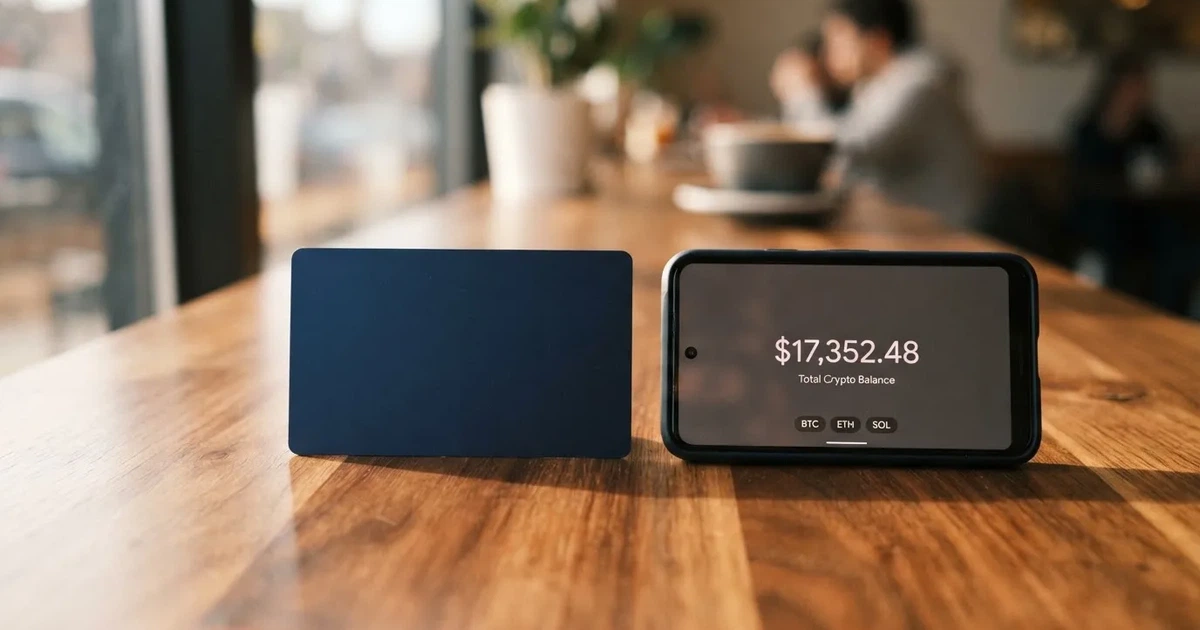
The conditions described here are current as of October 28, 2026.
Verdict: 5.1 out of 10
Here is the card criterion by criterion, with the marks I gave and why.
| Criterion | Mark | Why |
|---|---|---|
| Who can get it | 5 / 10 | Targets Latin America, app listed “worldwide” without a country list; US citizens are turned away |
| Cost | 5 / 10 | Cost and fees are not disclosed — pricing is “per user”, with no figures |
| Top-up options | 3 / 10 | USDT from a self-custody wallet; the app store caption accepts only USDT on Avalanche C-Chain |
| Reliability and complaints | 6 / 10 | NAKA GLOBAL d.o.o. (Ljubljana), ISO/IEC 27001:2022, ISO 9001:2015, ISO 22301:2019; issuer and licences not named; no complaints found; App Store 5.0 from 11 ratings |
| Everyday use | 6 / 10 | Virtual Visa Platinum, Apple Pay and Google Pay; ATM mentioned without conditions |
| Total | 5.1 / 10 | A workable mechanism, an unpublished price |
Who this suits: someone who already holds USDT in a self-custody wallet, lives somewhere the card actually works, and treats a spending card as one more consumer of that balance rather than as a financial relationship. If you want a card that spends a bank account, this is the wrong shape entirely.
Who it does not suit: anyone shopping on price, anyone who needs to know what a payment costs before they make it, and anyone who wants a named issuer standing behind the card. The absence of figures is not a small documentation gap. It is the thing you would need most.
Will they give you the card
They will probably consider you, but the targeting is not aimed at you unless you are in Latin America. The product “targets Latin America”; the app is listed “worldwide” without a country list. The one firm data point on eligibility is negative: starting data says “not a United States citizen”. So a US passport holder is out from the start, on citizenship rather than residence — which is exactly the distinction that gets people surprised, because most cards screen on where you live.
The legal paperwork is split across entities, and the split is by jurisdiction: NAKA Slovenia, NAKA Switzerland, NAKA El Salvador, with the note that the “specific provider depends on your jurisdiction and/or the product suite”. A US-specific card agreement also exists as a separate document. In practice this means your contract, and the company you are contracting with, may depend on where you are. That is normal enough in this category. What you should check first is which entity’s terms you actually accepted, and read that document rather than the marketing pages — I did not read the “NAKA Spend Card Terms” in full, and neither did the pages I looked at for you.
Age requirements are not stated. Proof of address is not stated. Whether you need a documents upload beyond identity is not stated. Those are the details to ask about before you send anything anywhere.
How to get it
The route is short. Set up your wallet inside NAKA Pay+, then pass what the company calls “a quick KYC verification”. No bank account is required — that is the point, and for people without access to a conventional account it is the reason to look here at all.
What you end up with is a virtual, tokenized Visa Platinum card, marketed against “over 150 million locations”. There is no physical card to wait for; the card lives in your phone and in your wallet apps. The currency the card itself is denominated in is not stated.
Verification levels are not stated. Whether a small balance works without full documents, and what triggers an upgrade, is not published. If your situation is one where you want to move money carefully rather than quickly, that is worth asking before you load anything.
Fees: what a NAKA payment really costs
Here is the honest version, and it is short: the numbers are not on the public pages. NAKA says its pricing is per user rather than per transaction, and gives no figures. Issuance, monthly fee, conversion fee, FX fee, ATM fee — all not stated. Spending limits are adjustable by you in the app, and the amounts are not stated either.
| Fee or limit | What NAKA publishes |
|---|---|
| Issuance | not stated |
| Monthly fee | not stated |
| Conversion | not stated (settlement in USDT per NAKA site) |
| FX | not stated |
| ATM | not stated |
| Daily and monthly limits | adjustable by the user; amounts not stated |
Read that table as the whole disclosure, because it is. “Not stated” means NAKA’s public pages do not say — it does not mean zero.
Now the part that actually determines what leaves your wallet. NAKA works by having USDT in your self-custodial on-chain wallet, “settled via smart-contract signature” at each payment. So a purchase is not a charge against a card balance; it is a signed transfer of USDT out of your wallet. What that costs you depends on layers that NAKA does not quote and the blockchain does charge:
- The on-chain network fee. Gas or bandwidth for your own deposit is charged by the blockchain, not by the card provider. On an Ethereum-standard network that means you need ETH to send USDT at all, because fees are paid only in ETH.
- The conversion and spread. If a purchase is in a currency other than what your USDT tracks, someone is converting. NAKA does not publish what that takes.
- The network you are on. Fees vary a lot by chain, and NAKA’s own store caption points at Avalanche C-Chain.
Two ordinary payments, so this stops being abstract. Buying a coffee in a city where your USDT already behaves like dollars: the bill is the price of the purchase, plus whatever network fee the transfer costs on the chain you are using, plus any undisclosed conversion or FX component. Paying a hotel or a subscription in euros on a card with no published card currency: now a currency conversion sits between you and the charge, and NAKA does not say who takes a margin on it or how large it is. You cannot compute either figure from anything the company publishes, and neither can I.
So the question “is NAKA card free” has a real answer: nobody knows, and the company is not saying. Budget for a cost you cannot predict rather than for a number you have been given.
How to Top up NAKA
There is no top-up button, because there is no stored balance to top up. The funding model is: USDT already sits in your self-custodial wallet, and each payment is signed from it. Funds remain on-chain in your wallet until a payment is signed — that is by design, and it is also what makes the card unusual.
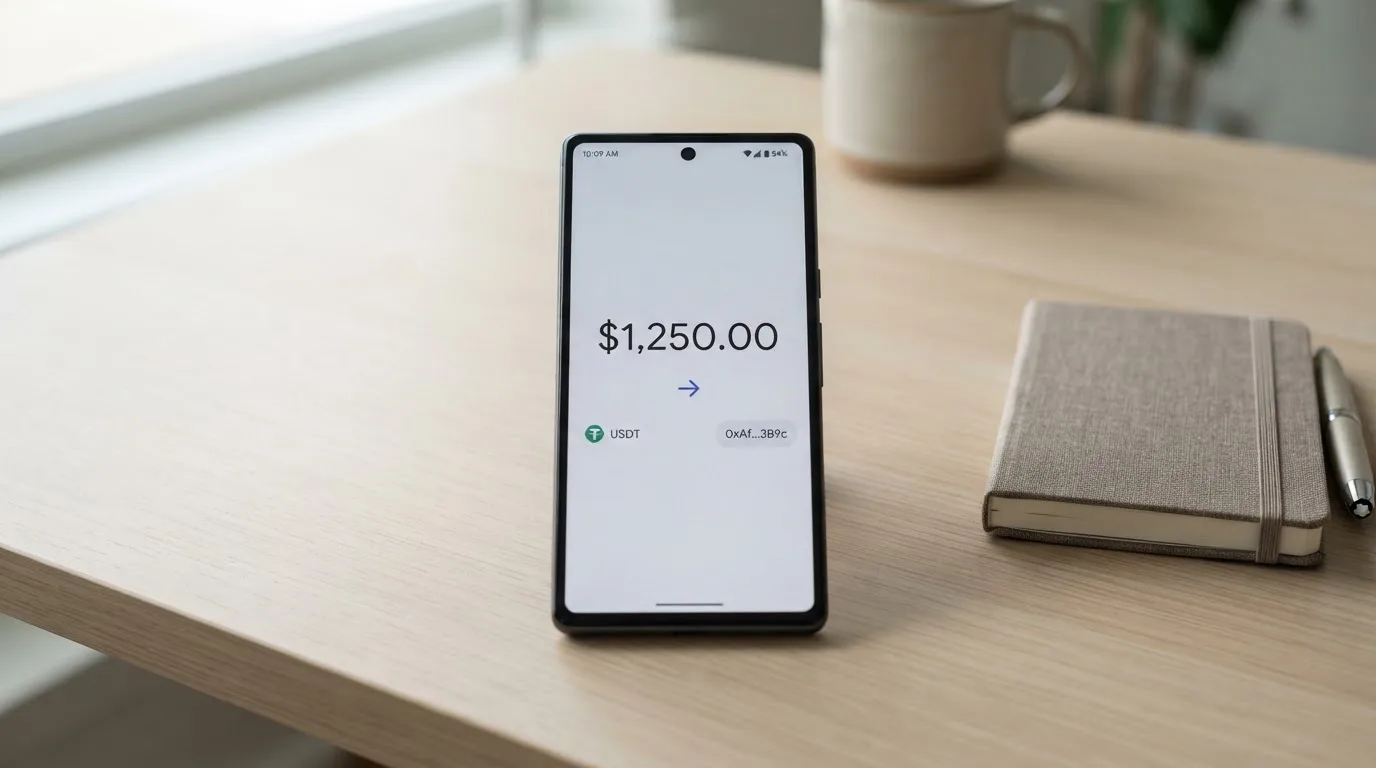
The practical detail that will bite you is the network. The NAKA Pay+ app store listing caption says only USDT on Avalanche C-Chain is accepted. That is a screenshot caption, so I would treat it as a strong hint rather than a contract term — but it is the clearest signal available about where to be before you send anything.
If you hold USDT on another network, the move is to have USDT on Avalanche C-Chain in a wallet the app can reach. And know the trap before you hit it: blockchain transfers are irreversible. A deposit sent on a network the provider does not support, or to an address belonging to a different network, can be lost outright or need manual support recovery with no guarantee attached.
Other funding options are not stated. Which coins besides USDT, which networks, and whether there is any fiat on-ramp at all — the public pages do not say. The single chain in the caption is the only concrete thing.
One more asymmetry worth knowing about, because it belongs in this section rather than later: stablecoins are not censorship-proof. Tether says it disables tokens in wallets on the OFAC sanctions list and has frozen funds tied to illicit activity. Funds you can spend may sit behind a switch you do not control.
Paying with it every day
Day to day, this behaves like a card. That is the appeal, and the details I can confirm are decent.
- Wallets. It integrates with Apple Pay and Google Pay, and the store listing mentions Apple Wallet tap-and-go. A virtual card added to a phone wallet is the normal way people use this.
- Acceptance. Online, in store, and at ATM use, across major card networks — which, with a Visa Platinum, is a very large number of terminals.
- App. NAKA Pay+ is published by NAKA GLOBAL d.o.o. App Store 5.0 from 11 ratings, version 2.2, per a third-party report read on 2026-10-21. A Google Play listing exists; I could not obtain its rating. Eleven ratings is a thin sample — it says the app has not been disliked, not that it is well loved.
- Controls. Freeze or block the card and set spending limits in the app.
- Category. There is one product, not a tier ladder. Partner-branded virtual cards are possible.
What is not stated, and what I would want to know: which merchant categories are blocked, and whether there are rewards on the card itself. A blog post mentions “programmable rewards” as a partner feature, which is not the same as you getting cashback.
Also worth naming plainly, because it is a category-wide behaviour and it will not surprise you if you have read this far: some merchants decline prepaid or foreign-issued card numbers. When a shop looks up the BIN it can see which institution and country issued the card, and may apply extra scrutiny if that differs from your billing address. This is why a card issued in one country can look foreign in another. Address verification is mainly offered in the US, Canada and the UK and is generally unavailable for foreign-issued cards, which can cause declines. A declined authorization may also leave a hold on your funds for several days.
And the dispute path: chargebacks, and your rights in a dispute, are not stated. The “NAKA Spend Card Terms” exist but I did not read them, so I am not going to guess.
What can go wrong
The distinctive risks here are not the usual card risks. They are custody risks and disclosure risks.
Self-custody means your problem is yours. Every single transaction requires a cryptographic signature from your private key, the key never leaves the device, and there is no shared custodial pool. That is the strongest structural feature of this card. It is also why a seed phrase — typically 12 to 24 words, an unencrypted form of the private key — is the whole security model. Anyone who obtains those words can restore the wallet and spend its funds. Cryptocurrency transfers are typically irreversible, and a stolen private key has no built-in recovery: nothing can freeze or return it. The usual traps apply with full force: phishing, and clipboard-hijacking malware that silently swaps a copied address.
Compare that with the alternative. Custodial platforms have a real record of failure — Mt. Gox, about US$350 million reported stolen across 2011–2014; Coincheck, about US$400 million in 2018; Ronin Network, US$625 million in 2022. Holding funds with a custodian carries counterparty and hack risk. NAKA’s design is a genuine answer to that. It is also a transfer of risk to you, and you should price it that way.
You are dealing with an entity you cannot name. NAKA GLOBAL, finančne tehnologije, d.o.o., Letališka cesta 33F, 1000 Ljubljana, Slovenia, registration number 8106452000. Related entities: NAKA CH SAGL (Switzerland) and NAKA SLV, S.A. de C.V. (El Salvador). It holds ISO/IEC 27001:2022, ISO 9001:2015 and ISO 22301:2019 — three real certifications, and worth something. But the card issuer and the licences behind the card are not named on the pages I read. That gap matters: a card is a payment service, regulated separately from the crypto side, so a product like this usually depends on two licences. When you cannot see either, you are trusting a company you cannot fully place.
Younger than it looks. The launch post is dated October 24, 2025, though the same page’s metadata shows a conflicting October 6, 2026. The card was first shown publicly in Lugano. The app was first released on October 9, 2025, per a third-party report. This is a young product, roughly a year old at most.
No complaints found — which is not the same as no problems. A search for reviews of this card returned nothing: no Trustpilot page, no Reddit thread, nothing from users. For a year-old product with eleven App Store ratings, that is expected. It also means you have no peer evidence to lean on when something goes wrong.
Programme closure is a real ending. Card programmes close. Visa terminated its global agreements with FTX on 13 November 2022 and the FTX US debit card was wound down. WaveCrest, a Visa issuer that supplied crypto card brands, was suspended by Visa in Europe in 2018, closing all WaveCrest-issued Visa programmes. The usual sequence is a notice period, then spending and loading stop, then you are asked to withdraw. What that means for funds sitting on-chain in your own wallet is not something the card’s terms tell me.
Taxes are yours. The IRS treats digital assets as property, so exchanging them for goods, services or dollars generally produces a taxable gain or loss, measured at fair market value on the date of the transaction. Every card payment funded from crypto can be a separate disposal. I am not giving tax advice — I am flagging that this exists and that your jurisdiction’s rules are the ones that count.
What to take instead
All three alternatives below scored higher than NAKA in my assessment, mostly because they publish what NAKA does not.
| NAKA | BloFin Wallet Card | Decaf | SafePal | |
|---|---|---|---|---|
| Score | 5.1 / 10 | 6.9 / 10 | 6.2 / 10 | 6.2 / 10 |
| Card | Virtual Visa Platinum | Visa Platinum | Visa, virtual or physical | Virtual Mastercard debit |
| Cost published | No | Yes — $0.00 activation, annual, issuance, dormancy | Yes — $5 virtual, $10 physical US / $90 rest of world, no annual | Partly — no account or management fees; issuance not stated |
| Spend fee | Not stated | 1% or lower by VIP tier, charged at payment | No FX fee added; crypto conversion not stated | Not stated |
| Top-up | USDT, Avalanche C-Chain per listing caption | USDT and USDC on Arbitrum and Base | USDC by card, bank transfer or payment link | Crypto from 40+ blockchains, converted to USDC or fiat |
BloFin Wallet Card — 6.9/10. The strongest of the three, and the only one with a published spend fee ladder: 1.00% at VIP 0 down through 0.90%, 0.80%, 0.50% and 0.20% to 0.00% at VIP 5, charged at payment. Activation, annual, issuance and dormancy fees are each $0.00, and cancellation carries no fee. Top up with USDT and USDC on Arbitrum and Base. Its catch is eligibility: no country list on the card page — the app just says “select your country or region” — while the starting data lists 35 countries including the US, Australia, Japan, the UAE, Brazil, Mexico, Malaysia and New Zealand. Citizenship versus residence is not stated. And instead of cashback, you get a reduced spend rate, framed as “no waiting for cashback or rebates”.
Decaf — 6.2/10. Best for anyone who wants no FX markup: Decaf adds no fee, because “the FX is the one Visa offers”. You can hold virtual or physical (physical has tracked delivery). But it publishes the longest and most restrictive country list in this group — not issued in Belarus, China, North Korea, India, Iran, Iraq, Israel, Myanmar, Nepal, Russia, Syria, Turkey, Cuba, Ukraine, Venezuela, Vietnam, Nicaragua, Puerto Rico, Nigeria, with restricted US states including Arizona, Delaware, Georgia, Idaho, Louisiana, Maryland, Montana, Ohio, Oregon, Rhode Island, Washington and Wisconsin. Whether that applies by citizenship or residence is not stated. The crypto conversion fee is not stated, and which coins and networks top up the card itself is also not stated, even though payment by card, bank transfer or USDC is possible.
SafePal — 6.2/10. The most conventional, with a virtual Mastercard debit and limits given in euros against a Swiss Fiat24 account. No account creation or management fees; card issuance fee not stated. Top-up fee 0% standard; Mastercard non-USD settlement carries a 1% FX fee; refund processing runs 1 USD, EUR, CHF or 7 CNH; swaps include an unquantified spread, though the bank page elsewhere advertises crypto top-up “as low as 0.4%” on the top tier. Crypto comes from 40+ blockchains converted to USDC (default) or fiat, with transactions on Arbitrum. Its eligibility wording — “citizens of supported regions who live in supported areas” — is only as good as the list, and the list at its regions page was empty when fetched.
Where NAKA genuinely wins is custody and network choice: self-custody with a per-payment signature, and Avalanche C-Chain as the named rail. Where it loses is everything a buyer should be able to see before committing.
Who I would recommend it to
I would recommend NAKA to someone in one specific situation: you already hold USDT in a self-custody wallet, you spend mostly through Apple Pay or Google Pay, you have read the terms of the entity you are contracting with, and you accept that you cannot calculate the cost of a purchase in advance from anything the company publishes. For that person the card is a clean, small, well-controlled way to spend a stablecoin balance — the key never leaves your device, and you can freeze the card from your phone.
I would not recommend it as a first crypto card. If you are choosing where to hold money, the absence of a named issuer and unstated fees is not a good enough foundation, especially for someone whose reason for wanting a card is that ordinary banking has been difficult. In that situation you need to know who stands behind the card and what happens when they stop, and neither answer is on the table.
My actual advice, for anyone reading this with a real decision in front of them: send a small amount first, make one ordinary purchase, and watch what leaves your wallet. That single transaction will teach you more about fees than any page the company could publish. Then check whether NAKA appears on the register ESMA keeps of authorised crypto-asset service providers — the crypto side is regulated under MiCA, and the register is public.
Frequently asked questions
What is NAKA card?
NAKA is a payment card that spends USDT directly from a wallet you control. Instead of loading a prepaid balance, your USDT stays on-chain in a self-custodial wallet, and every payment is settled by a smart-contract signature from your own private key. The card itself is a virtual, tokenized Visa Platinum, marketed against more than 150 million acceptance locations, used through Apple Pay or Google Pay.
How does NAKA card work?
You set up a wallet inside the NAKA Pay+ app, pass a quick KYC verification with no bank account required, and receive a virtual Visa Platinum. When you pay, the app signs a transfer of USDT out of your wallet for that amount. Your key never leaves your device and there is no shared custodial pool. Funds stay on-chain in your wallet until you sign a payment, which is the core difference from a stored-balance card.
Is NAKA a bank?
No — and this is worth being precise about. The company behind it is NAKA GLOBAL, finančne tehnologije, d.o.o., based at Letališka cesta 33F, 1000 Ljubljana, Slovenia, with related entities in Switzerland and El Salvador. It holds ISO/IEC 27001:2022, ISO 9001:2015 and ISO 22301:2019. However, the card issuer and the licences behind the card are not named on the public pages.
Who owns NAKA?
Ownership is organised around NAKA GLOBAL d.o.o. in Slovenia, with related entities NAKA CH SAGL in Switzerland and NAKA SLV, S.A. de C.V. in El Salvador. The product was first shown publicly in Lugano, and a launch post is dated October 24, 2025, though the same page’s metadata shows a conflicting October 6, 2026. The underlying owners behind those entities are not disclosed on the pages reviewed.
Does NAKA card require KYC?
Yes — the company describes “a quick KYC verification” after you set up the wallet, and no bank account is required. The pages do not state which documents are needed, whether proof of address is required, what the age threshold is, or how verification levels are tiered. Those details are worth asking about before you upload anything.
Where can I use NAKA card?
Online, in stores, and at ATMs across major card networks, with the Visa Platinum card itself marketed against over 150 million locations, plus Apple Pay and Google Pay integration and Apple Wallet tap-and-go. Which merchant categories are blocked is not stated. Some merchants do decline prepaid or foreign-issued card numbers, so a minority of payments may be refused.
How do I top up NAKA card?
There is no top-up step, because there is no stored balance. USDT sits in your own self-custodial wallet and each payment is signed from it. The app store listing caption says only USDT on Avalanche C-Chain is accepted, so get your USDT onto that network first. Other coins and networks are not stated — and transfers are irreversible, so a wrong-network deposit can be lost.
What are NAKA card fees?
Not disclosed. NAKA says pricing is per user rather than per transaction, and publishes no figures for issuance, monthly, conversion, FX or ATM fees, nor for daily or monthly limits. What you actually pay includes the blockchain’s own network fee for your transfer, charged by the chain and not by the card, plus any undisclosed conversion or currency margin. Treat your cost as unpredictable rather than zero.
Is NAKA card safe?
Structurally, it is among the safer designs: the private key never leaves your device, no custodial pool holds your funds, and you can freeze the card and set spending limits in the app. The trade-off is that losses are yours — a stolen seed phrase, typically 12 to 24 words, lets someone restore the wallet and spend it, with no reversal available. There are no safety guarantees from me; check the entity’s terms yourself.
Is NAKA card worth it?
Worth it if you already hold USDT in self-custody, live in a region where it actually works, and mostly pay by phone. Not worth choosing as a first card, because the issuer and licences are unnamed, the fees are unpublished, and it is young — the app first appeared in October 2025 with only 11 App Store ratings and no public user reviews to lean on. Compare BloFin at 6.9/10, Decaf at 6.2/10, or SafePal at 6.2/10 before committing.
How wallet cards work – cryptocardsexplained.com
Content created by the «cryptocardsexplained.com» team