
The card costs nothing to hold and spends euros — the gaps are in the fine print
 Available in US
PayPilot is a Visa card you fund with crypto or euros and then spend like an ordinary payment card. It is free to issue and free to keep, charges nothing when you pay straight from the euro balance, and converts crypto to euros at 0.4%. On the headline numbers that is one of the more generous arrangements in this category. What is harder to judge is what the card’s own pages do not say: not which countries are supported, not what the FX fee is, not the limits, not which networks your crypto must arrive on. My overall mark is 7.4 out of 10.

Conditions are current as of October 28, 2026.
The card suits people who spend euros, hold BTC, ETH or USDT, and have found ordinary bank cards hard to get — residents of countries where a mainstream account with a card attached is not straightforward, or applicants who simply want a card that does not require a salary account. It does not suit you if you need published limits before you commit money, if you travel often and care about the exchange rate on foreign purchases, or if you want to hold your crypto yourself rather than on a platform balance.
My score, criterion by criterion
| Criterion | Mark | Why |
|---|---|---|
| Who can get it | 5 / 10 | Depends on country of residence and local rules; supported regions are not listed |
| Cost | 9 / 10 | Issuance 0 EUR, service 0 EUR, euro-balance payments free, crypto-to-euro conversion 0.4%; FX not disclosed |
| Top-up options | 6 / 10 | BTC, ETH, USDT and EUR, by crypto or by euros; networks not named |
| Reliability and complaints | 8 / 10 | Issuer Walletto UAB, Lithuanian e-money licence No 33 of 29 March 2018; no complaints found |
| Everyday use | 9 / 10 | Visa, virtual immediately and physical by post, Apple Pay and Google Pay, ATMs |
| Total | 7.4 / 10 | A cheap, usable card whose availability and fine print are thin |
The cost and everyday-use marks are the strongest part of the picture. The top-up mark is held back by a practical gap: you can send USDT, but the card’s pages do not tell you which chain to send it on, and getting that wrong can mean a lost deposit.
Who will they give you the card
This is the question I would ask first, and it is the one the card answers least clearly. Availability “depends on your country of residence and local regulations”. The card’s public pages do not list supported regions, and the rule is framed by residence — citizenship is not mentioned. So the honest answer is: you cannot tell from the outside whether you qualify until you register and try. If you are reading this hoping for a country-by-country yes or no, the card does not give one.
That is worth weighing against what the issuer side does tell us, because it is more concrete than the front of the site. The card terms name Walletto UAB (company code 304686884, Vilnius, Lithuania) as the Card Issuer, holding electronic money institution licence No 33, issued by the Bank of Lithuania on 29 March 2018, in terms dated May 2024. A named licensed institution in a member state is a better footing than an anonymous brand. Whether its licence reaches your address depends on local rules and on how the platform routes users, and that is exactly what is not published.
One more thing that shapes who gets in: the card requires a one-time identity verification before you can create the card, and the account is “verified once”. The KYC partners named are KycAid and Ondato. Levels, processing times and rejection reasons are not stated. Note the asymmetry there — the check is mandatory, but its friction is undocumented. Expect to be asked for more documents later too: the terms let the issuer re-verify your identity and request further documents at any time.
How to get it
The sequence the card describes is short: register, verify, create the card. There is no branch, no interview, no notarised paperwork as far as the pages show.
- One-time “quick identity verification” before card creation
- Documents, proof of address and age requirement: not stated
- KYC partners named: KycAid and Ondato
- Account “verified once”; the issuer may re-verify and ask for more documents at any time
- Card type: Visa, usable online and in stores, spending from a euro balance
On the virtual-versus-physical question, the card page does not commit, but the card terms do: they allow a virtual card, usable immediately, and a physical card that needs activation and is sent by post. The terms say the issuance fee includes postal costs, with the amount set by the issuer’s pricing page per country. The time to delivery and the exact cost are not stated. In practice, that means the virtual card is the route people use while the plastic is in transit, and the cost of the post is folded into a fee the card does not print.
Fees: what it really costs
The headline is genuinely good, and unusually so for this category. Here is everything the card publishes, with everything it does not publish shown as it is.

| Fee or limit | What the card says |
|---|---|
| Issuance | 0 EUR |
| Monthly service fee | 0 EUR |
| Payment from euro balance | No commission |
| Crypto-to-euro conversion | 0.4% |
| FX fee | not stated |
| ATM withdrawal | Cash withdrawal possible; fee and allowance not stated |
| Card tiers | not stated (single card, no tiers described) |
| Daily / weekly / monthly limits | Exist, set by the issuer; values not stated |
Two or three everyday payments show how thin the free part is, and where it stops.
Coffee in a euro country, paid from your euro balance. Nothing is deducted beyond the price of the coffee. No commission, no conversion, no involvement from crypto at all.
Coffee paid straight after a crypto top-up. The crypto is converted to euros at 0.4%. If the balance is already in euros, that 0.4% has already been paid at the moment you topped up, not at the till.
Something priced in dollars while you hold euros. Here the card goes quiet. It says the conversion to the merchant’s currency happens when needed, and the terms say exchange fees are specified in the payment account and based on Visa/Mastercard published rates at the time of exchange. The rate basis is stated; the fee percentage is not. The wallet holds BTC, ETH, USDT and EUR, and the euro balance is what the card spends from — so a holiday abroad is exactly the case where the missing FX figure matters most, and it is the case the card leaves blank.
The 0.4% is also the whole of the stated cost of a euro top-up path: the fee applies only when crypto is being converted to euros. The minimum top-up and any fee on a plain EUR top-up are not stated. One caution that is not the card’s fault but is yours: the on-chain network fee for sending crypto is charged by the blockchain, not by PayPilot.
Top up
Two routes, both simple on paper. You can top up with crypto or with EUR, and the FAQ names BTC, ETH, USDT and EUR as what the wallet holds. The card spends from the euro balance, so anything in crypto is converted at 0.4% along the way.
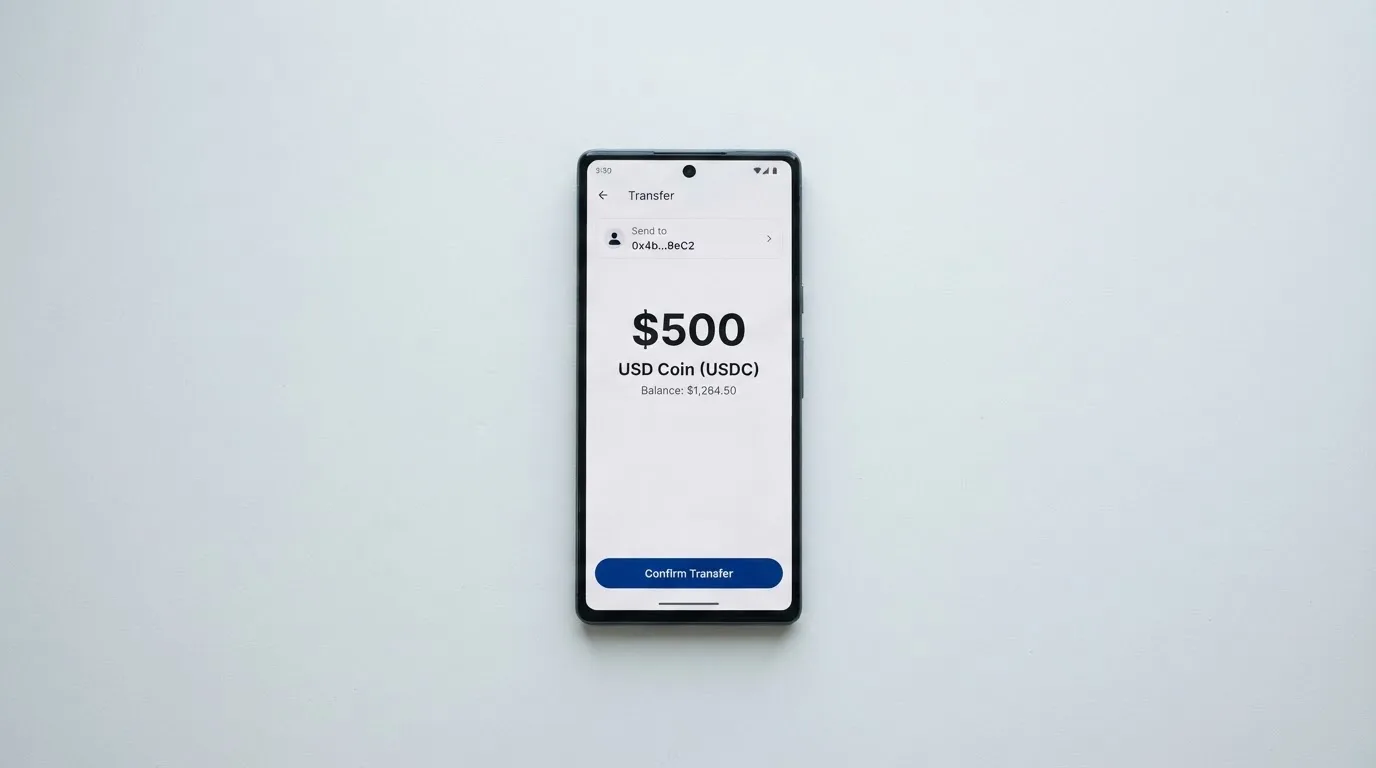
The gap is networks. The card’s pages do not say which networks are supported for deposits. That matters more than it sounds. Blockchain transfers are irreversible, so a deposit sent on a chain the provider does not support, or to an address belonging to another network, can be lost or need manual support recovery with no guarantee. USDT, for example, exists on several chains including Ethereum, Tron, Solana, Polygon and Avalanche, and the difference between them is not cosmetic — a wrong choice is a wrong address. Before your first transfer, get the deposit instructions from inside your own account and match them exactly.
Withdrawing works the other way: you sell crypto for EUR and withdraw to an IBAN, “subject to limits and compliance checks”. Note what that means — the off-ramp is gated by rules the card does not publish. If the payment account is closed, the card becomes invalid; what happens to the balance on closure is not stated.
| Top-up route | Stated cost | Stated minimum | Networks named |
|---|---|---|---|
| Crypto (BTC, ETH, USDT) | 0.4% when converting to euros | not stated | not stated |
| EUR | not stated | not stated | not applicable |
Paying with it every day
Day to day this behaves like a normal Visa. The FAQ says the card can be linked to Apple Pay or Google Pay, and the card itself works online and in stores wherever Visa is accepted. There are apps — an Apple App Store listing (id6751874532) and a Google Play listing under org.paypilot.app — though the store ratings could not be read, so I cannot tell you what users say about them.
What I would watch in the first weeks is more mundane than the card’s features:
- Merchant declines. A prepaid or foreign-issued card can be declined because the BIN lookup reveals the card type and issuer country. Address Verification Service, which compares the street number and ZIP a buyer typed with issuer records, is mainly offered in the US, Canada and the UK and is generally unavailable for foreign-issued cards — which can cause declines of their own.
- Category blocks. Gambling (MCC 7995) is blocked by many issuers by policy rather than by law, and the blocked list varies by issuer. PayPilot’s own blocked categories are not stated. If gambling or another sensitive category matters to you, ask.
- Holds. A declined authorisation can leave a hold on funds that stays for several days, typically up to 7.
- Authorisation and refunds. The terms say a payment made with your card credentials is deemed authorised and is not refunded unless the payee agrees to refund. A chargeback procedure and time frames are not stated.
- Rewards. None stated. There is no cashback or points scheme published.
Under EU regulation, paying with the card in a browser or app usually brings 3-D Secure (Visa Secure for Visa), which adds a one-time code or a biometric check. That is normal friction, not a problem, but expect it on the first few payments.
What can go wrong
The main risks here are structural rather than dramatic.
Wrong network on a deposit. Covered above, and it is the one that costs real money with no reversal available. Blockchain transfers are irreversible and stablecoin providers are not censorship-proof either — Tether says it disables tokens in wallets on the OFAC sanctions list and has frozen funds tied to illicit activity.
Frozen or closed account. Anti-money-laundering law requires regulated businesses to verify customers and monitor transactions. In the EU, due diligence covers name, address, date of birth, nationality and identity documentation, a sanctions check, the purpose of the relationship and whether you are a politically exposed person. Nationality is screened separately from residence because sanctions screening and issuer risk policy often apply to citizenship and country of birth as well as to address. If due diligence cannot be completed, the rules require the institution to hold back the transaction and, where necessary, end the relationship — which is why accounts close or freeze pending documents. The card’s own terms give the issuer wide powers: it can block the card on suspicion of fraud, the physical card locks after three wrong PINs, and you can request a block at any time.
Counterparty risk. Platform development is by Pilot Innovation Sp. z o.o.; financial services are provided by Nexora Fintech Limited “where applicable”; the Walletto UAB terms are linked as the card e-money provider. The issuer is not explicitly named on the main pages, and licences are not stated there — the site refers to “regulated partners”. The names are traceable, but you are trusting a chain of companies, not one. Custodial platforms have a real history: Mt. Gox (about US$350 million reported stolen 2011–2014), Coincheck (about US$400 million, 2018), Ronin Network (US$625 million, 2022). The card site claims AES-256 encryption, PCI-DSS, ISO 27001, cold wallet storage, 2FA and an audit reserve; the custody model is not stated.
Programme closure. Visa and Mastercard do not issue crypto cards themselves — they license issuers and can suspend a programme. Visa terminated its global agreements with FTX on 13 November 2022 and the FTX US debit card was wound down. WaveCrest, a Visa issuer that supplied crypto card brands, was suspended by Visa in Europe in 2018, closing all WaveCrest-issued Visa programmes. Closures typically give notice, then stop spending and loading, then ask users to withdraw remaining balances. With the withdrawal route itself subject to limits and compliance checks, that is the scenario to keep in mind: your way out can be the thing that is restricted.
Jurisdiction and support. The card is European, and crypto-asset rules are tightening around it. MiCA (Regulation (EU) 2023/1114) took legal effect in June 2023; its stablecoin rules applied from 30 June 2024 and the crypto-asset service provider rules from 30 December 2024. Under MiCA, e-money tokens may be issued only by a credit institution or an electronic money institution (Article 48), and providers operating under national law have a transitional window only until 1 July 2026 or until they are authorised or refused, whichever comes first. In the US, FinCEN guidance treats administrators and exchangers of convertible virtual currency as money transmitters, while people merely buying goods are not. E-money funds must be safeguarded, but they are not bank deposits and may not sit under a deposit guarantee scheme. Support is email at [email protected] plus a “Write to us” form and socials on X, Telegram, Instagram, Facebook and LinkedIn; hours are not stated, which matters if you are mid-dispute.
Good news on complaints: I found no PayPilot-specific Trustpilot, Reddit or news complaints, and no official incidents. Complaint detail is not stated by the card either. An absence of complaints in a young product is not the same as a track record.
What to take instead
If the gaps in PayPilot’s disclosure are the deciding factor for you, the alternatives below all have their own gaps, but they are shaped differently — and two of them at least tell you more about fees and limits up front. Scores are mine on the same scale.
| Card | Score | Cost disclosure | Who it targets |
|---|---|---|---|
| PayPilot | 7.4 / 10 | Best on paper: 0 EUR issue and service, 0.4% conversion; FX unstated | Euro spenders topping up with crypto |
| Stella | 6.5 / 10 | Fees “described under this User Agreement and/or on the App”; amounts not stated | Users barred by sanctions routed via affiliates |
| Whop Cards | 5.2 / 10 | “No extra fees”; no amounts listed | US consumers in 31 states, businesses in 41 |
| UniFi Card | 4.7 / 10 | “Fees may apply. See UniFi website” | US-centric, USD balance, remittance routes |
Whop Cards publish the longest eligibility list of the three: 31 US states for consumers (Alabama, Alaska, Arkansas, California, Colorado, Connecticut, Florida, Hawaii, Illinois, Indiana, Iowa, Kansas, Kentucky, Maine, Massachusetts, Michigan, Minnesota, Montana, Nebraska, New Hampshire, New Jersey, New York, North Carolina, Oklahoma, Pennsylvania, South Carolina, Texas, Utah, Virginia, West Virginia, Wyoming) and 41 states for businesses. Unsupported consumer countries include Belarus, China (Mainland), Cuba, Hong Kong, India, Iran, Iraq, Israel, Myanmar, Nepal, Nicaragua, North Korea, Russia, Syria, Turkey, Ukraine, Venezuela and Vietnam; unsupported corporate countries include Russia and Belarus. Whether the test is citizenship or residence is not stated. It is a Visa, spending a Whop balance; pending balances are usable as soon as a payment arrives while standard withdrawals use settled funds. The balance is backed by stablecoin collateral from a linked wallet, coins and networks not stated. Rewards are 5% cashback at select merchants, currently Uber, more planned — payout currency and conditions not stated.
Stella offers both virtual and physical, says its Visa works at “over 40 million VISA merchants globally”, and funds the card by depositing crypto into an in-app custodial wallet that automatically tops the card up. Its terms bar users under economic sanctions programmes and route US and European users through affiliates. Countries available are not stated on the official site, fees are not stated officially, and the official card page lists no cashback — the Earn product is a separate yield.
UniFi Card is the most different: a prepaid debit Visa issued by Lead Bank, spending a USD balance, supporting Apple Pay. You fund it by ACH, wire, SEPA (IBAN) or SPEI (CLABE), or get paid to a USDC wallet. The listing claims 3% rewards on balances but says nothing about card cashback, and fees are “may apply”. Availability is not confirmed from official pages; the app listing shows send-money routes to the Philippines (PHP), Mexico (MXN) and the eurozone (EUR), with recent release notes mentioning Colombia, Brazil (PIX) and the UK (GBP). Base it on a stablecoin and a US bank rather than on euro spending.
For a euro spender holding BTC, ETH or USDT who wants zero monthly cost, PayPilot is still ahead of this field. For someone who needs to know the FX fee before booking a flight, none of the four publishes it clearly — that is the honest conclusion of this comparison.
Who I would recommend it to
I would recommend PayPilot to a euro-based spender who already holds crypto, wants a card with no issue fee and no monthly fee, and is comfortable with a platform balance rather than self-custody. The 0.4% conversion and free euro-balance spending are hard to argue with, the issuer is a named licensed e-money institution in Lithuania, and the absence of complaints is a mild positive.
I would not recommend it to you if any of these apply:
- You need certainty about which countries are supported before you start
- You spend abroad regularly and the FX fee matters to you — it is not published
- You intend to move a large balance, since daily, weekly and monthly limits exist but their values are not stated
- You want your own keys, or you need to know the custody model
- You are a non-EU resident unsure whether the licence reaches you
- You are gambling on it, or plan on ATM withdrawals — fees and blocked categories are unpublished
One last thing, outside the card’s scope but part of the picture: the IRS treats digital assets as property, so exchanging them for goods, services or dollars generally produces a taxable gain or loss, measured in your local currency at the fair market value on the date of the transaction. That can mean each card payment funded from crypto is a separate disposal. I am not offering tax advice — treat this as a flag to check with a professional in your country, not as a conclusion.
Frequently asked questions
What is PayPilot card?
PayPilot is a Visa payment card funded with crypto or euros rather than a bank account. You top up, the crypto is converted to a euro balance, and the card spends from that balance. The card is issued by Walletto UAB, a Lithuanian electronic money institution holding licence No 33 from the Bank of Lithuania, issued 29 March 2018. It is a payment tool, not a bank, and it does not give you access to fiat banking services.
How does PayPilot card work?
You register, pass a one-time identity verification, and create the card. The card is Visa and works online and in stores. Spending draws on your euro balance. Crypto top-ups are converted to euros at 0.4%, so that cost is paid once at the point of funding, not at each payment. Payments from the euro balance itself carry no commission, and conversion to the merchant’s currency happens when needed.
Is PayPilot a bank?
No. The card’s terms link Walletto UAB as the card e-money provider, an electronic money institution licensed by the Bank of Lithuania. An e-money institution can issue e-money, payment cards and wallets, but it cannot lend, and safeguarded customer funds are not bank deposits and may not be covered by a deposit guarantee scheme. The site refers to “regulated partners” rather than naming an issuer on its main pages.
Will I get the PayPilot card in my country?
The card says availability “depends on your country of residence and local regulations”, and supported regions are not listed. Citizenship is not mentioned, so the test appears to be residence. The practical answer is that you find out by registering. If being turned away after verification would be costly or slow for you, check with support at [email protected] before you send anything.
Does PayPilot card require KYC?
Yes, a one-time “quick identity verification” is required before the card is created, and the account is described as “verified once”. The named KYC partners are KycAid and Ondato. Which documents, whether proof of address is needed, the age requirement, processing times and rejection reasons are not stated. The issuer may also re-verify your identity and ask for more documents at any time.
Is PayPilot card free?
Issuance is 0 EUR and the monthly service fee is 0 EUR. Payments from your euro balance carry no commission. Converting crypto to euros costs 0.4%. Not free: the FX fee, ATM fees and allowances, and any fee on a plain EUR top-up are all not stated on the card’s pages. Network fees for sending crypto are charged by the blockchain, not by PayPilot.
How do I top up the PayPilot card?
With crypto or with euros. The FAQ names BTC, ETH, USDT and EUR. The 0.4% applies when crypto is converted to euros. The minimum top-up is not stated, and — most importantly — the networks are not named. Transfers are irreversible, so a deposit sent on an unsupported chain can be lost. Get the deposit address and network from inside your account and match it exactly before sending.
Can I use the PayPilot card in Apple Wallet and Google Pay?
Yes. The FAQ says the card can be linked to Apple Pay or Google Pay. When you add a card to a mobile wallet it is tokenised: the device stores a device-specific number rather than your card number, and each payment uses a one-time security code. Your issuer can still restrict the tokenised number by limiting where it may be used, so a decline is not always a sign the card is faulty.
How do I withdraw money from PayPilot?
You sell the crypto for euros and withdraw to an IBAN, subject to limits and compliance checks. Those limits are not published, and neither is what happens to a balance if the payment account is closed — though the card itself becomes invalid on closure. Because the off-ramp is gated, a disputed or frozen account can leave you holding a balance you cannot readily move.
Is the PayPilot card safe and worth it?
Safety is not one question. The site claims AES-256 encryption, PCI-DSS, ISO 27001, cold storage, 2FA and an audit reserve, but the custody model is not stated, so you are trusting a chain of companies — platform development by Pilot Innovation Sp. z o.o., financial services by Nexora Fintech Limited where applicable, card issuance by Walletto UAB. I found no PayPilot-specific complaints and no official incidents, but that is a young record. For whether it is worth it: if you spend euros and hold crypto, the zero fees are hard to beat; if you need published FX fees, limits or self-custody, look elsewhere.
How app and neobank cards work – cryptocardsexplained.com
Content created by the «cryptocardsexplained.com» team