
A Lima-based crypto card with a Visa badge and a lot of blank spaces
 Available in US
If you are looking for an ordinary card to spend from, and a normal bank route has been difficult — a declined application, no fixed address in your name, a salary you cannot easily formalise, a country where opening an account takes months — then the Tarjeta Cripto Fluyez is exactly the kind of thing you would come across. It is a Peruvian platform that turned itself into a Visa card: you load crypto, and the money comes off your balance at the till. It is a plausible fit for that situation, and for very little else.
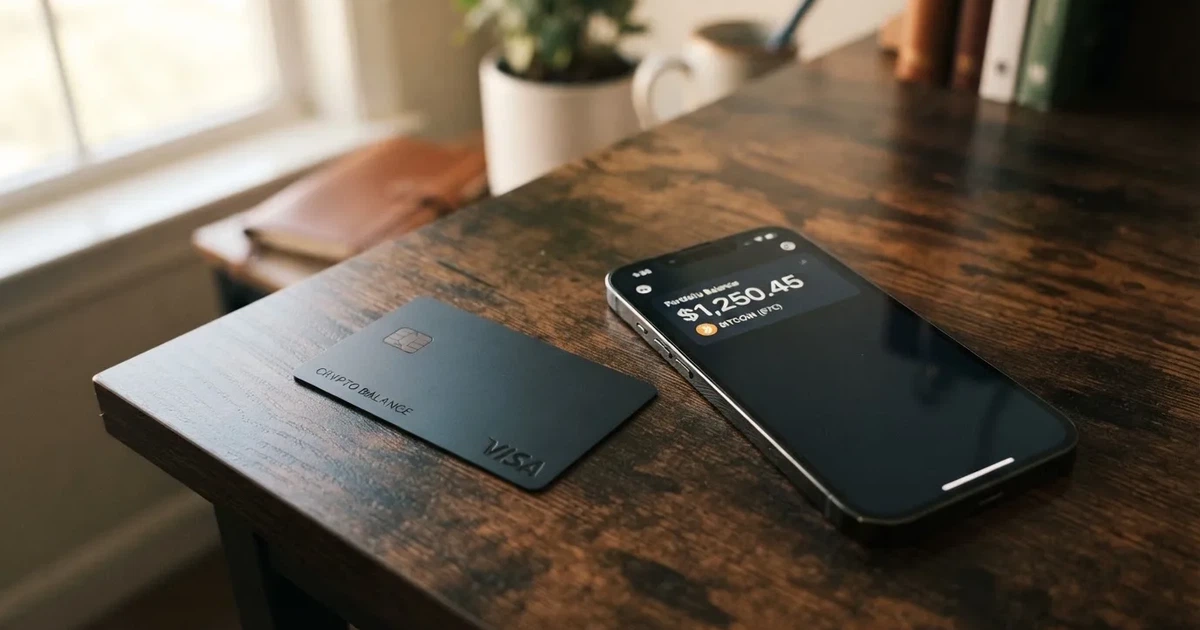
Conditions are current as of October 28, 2026.
My honest score for it is 5.5 out of 10, and the single biggest reason for a middling mark is not a scandal or a warning sign. It is that the card’s own public pages leave out the things you need in order to decide. The card fees are not published. The network to use for a transfer is not published. The name of the bank that issues the card is not published. That is not unusual for this category, and I will explain later why it happens — but for you it means that you are making a decision on the basis of a marketing page rather than a schedule of charges, and you should know that going in.
Everything I state below is current as of 2026.
Verdict: 5.5 out of 10, and the gap is disclosure rather than performance
Let me start with the table, because the breakdown is more informative than the total.
| Criterion | Mark | Why |
|---|---|---|
| Who can get it | 4 / 10 | “Toda Latinoamérica”, “Funciona en Perú y toda Latinoamérica sin restricciones” — one region, one market |
| Cost | 6 / 10 | “Sin costos ni mantenimiento si llegas al monto mínimo de uso” (amount not named); issuance and card fees not disclosed; 1% platform commission per operation |
| Top-up options | 6 / 10 | Bitcoin, USDT, ETH “u otras criptomonedas disponibles”; the crypto equivalent is deducted at payment; networks not disclosed |
| Reliability and complaints | 6 / 10 | Fluyez Digital Investments S.A.C., Peru, registered with SBS as a virtual asset provider (Resolución N° 02568-2021); Bit2Me bought a stake; issuer not named; in January 2026 the card was still being prepared; Trustpilot 4.3 from 9 reviews |
| Everyday use | 6 / 10 | Virtual Visa activates in under 10 minutes, Apple Pay and Google Wallet supported; ATM situation not disclosed, physical card not confirmed |
Who it suits. A crypto holder in Peru, or elsewhere in Latin America, who already has funds in Bitcoin, USDT or ETH and wants to pay for things — a subscription, a meal, an app that refuses crypto — without opening a second bank account. The pitch is coherent for that person: no monthly fee below a usage threshold, a 1% platform commission that is at least stated, and a virtual Visa that exists within minutes rather than a plastic card in the post.
Who it does not suit. Anyone who needs a card as their primary everyday money, who needs a card they can defend to a landlord or an employer, or who needs to know the exact cost of a foreign purchase before they make it. If you are converting currency regularly, a 1% platform fee plus an unnamed FX cost plus an unnamed conversion cost is a bad place to be. If you plan to draw cash from an ATM, note that the card’s public pages say nothing about ATM support at all — there is a 2% ATM figure floating in the site’s comparison table, but that belongs to the Binance Card and Lemon Card rows, not to Fluyez.
My advice: treat the money on this card as money you are willing to spend slowly, and keep the balance small until you have seen your own first statements.
Will they give you the card?
Yes, at least on paper, and the restriction is the one thing here stated twice and plainly.
The page says the card is “Disponible en Latinoamérica” and “Toda Latinoamérica”, and adds “Funciona en Perú y toda Latinoamérica sin restricciones”. Read that carefully, because it is doing a lot of work in a short sentence. It promises coverage across the region without restrictions, and then says the card works anywhere Visa is accepted — which is the same claim twice, in slightly different words.
What this does not say is anything about your nationality, and this is the point people most often get wrong. Residency and citizenship are different filters, and crypto platforms apply both. KYC rules require regulated businesses to verify customers and assess risk as part of anti-money-laundering and counter-terrorism-financing law, including ongoing monitoring and suspicious-activity reporting. In the EU that due diligence covers name, address, date of birth, nationality and identity documentation, a sanctions check, the purpose of the relationship, and whether you are a politically exposed person. In the US the customer identification programme requires name, date of birth, address and an identification number. And because sanctions screening and issuer risk policy are frequently applied to citizenship and country of birth as well as country of address, your passport can matter even where your residence does not.
Fluyez’s page makes no citizenship statement whatsoever. If your citizenship is unusual relative to where you live, you should treat that as an open question, not a yes.
One more piece of background that changes how you read any crypto card: a payment card number starts with an issuer identification number of 6 or 8 digits that identifies the issuing institution. Merchants can look that up and see which institution and country issued the card, and some apply extra scrutiny when the issuer country differs from the billing address on file. That is the ordinary reason a card issued in one country can look “foreign” to a shop in another — it is not necessarily about you.
What the page does not state: proof of address requirements, age thresholds, and why an application might be refused. Cards of this type are generally available to adults (18+), and some issuers set higher limits, but Fluyez does not publish its own rule.
How to get it
The process as described is short, and unusually the site commits to timings.
You upload an identity document and complete facial verification. The site says registration “toma menos de 2 minutos” and activation is “Inmediata (menos de 10 min)”. You request the virtual card inside your account and activate it in the app. There is no delivery involved — the card is virtual — so nothing is coming through a letterbox.
What that two-minute figure does not include is the review. In practice, identity checks on regulated platforms take time when a system flags something, and the reasons for a refusal are things you would want to know in advance. The levels of verification, the expected time per level and the rejection reasons are not stated.
The card itself is described as a “Visa Virtual” in the comparison table. There is one loose end: the page’s structured data also mentions “tarjeta física y virtual”, which the visible text does not confirm. So treat the virtual card as the confirmed product and physical plastic as unconfirmed. The currency the card is denominated in is also not stated.
Because of how these programmes are structured, it is worth being blunt about a question people search for and rarely get a straight answer to: is this a bank? No. Fluyez Digital Investments S.A.C. is registered with Peru’s SBS as a virtual asset service provider under Resolución N° 02568-2021, and it is not a bank. Visa and Mastercard do not issue crypto cards to consumers themselves; they license issuers, and a crypto brand is often only a programme manager or front end that markets the card. There are at least three parties here — the network, the licensed issuer, and Fluyez — and the card’s pages name only two of them.
What it really costs: Fees, and the parts nobody publishes
Here is the honest position: you can read what Fluyez charges for using its platform, and you cannot read what the card charges. Both facts matter.

| Fee or limit | What is published |
|---|---|
| Issuance fee | Not stated |
| Monthly fee / maintenance | “Sin costos ni mantenimiento si llegas al monto mínimo de uso” — the minimum amount is not specified |
| Card commission | Not stated; the site says “Las comisiones dependen del tipo de operación” |
| Crypto conversion cost | Not stated for the card; the equivalent crypto balance is deducted at payment |
| FX / foreign currency fee | Not stated |
| ATM withdrawal fee | Not stated (the 2% figure on the site belongs to Binance Card and Lemon Card) |
| Daily and monthly spending limits | Not stated |
| Fluyez platform commission | 1% per operation |
| Card tiers | Single card, no tiers |
Now let me apply that to three real payments, because abstract disclosure tables do not help anyone.
A $12 lunch in a local currency. Your crypto is converted at the moment of payment and the equivalent balance is deducted — the mechanics are clear. What is not clear is what the conversion costs you on top, because neither the conversion fee nor the FX treatment is published. If the card transacts in a currency other than the one you loaded, an unnamed cost may sit between the conversion and the purchase. Add the 1% platform commission on the operation, and you know one of the three numbers in your cost, not all of them.
A €9.99 monthly subscription billed in euros. This is the case where disclosure gaps bite hardest. You are buying in a foreign currency, so at least two unnamed costs may apply — one at conversion, one in the foreign-exchange handling — and neither is disclosed. A recurring payment is where a percentage you did not know about gets charged every single month. This is the purchase I would run first, at a small amount, precisely because it is the one that will expose the FX behaviour.
A cash withdrawal. I cannot model this, and neither can you from the public pages. ATM support is not stated, ATM fees are not stated, and there is no indication of how many free withdrawals, if any, are included. Do not plan a month around this card until you have read your own statement after one attempt.
There is a second layer of cost that people forget exists on these platforms: the blockchain itself. On-chain network fees for your deposit are charged by the blockchain, not by the card provider. If you top up with USDT over a network where you hold no gas token, you can pay a small network fee on top of everything above.
And a category of risk worth naming before you decide anything: transfers are irreversible. A deposit sent on a network the provider does not support, or to an address belonging to a different network, can be lost or may need manual support recovery with no guarantee.
My bottom line on cost: the 1% is the only rate you can plan around, and everything else on this page would need to come from the in-app schedule rather than from the marketing site.
How to Top up the card
Topping up starts with a transfer to the right network — and the right network is the one thing not stated.
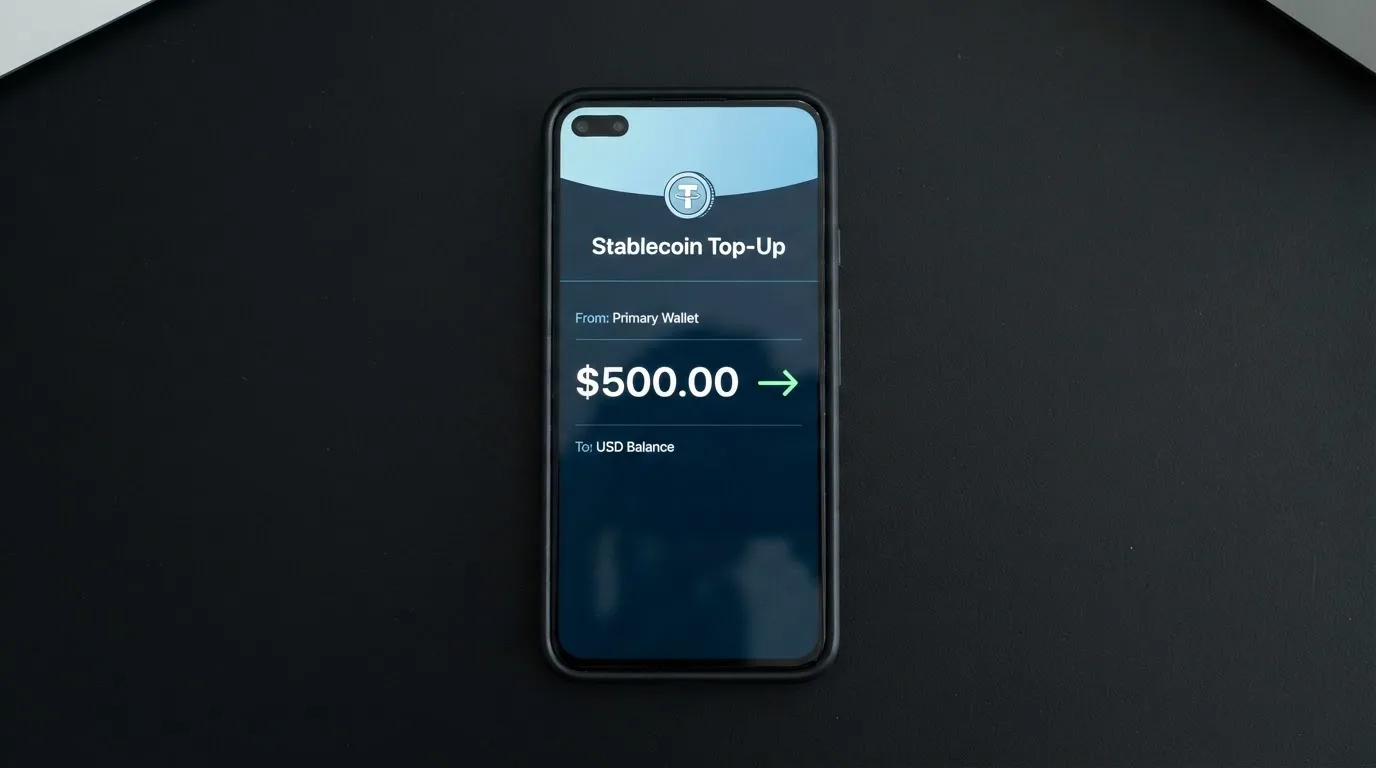
The platform accepts deposits in Bitcoin, USDT and ETH, “u otras criptomonedas disponibles”. The wording matters: “other available cryptocurrencies” is not a list, and which ones those are can change without notice. When you pay, the equivalent crypto balance is deducted and converted to fiat. That is the same mechanism a prepaid card uses: crypto is converted and loaded as a fiat balance, and the card can only spend what is on it.
Platform-level fees, which are separate from card fees:
| Platform operation | Fee |
|---|---|
| Bank deposits | Free, minimum $1 |
| Buying crypto by card | 4.65%, up to $5,000 per day |
| Card top-up from crypto | No fee stated |
| Bank withdrawal PEN/USD | $5 flat under $500; 1% from $500; minimum $6; up to 24 hours |
| Card balance return | Not stated |
The withdrawal row deserves a second look: a $5 flat fee applies for withdrawals under $500, 1% for $500 and above, and a $6 minimum fee applies. The percentages are stated, the floors are stated, and the arithmetic is yours.
If you withdraw crypto or move it on-chain, the network matters more than anything else on this page, and it is the one thing I cannot tell you. Stablecoins exist on many chains. USDT has been issued on networks including Ethereum, Tron, Solana, Polygon, Avalanche and others; Circle lists USDC as natively supported on 38 networks as of 16 September 2026, including Ethereum, Solana, Base, Polygon PoS, Avalanche, Arbitrum and Stellar. If the card expects one and you send on another, the transfer is irreversible and support may or may not recover it. Before you send anything, get the network from the app’s deposit screen for that specific coin.
One practical note: ERC-20 tokens need ETH for gas, so a wallet holding USDT with no ETH cannot send. On Tron, fees are paid through bandwidth and energy, often burning TRX. These are small costs, but they are real and they are the difference between a deposit landing and not landing.
I would make the first top-up trivial in size. The reason is not distrust of the platform — it is that a wrong-network deposit has no undo, and the only way to learn which network is correct is to test it once.
Paying with it every day
The day-to-day experience is the strongest part of the offer. Apple Pay and Google Wallet are supported, so you push the virtual card into your phone wallet and tap. In Apple Pay, the card number is replaced with a device-specific Device Account Number stored in the Secure Element, never on Apple’s servers, and each payment carries a one-time dynamic security code. That is genuinely better security hygiene than a number sitting in a photo.
Per-transaction approval in the app with biometrics is offered, along with instant freeze, real-time notifications, 2FA, tokenised payments, Visa protection and PCI DSS compliance. Blocked merchant categories are not stated — and that omission is worth attention, because a merchant category code is simply a four-digit number classifying a business, and issuers block categories like gambling (MCC 7995) by policy rather than by law. The blocked list varies by issuer. So you cannot tell from the public pages whether this card will be refused at a betting site.
Two things about online payments generally, so you are not surprised by a decline:
- Address Verification Service compares the numeric parts of the billing address you type with issuer records. It is mainly offered in the US, Canada and the UK, and is generally unavailable for foreign-issued cards — which can cause declines. A card issued in Peru buying from a US merchant sits exactly in that gap.
- Some merchants decline prepaid or foreign-issued cards because the BIN lookup reveals the card type and issuer country. For a card that behaves like a prepaid card, that is a plausible everyday friction.
- Under 3-D Secure — Visa’s brand is Visa Secure — the issuer assesses risk and either approves without friction or challenges you with a one-time code or a biometric. If it challenges you and you do not complete it, the payment fails.
There is also a category of surprise that is not Fluyez’s fault but will land on your statement: a declined authorisation can leave a hold on funds that stays for several days, typically up to seven.
No rewards. The page mentions no cashback, no points, no tier benefits. Compare that to the market: some competing cards now pay tiered cashback, and MEXC’s scheme is 4% capped at 100 USDT a month on the Standard tier rising to 10% capped at 800 on Elite. If you spend on this card, spend on it for access, not for returns.
The app is a weak spot. The iOS listing shows a rating of 3.7 from 3 ratings, read 2026-10-21. That is a very small sample, and small samples move violently — but three ratings is three ratings. The Google Play listing reads “Próximamente”, so on Android there is, as far as the public pages show, no published app listing. On Android you should confirm you can get the app at all before you load money.
Support is described as “Español completo 24/7”, with a Peru phone and WhatsApp number and an email address published. Published contact details are a small but real signal, and Spanish-only support is worth weighing if that is not your language.
Dispute handling for card transactions is not stated. If you are treated to a double charge or a merchant that takes your money and delivers nothing, the usual route is a chargeback — a refund ordered by the card issuer, with reason codes such as fraud, duplicate billing or goods not received. But prepaid-card coverage varies by jurisdiction and should not be assumed, and I cannot tell you from the public pages what Fluyez would do.
What can go wrong
Let me separate the things I found from the things I simply could not check, because here they blur together more than I would like.
On complaints. I looked for official incidents and found none. Searches for Fluyez card reviews and complaints returned nothing about Fluyez. Trustpilot shows 4.3 from 9 reviews, all of them 5-star, all dated August 2021, none in the last 12 months as of a read on 2026-10-21, and no complaint themes found.
Read that carefully, because it is a *thin* signal rather than a clean one. Nine reviews, all from a single month five years ago, tells you almost nothing about 2026. A platform with no complaints often means a platform nobody has used. The Trustpilot figure is a user-reported third-party listing, not something confirmed by the card.
On the company. Fluyez Digital Investments S.A.C. is the App Store seller, based in Peru. Bit2Me bought a stake — 1 million euros according to the site, July 2022 according to news coverage. The company is registered with Peru’s SBS as a virtual asset service provider under Resolución N° 02568-2021, and it is not a bank. The card issuer is not named; a partnership with Visa is announced.
On timing. On 20 January 2026 news reported Fluyez preparing a public launch of its crypto card with the Visa alliance. That is the most recent dated datapoint I have, and it describes preparation, not a mature operating history. Fluyez also lists a Peru Blockchain Conference for 10–11 July 2026 in Lima.
On custody — and this is the real question. Control of crypto belongs to whoever holds the private key or seed phrase. With a custodial wallet, the provider holds the credentials, and you must trust them completely. A seed phrase is typically 12 to 24 words and unencrypted; anyone who obtains it can restore the wallet and spend its funds. Transfers are typically irreversible, and a stolen key has no built-in recovery because the network cannot freeze or return anything. The custody model of this card is not stated — I do not know whether your crypto sits with Fluyez or in a wallet you control.
This is not an abstract worry. Custodial platforms have a record of it: Mt. Gox (about US$350 million reported stolen, 2011–2014), Coincheck (about US$400 million, 2018), Ronin Network (US$625 million, 2022). Against that, a self-custody-linked card keeps funds in your own wallet until the moment of payment, but the burden shifts entirely to you — key loss, phishing, and clipboard-hijacking malware that silently swaps a copied address are all yours to handle.
On being locked out. This is the category risk that no score can express. Card programmes do close. In November 2022 Visa said it had terminated its global agreements with FTX, and the FTX US debit card programme was wound down by its issuer. WaveCrest, a Visa issuer that supplied crypto card brands, was suspended by Visa in Europe in 2018, closing all WaveCrest-issued Visa programmes. Visa and Mastercard can license issuers and can suspend a programme. When that happens the pattern is usually: a notice period, then spending and loading stop, then you are asked to withdraw whatever is left. One 2026 closure reported by a secondary source ended new loads on 8 July 2026 and spending on 8 August 2026 — a single unconfirmed source, offered only to show the shape of a timeline, not as a prediction.
If you hold crypto on a card, you are choosing a counterparty. Make sure that is a choice you made deliberately.
On regulation. Fluyez sits under Peruvian rules, not EU ones, so MiCA does not directly govern it — but MiCA explains the shape of the regime most providers are moving into. MiCA is Regulation (EU) 2023/1114, and ESMA states it took legal effect in June 2023. Its rules on asset-referenced tokens and e-money tokens applied from 30 June 2024, and the remaining provisions including crypto-asset service provider rules from 30 December 2024. Under MiCA, e-money tokens may be issued only by a credit institution or an electronic money institution. The transitional period lets providers already operating under national law continue only until 1 July 2026 or until they receive or are refused a MiCA authorisation, whichever comes first — and that date is now in the past, so a Peruvian provider today is operating either under a regime outside the EU or working toward authorisation. ESMA maintains an interim register you can check a provider on. Note also that a card is a payment service regulated separately from the crypto side, so a crypto card often rests on two licences rather than one. And if you are ever paid in crypto, note that Tether says it disables tokens in wallets on the OFAC sanctions list and has frozen funds tied to illicit activity — stablecoins are not censorship-proof.
On taxes, one sentence only, because I am not qualified to advise you. Digital assets are generally treated as property for tax purposes, and each card payment funded from crypto can be a separate disposal, measured in local fiat currency at the fair market value on the date of the transaction. What that means for you depends entirely on your jurisdiction and your holding period. Ask a professional, not a card review.
What to take instead
I would rather tell you where the alternatives are genuinely stronger than tell you this card is the only option.
Bybit Card — 6.0 / 10. The most transparent of the three, and the disclosure contrast is stark. Its help centre lists card regions explicitly: Argentina, AIFC (Kazakhstan), Georgia, Kazakhstan, Australia, Mexico, Brazil, Peru, Asia Pacific. The application asks for your country of residence; if the country is unsupported, Bybit “will register your interest”. The cards page carries a blunt exclusion: “This product is not meant for European Economic Area customers. All European Economic Area customer participation is strictly prohibited.”
Its fees are published: crypto conversion 0.9% over the One-Click Sell rate in Australia, Asia Pacific, Georgia, Kazakhstan, Brazil and Mexico; 0.5% in Argentina. FX fee 2% on top of the network rate in Australia, Asia Pacific, Georgia and Mexico; 2% as an “International Fee” in Kazakhstan; 7% in Argentina; 1.5% in Brazil; 1% in Peru. Cards page: “Auto interest, no annual fees”. Physical card issuance: 29.99 USD Australia, 5 USD/USDT Argentina, 29.99 USDT Georgia and Kazakhstan, 5 USDT Asia Pacific, none in Brazil or Mexico, and VIPs holding a physical card in the Australia, Kazakhstan, Georgia or Asia Pacific group pay no issuance or replacement fee.
The catch, and it is a real one: from 2026-10-05 10:00 UTC, only crypto-funded transactions earn points or cashback, because fiat-funded spending does not. So the reward headline does not apply to your actual behaviour unless you pay from crypto. Tiers run Base 2.00% capped at 5 USD, Beta 2% capped at 50 USD at 500 USD monthly spend, Alpha 4% capped at 150 USD, Apex 6% capped at 250 USD, Omega 8% capped at 400 USD, Infinite 10% capped at 600 USD. Card currency depends on your country of Advanced Identity Verification — PEN or USD for Peru, for instance.
MEXC — 5.6 / 10. Very close to Fluyez on score, and thin in a different way. Virtual card only, physical not yet available. Issuance fee 20 USD, service fee 0%, with fees varying by card type per a linked guide. Its funding route is specific: USDT transferred to the Fiat account, then added on the My MEXC Card page — networks not stated, which means the same irreversibility risk as Fluyez. Rewards are better than Fluyez’s nothing: Standard 4% capped at 100 USDT a month, Premier 6% capped at 300, Elite 10% capped at 800, paid by the 15th of the next month. The page lists “The Philippines, Taiwan, Thailand…” with a Details link and does not show the full list.
MSX — 6.4 / 10. The highest score of the four, and the least transparent: on the pages I could read, its eligibility, card type, cost, fees, funding and rewards are not stated.
| Fluyez | Bybit Card | MEXC | MSX | |
|---|---|---|---|---|
| Score | 5.5 / 10 | 6.0 / 10 | 5.6 / 10 | 6.4 / 10 |
| Eligibility | “Toda Latinoamérica” | Named regions; EEA excluded | Partial list shown | Not stated |
| Card fees | Not stated | Published by region | Not stated | Not stated |
| Platform fee | 1% per operation | Conversion 0.9% over sell rate | Not stated | Not stated |
| Rewards | None mentioned | Tiered cashback, crypto-funded only | Tiered cashback by M-Score | Not stated |
| Card form | Virtual confirmed | Virtual then physical | Virtual only | Not stated |
If you want a pattern rather than a verdict: pick the card that publishes its numbers, in the currency you need, for the region you live in. Bybit is the only one of these that tells you both what it charges and where it operates. That transparency is worth more than a headline reward rate.
Who I would recommend it to
I would recommend the Tarjeta Cripto Fluyez to one person: someone in Peru or elsewhere in Latin America who already holds Bitcoin, USDT or ETH, needs a Visa number they can push into Apple Pay or Google Wallet today, and has decided — knowingly — that the money loaded onto it is spending money rather than savings.
I would not recommend it as a first card. If you are new to crypto, start with a card that names its issuer and publishes its fees, because those are the two facts you will need on the day something goes wrong. And if you are outside Latin America, “toda Latinoamérica sin restricciones” is not an eligibility statement for you, and your citizenship may be filtered separately from your address.
Three things to do before you load money, in this order: check the in-app fee schedule against the marketing page and accept only what you have read in numbers; send a small test deposit on the network the app tells you for that specific coin; and confirm the app is actually obtainable on your phone — because on Android the public listing reads “Próximamente”, and a card you cannot open is a card you cannot freeze.
Frequently asked questions
What is the Tarjeta Cripto Fluyez card?
It is a virtual Visa card issued through Fluyez, a Peruvian crypto platform registered with SBS as a virtual asset service provider. You load it from crypto — Bitcoin, USDT, ETH and other available coins — and when you pay, the equivalent balance is deducted and converted to fiat. It behaves like a prepaid card: it spends only what is on it.
How does the Tarjeta Cripto Fluyez card work?
You deposit crypto to the platform, and the card draws on that converted balance when you pay, in physical shops or online. It works with Apple Pay and Google Wallet, and you approve each transaction in the app with biometrics. Crypto is converted and loaded as a fiat balance, so the card cannot overdraw — it just stops when the balance runs out.
Is the Tarjeta Cripto Fluyez a bank?
No. Fluyez Digital Investments S.A.C. is a Peruvian company registered with SBS as a virtual asset service provider under Resolución N° 02568-2021, and it is not a bank. The issuer that actually holds the card programme is not named on the public pages. Visa licenses issuers rather than issuing crypto cards itself, so several separate parties are involved.
Who owns the Tarjeta Cripto Fluyez card?
Fluence-style ownership is not the right question: Fluyez Digital Investments S.A.C. is the company behind the app, and Spanish exchange Bit2Me bought a stake — reported at 1 million euros, in July 2022. A partnership with Visa has been announced. Card issuer and bank partner are not named in the public material.
Can I use the card in my country?
The page says “Disponible en Latinoamérica” and “Funciona en Perú y toda Latinoamérica sin restricciones”, and that it can be used wherever Visa is accepted. If you live outside Latin America, that sentence does not cover you and you should ask directly. Citizenship may be screened separately from residence, so your passport can matter independently of where you live.
How much does the card cost to open and maintain?
The page says “Sin costos ni mantenimiento si llegas al monto mínimo de uso” — no costs or maintenance if you reach the minimum usage amount — but that minimum is not specified, and the issuance fee is not stated. What is stated is the platform side: a 1% commission per operation, free bank deposits from $1, 4.65% to buy crypto by card up to $5,000 a day.
How do I top up the card, and on which network?
You deposit Bitcoin, USDT, ETH or other available coins, and the platform credits the equivalent balance. The critical unknown is the network, which the pages do not state. Transfers are irreversible, so a deposit on the wrong network can be lost or need manual recovery with no guarantee. Send a small test first, using the network the app’s deposit screen specifies for that coin.
Is the card safe for large amounts?
I would not put large amounts on it, and the reason is disclosure, not warning signs. The card fees, conversion cost, FX treatment, ATM support and limits are all unstated, and the custody model is not stated either. Custodial platforms have failed badly before — Mt. Gox, Coincheck, Ronin — and I found no official incident involving Fluyez, but I also found only 9 Trustpilot reviews, all from August 2021.
Does it work with Apple Pay and Google Wallet?
Apple Pay and Google Wallet are both named as supported, which is the best everyday feature here. In Apple Pay the card number is replaced by a device-specific number in the phone’s Secure Element with a one-time code per payment, which is good practice. One caveat on the app side: the Google Play listing reads “Próximamente”, so confirm you can actually get the app on Android.
Is it worth it compared with other crypto cards?
At 5.5 out of 10, it ranks below Bybit Card at 6.0, MSX at 6.4 and roughly level with MEXC at 5.6, and the gap is transparency. Bybit publishes its regions, its conversion fee and its FX fee; Fluyez publishes none of its card-level costs. It also offers no rewards where MEXC pays tiered cashback and Bybit pays tiered cashback on crypto-funded spending. If you want rewards, this is not the card.
How exchange cards work – cryptocardsexplained.com
Content created by the «cryptocardsexplained.com» team