
The Whop Card in Practice: A Seller's Visa, Not a Bank Account
 Available in US
The Whop Card is a Visa card that spends from your Whop balance rather than from a bank account. That single design choice explains almost everything about it: who can have one, what you can pay for, and what happens when something goes wrong. It is not a bank account, not an exchange wallet, and not a general-purpose card for anyone with crypto. It is a payout tool for people who sell on Whop and want the money to be spendable immediately.
Conditions are current as of October 28, 2026.
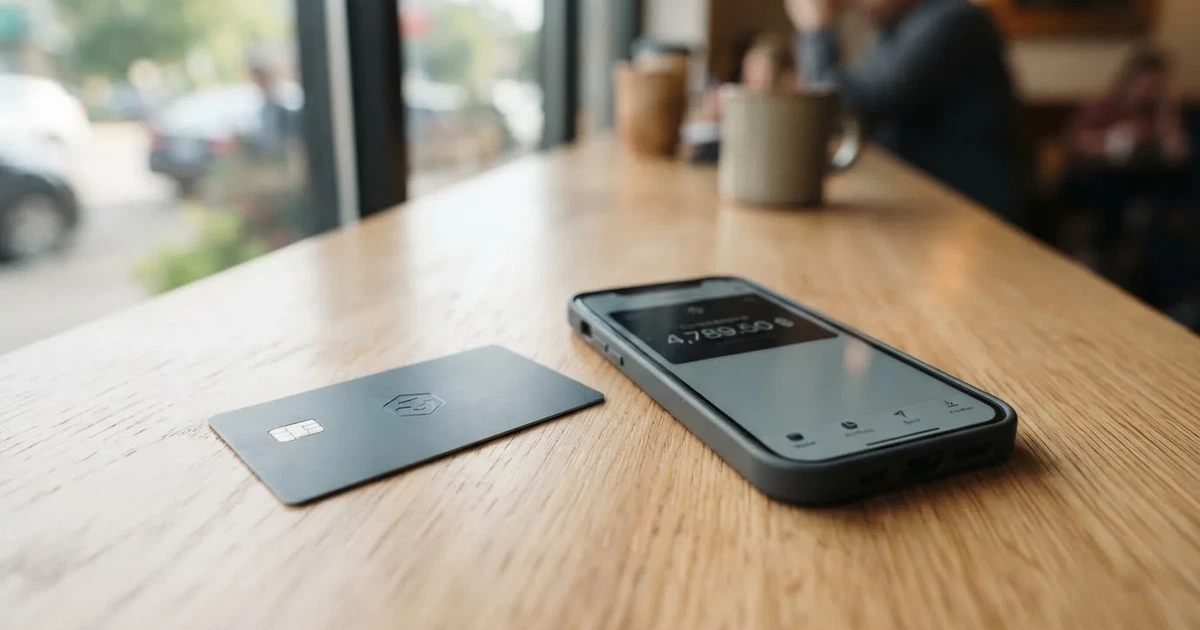
My score for it is 5.2 out of 10. That is not a verdict on the product idea — the idea is sensible and the audience it serves is real. It is a verdict on what is disclosed versus what is not, and on how much of the card’s behaviour you have to take on trust. Every number below comes from the card’s own public pages and from checks made on 2026-10-20, with one exception: the Trustpilot numbers come from user reports rather than from Whop.
The conditions described here are current as of October 28, 2026.
Who this is for, in one line: if you are a US-based Whop seller who gets paid in crypto through the platform and wants a Visa that draws down that balance, the Whop Card is aimed squarely at you. If you are anywhere else, or you want a general spending card, or you need to know exactly what a payment will cost before you make it, you will finish this review with more questions than answers.
The score, line by line
| Criterion | Mark | Why |
|---|---|---|
| Who can get it | 7 / 10 | 31 US states for consumers, 41 for businesses; 18 named countries closed, including Russia, Belarus, China, India, Turkey, Ukraine, Vietnam |
| Cost | 5 / 10 | The page says “No extra fees” and lists no amounts for issuance, monthly service or conversion |
| Top-up options | 4 / 10 | Spends from the Whop balance; starting data says it is backed by stablecoin collateral from a linked wallet, with coins and networks undisclosed |
| Reliability and complaints | 4 / 10 | Whop Inc., a Rain-powered programme, issuing bank and licences all unnamed; unofficial Trustpilot reporting cites frozen payouts, account blocks and unreturned money |
| Everyday use | 5 / 10 | Visa, adds to Apple Wallet and Google Wallet; no ATM by default, 250 USD per transaction when enabled; virtual or physical not stated |
| Total | 5.2 / 10 | A workable seller tool wrapped in a lot of silence |
Two things in that table deserve a second look. The 7 out of 10 for eligibility is the strongest mark, and it is largely a US-coverage mark — if you are outside the United States, that 7 is not about you. The 4 out of 10 for reliability is the weakest, and it is not because the product demonstrably fails; it is because the issuing bank and licences are not named, and because user reports on Trustpilot describe frozen funds and account suspensions. I can tell you what reviewers say. I cannot tell you which institution stands behind the balance.
Will they give you the card
Yes for a large part of the United States, no for a long list of countries, and unstated for everyone else.
For consumers, Whop lists 31 US states: Alabama, Alaska, Arkansas, California, Colorado, Connecticut, Florida, Hawaii, Illinois, Indiana, Iowa, Kansas, Kentucky, Maine, Massachusetts, Michigan, Minnesota, Montana, Nebraska, New Hampshire, New Jersey, New York, North Carolina, Oklahoma, Pennsylvania, South Carolina, Texas, Utah, Virginia, West Virginia and Wyoming. For businesses, the list is 41 states. That gap matters if you are a company rather than an individual: the business footprint is wider than the consumer one.
The countries the card’s pages say are not supported for consumers are Belarus, China (Mainland), Cuba, Hong Kong, India, Iran, Iraq, Israel, Myanmar, Nepal, Nicaragua, North Korea, Russia, Syria, Turkey, Ukraine, Venezuela and Vietnam. For corporate customers, Russia and Belarus are named as unsupported. Any country not on those lists is not named as closed — which is not the same as supported. The card does not say whether eligibility runs on citizenship, on residence, or on both, and I would not want you to guess. If your situation is unusual — a dual national, someone who moved recently, someone who sells on Whop from a country that is not on either list — that ambiguity is something only Whop can resolve for you, and it is worth an email before you plan around the card.
Sanctions and country rules are the card’s own to apply and change. Nothing in this review is a way around them.
How to get it
Cards are created from a Whop account in seconds. That is the whole flow as the card documents describe it: you have a Whop account, you get a card. Cards can also be issued to team members, which is the business-side use.
Here is what the public pages do not say. Whether identity verification is required is not stated in the card docs — KYC is not mentioned at all. Whether physical or virtual, or both, is not stated. What currency the card is denominated in is not stated. Delivery times are not stated. Nor is any tier structure or KYC level: there is a single card for consumers and one for businesses, and nothing more granular.
I want to be careful about the KYC point, because silence here is not permission to skip checks. Any regulated intermediary in this chain — an e-money institution, a bank, a money transmitter — will be obliged to identify you under anti-money-laundering law regardless of what a marketing page says. So the honest reading is: verification probably happens somewhere in the chain, but the card’s own pages do not tell you where, when, or what documents you would be asked for. If being asked for documents is a deal-breaker or a non-issue, you need that answered in writing before you rely on this card.
Fees and the cost of an ordinary payment
The card’s page says “No extra fees”. It does not list an issuance amount, a monthly service amount, or a conversion or foreign-exchange amount. Those are not stated. So the correct thing to say is not that the card is free, and not that it is expensive — it is that the price list is unpublished, and the words “No extra fees” are not a number.

| Fee or limit | What the card says |
|---|---|
| Issuance | No amount listed; page says “No extra fees” |
| Monthly fee | No amount listed |
| Conversion (crypto to balance) | Not stated |
| Foreign exchange | Not stated |
| ATM withdrawal | Fee not stated; unavailable by default, and when enabled the per-transaction cap is $250 |
| Per-transaction caps | Gaming $2,000; advertising services $10,000; adult content $200; ATM $250 |
| Velocity caps | For example, more than 11 card-not-present transactions in 24 hours is blocked |
| Daily and monthly totals | Not stated; a custom spending limit per card is available |
| Tier structure | Single tier for consumer and business; no tiers stated |
Now let us run three everyday payments through that table, because the table on its own is abstract and you will not read it the way a bank reads its own schedule.
Coffee. Suppose you spend a few dollars at a café. If the balance is already in the currency of the transaction, no conversion happens and nothing in the table appears to bite — the card’s own word is “No extra fees”. If your balance has to be converted from crypto first, the conversion rate at that moment applies, and the card does not publish a conversion fee or a spread. That is the number you cannot see, and it is the number that decides what you actually paid for the coffee.
A subscription in euros. You buy something priced in euros while your balance is in dollars. The transaction needs a currency conversion, and neither the foreign-exchange fee nor the rate source is stated. Separately, the Address Verification Service — the check that compares the numeric parts of the billing address a buyer types against issuer records — is mainly available in the US, Canada and the UK, and is generally unavailable for foreign-issued cards, which can cause declines. Whop being a US programme, a euro subscription on a US-issued card is exactly the shape of payment that can be declined for reasons that have nothing to do with your balance.
Money out at an ATM. This one is straightforwardly limited. ATM withdrawals are unavailable by default. When you enable them, the per-transaction cap is $250, and more than three attempts in 24 hours are blocked. The fee is not stated. There is no monthly picture at all: daily and monthly totals are not stated, so you cannot tell from the public pages whether a heavy month of spending hits a ceiling.
The per-transaction caps are the part most likely to surprise you, and they are not all about money. Gaming is capped at $2,000, advertising services at $10,000, adult content at $200. The $200 adult-content cap reads less like a spending limit than like a policy statement, given that adult merchants are blocked entirely (more on that in the daily-use section). If you are in advertising, the $10,000 line is your number to notice.
Top up: where the money comes from
The Whop Card spends from your Whop balance. That is the mechanism, and it has one consequence worth understanding before anything else: the card has no separate wallet of its own to fill.
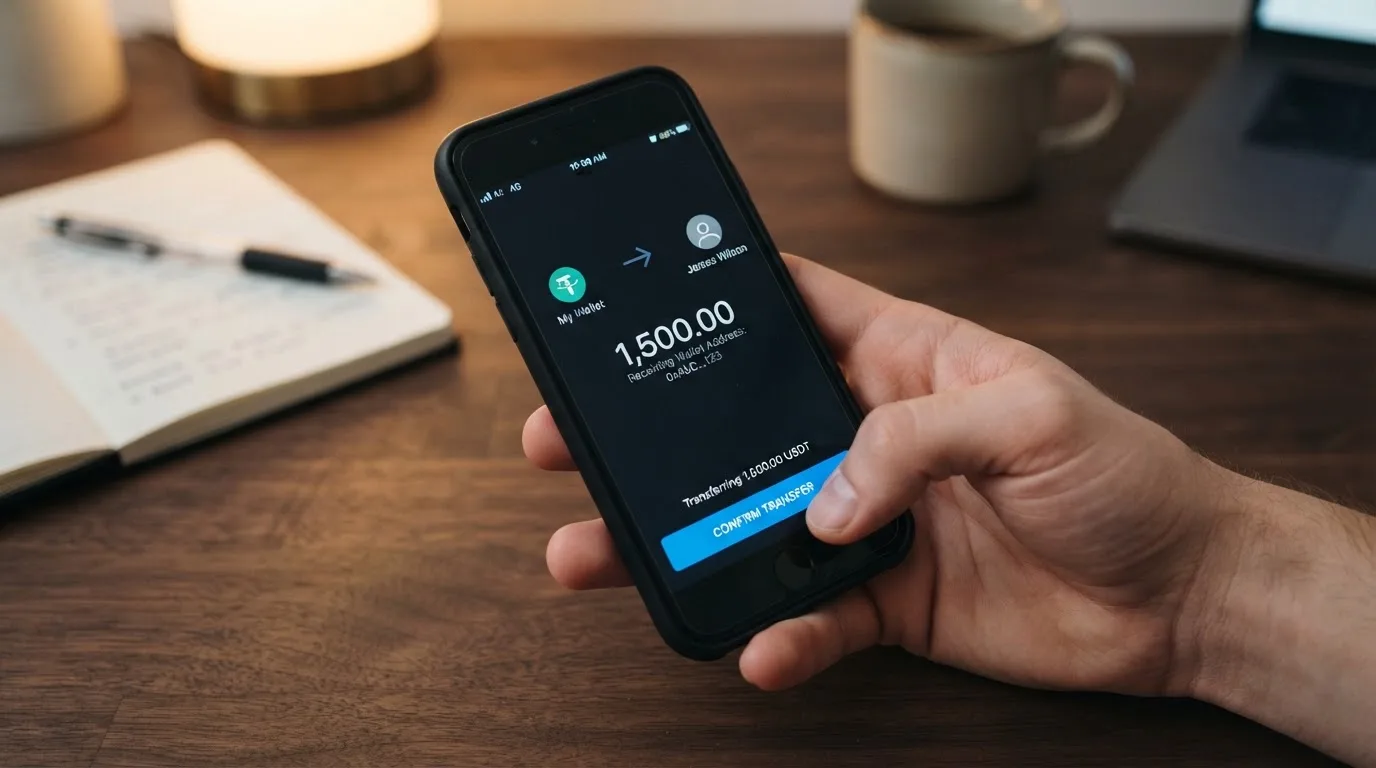
So how does the balance get filled? Through Whop — from sales you make there. A pending balance is usable as soon as a payment arrives to you. Standard withdrawals and transfers, by contrast, use only settled funds. That distinction is the practical heart of this card for a seller: your money is spendable before it has cleared, which is the convenience, and it is also the reason a card payment and a bank transfer can behave differently in the same week.
Underneath that, the starting data says the balance is backed by stablecoin collateral from a linked wallet. Which coins and which networks is not stated. Nor is any deposit fee or minimum. This is the single least transparent part of the product, and I want to be blunt about why it matters: the answer determines your cost. A transfer on one network may cost a fraction, on another a few dollars, and a wrong network can mean a deposit that does not arrive at all. Blockchain transfers are irreversible, so a deposit sent on a network the provider does not support, or to an address belonging to another network, can be lost or need manual recovery with no guarantee. If the coins and networks are not published, you cannot price your own top-up.
You do not need a bank withdrawal to spend. Whop says so directly. Whether you can withdraw a remaining balance if you close the account is not stated.
A last piece of the funding picture: Tether, maker of USDT, says it disables tokens in wallets on the OFAC sanctions list and has frozen funds tied to illicit activity. Stablecoins are not censorship-proof. That is a property of the asset class, not of Whop, but it is part of what “backed by stablecoin collateral” means in practice.
Paying with it every day
It is a Visa, so it works anywhere Visa is accepted, online and in stores, and you can add it to Apple Wallet or Google Wallet. Under Apple Pay the card number is replaced with a device-specific number stored in the Secure Element and each payment uses a one-time dynamic code, which is why adding it to a wallet is a meaningfully better idea than leaving it as a bare plastic rectangle. The issuer can also restrict a tokenised number, for example blocking it on phone or website use.
Now the part that will shape your week: the block list.
Blocked merchant categories include wire transfers and money orders (MCC 4829), ATM and cash (6010–6011), quasi cash (6051), securities (6211), gambling (7995 and related 7800–7802 and 9754), adult and dating (7273), and direct marketing (5960–5969). There is also a list of named merchants, among them Wise, Skrill, Neteller, MoonPay, eToro, Blockchain.com Europe, CEX.IO and Fortnite.
Read that list again with a specific question in mind. Almost every name on it is somewhere you would go to move money, not to buy coffee. If you are a seller, the tool you would most want — moving earnings out to another platform or to an exchange — is either blocked outright or sits behind a $250-per-transaction cap. This is a card for spending earnings, not for relocating them.
Why do categories get blocked at all? A merchant category code is a four-digit number classifying a business by what it sells, assigned when the business starts accepting cards. Gambling sits under 7995, and issuers block it by policy rather than by law, with the list varying by issuer. The same freedom of choice is visible on the positive side: Whop offers 5% cashback at select merchants, currently Uber, with more planned. What currency the cashback is paid in and what the conditions are is not stated — so treat the 5% as a headline until you have seen a payout.
Two more everyday-use items are simply unknown. Whether there is a functioning app listing I could check: not verified. And how disputes work is not stated in the card docs, with one user report of an unexplained $29 dispute fee and refunds that never arrived.
One practical thing that catches people out on any card: a declined authorisation can leave a hold on your funds for several days, typically up to seven. A decline is not always just a decline.
What can go wrong
This is the section where the card’s own pages are quietest and where outside reports are loudest.
Who stands behind it. The company is Whop Inc. The card programme is powered by a stablecoin-card issuer called Rain, per launch coverage; the press release date I did not read. The issuing bank and the licences are not stated. That matters for a plain reason: a card network licenses issuers and can suspend a programme, and programme closures follow a pattern — a notice period, then spending and loading stop, then users are asked to withdraw remaining balances. One 2026 closure reported by a secondary source ended new loads on 8 July 2026 and spending on 8 August 2026; I have that from a single unconfirmed source, so treat it as an illustration of the shape rather than as a fact. But the general point stands on its own: when you cannot identify the issuing institution, you cannot judge how a wind-down would be handled for your money.
What users report. On Trustpilot, for the Whop platform rather than the card specifically, there are 3,052 reviews with 65% five-star and 30% one-star; a reading on 2026-10-21 showed a TrustScore of 3.5, while another snapshot showed the score hidden as “unavailable due to a breach of our guidelines”. This is unofficial user-reported data, not confirmed by Whop, and the ratings moved within days. The recurring themes are consistent across reviews up to October 2026: frozen funds and paused payouts, account suspensions for alleged “fraudulent activity”, support that reviewers describe as mostly AI and unhelpful, and refunds that never arrive. None of that is a finding about the card. All of it is a warning about the balance the card draws on, which is the same balance.
What the card does protect. Per-card spending limits, a PIN lockout after too many wrong PINs, a fraud risk engine, 3-D Secure and address verification checks. Under 3-D Secure the issuer assesses risk and either approves a payment without friction or challenges you, for example with a one-time code or a biometric; Visa’s brand of it is Visa Secure. Note that liability for fraudulent online payments can shift between the merchant and your bank under 3-D Secure — some critics argue it can shift to the cardholder. And on the US side, debit card reversal rights come from Regulation E and credit card rights from Regulation Z; prepaid-card coverage varies and should not be assumed.
What is not disclosed at all. Whether customer funds are safeguarded — segregated in dedicated accounts or insured — is not stated, and that is not a technicality. Electronic money institutions are required to safeguard customer funds, but safeguarded funds are not bank deposits and may not be covered by a deposit guarantee scheme. If your money is not in a bank deposit and you do not know whether it is safeguarded, you are carrying that difference yourself.
If a decline looks wrong. Whop says to contact support. Channels, languages and hours are not stated.
What to take instead
All three alternatives below are also built on a balance rather than a bank account, and none of them fixes every problem the Whop Card has. I am comparing them on the same axes I used above, so you can see where the trade-offs sit.
| Whop | Stella | UniFi Card | Renegade | |
|---|---|---|---|---|
| Score | 5.2 / 10 | 6.5 / 10 | 4.7 / 10 | 4.1 / 10 |
| Card | Visa; physical or virtual not stated | Virtual and physical Visa | Prepaid Debit Visa, issued by Lead Bank | Virtual card, “VISA integration” |
| Cost | “No extra fees”, no amounts | Not stated; fees in the User Agreement or app | Not stated; “Fees may apply” | Pioneer 9.90 EUR, Voyager 19.90 EUR, Vanguard 29.90 EUR monthly (less if paid in RNG) |
| Conversion / FX | Not stated | Not stated officially | Not stated | Crypto/fiat exchange 1.6%; FX not stated |
| Funding | Whop balance; stablecoin collateral from linked wallet | Deposit crypto, account auto-tops-up the card | ACH, wire, SEPA, SPEI; get paid to a USDC wallet | Crypto vIBAN via Striga and IBAN account |
| Rewards | 5% cashback at select merchants, currently Uber | No cashback stated on the card page | “3% rewards on balances”; card cashback not stated | 3% rewards in RNG on all three tiers, monthly caps listed |
| Who it suits | US-based Whop sellers | Sellers who want crypto in, card out, with no country list published | People who want ACH and SEPA rails alongside USDC | Euro-area users with three paid tiers |
Stella scores highest here at 6.5, and the reason is narrow rather than sweeping: its terms bar users under economic sanctions programmes and route US and European users through affiliates, and the official site does not state countries. That is not a better answer to the eligibility question, it is a differently-shaped one. What it does state is more useful in places — virtual and physical cards, working at what it calls over 40 million Visa merchants globally, custodial in-app wallet funding. But its fees are described only as being in the User Agreement and the app, and no cashback is stated on the card page.
UniFi Card at 4.7 is interesting for the wrong reasons to compare it to Whop: I could not confirm supported countries from official pages, though its App Store listing lists send-money routes to the Philippines, Mexico, the eurozone, and recent release notes mention Colombia, Brazil and the UK. It is a USD prepaid Visa from Lead Bank with ACH, wire, SEPA and SPEI funding, so it is a genuinely different rail from a platform balance.
Renegade at 4.1 is the most transparent of the three on price — and the transparency cuts both ways, because a 9.90 EUR monthly floor is a real, published cost against Whop’s unpublished one. Its exchange fee is 1.6% and it says no other fees are collected, with 30 days’ notice before new ones. Rewards are 3% in its own coin with monthly caps. But its euro deposits and withdrawals run through a virtual IBAN restricted to the European Economic Area, so the geographic constraint is tighter than Whop’s US-state list rather than looser.
The honest summary of this comparison: the alternatives publish different things, and none of them publishes everything. Whop publishes the best eligibility list and the vaguest price list. If your decision hinges on knowing your cost per payment, none of these four gives you that on its public pages.
Who I would recommend it to
I would recommend the Whop Card to one specific person: someone selling on Whop in one of the 31 consumer states or 41 business states, paid in crypto by the platform, spending most of what comes in on ordinary things, and content to have a balance that clears before the money has settled. For that person it does a narrow job well, and the pending-balance feature is the reason.
I would not recommend it to you if any of these are true. You are outside the United States, or in a country the card does not name. You need to move money between platforms rather than spend it — Wise, Skrill, Neteller and MoonPay are all on the blocked-merchant list. You need a bank you can name behind your balance, because the issuing bank and licences are not stated. You want cash from an ATM without friction, because ATMs are off by default and capped at $250 per transaction. Or you are the kind of person who wants a published fee schedule, in which case this is not it, and given how much else is unpublished, I would not expect that to change quickly.
What I would do before relying on it: ask Whop, in writing, four questions — what is the issuing bank and what are the licences, what is the conversion and FX cost, which stablecoin and networks back the balance, and what happens to a remaining balance if the programme ends. Any card whose public pages do not answer those is asking you to accept the balance on trust, and trust is a reasonable thing to extend to a seller you already use, but not an unlimited amount of it.
One thing that is not in scope of this review but belongs in your thinking: the IRS treats digital assets as property, so exchanging them for goods, services or dollars generally produces a taxable gain or loss, measured in the local currency at fair market value on the date of the transaction. Each card payment funded from crypto may be a separate disposal. I am not giving tax advice here — I am telling you to ask a qualified professional in your own jurisdiction what a spending pattern means for your filing.
Frequently asked questions
What is the Whop Card?
It is a Visa card that draws on your Whop balance instead of a bank account. It is aimed at people who sell on Whop and are paid in crypto through the platform, and it lets them spend earnings directly. It is not a bank account, and it does not hold crypto itself — the balance sits on the Whop side and the card spends it.
How does the Whop Card work?
You get a Visa from your Whop account in seconds, add it to Apple Wallet or Google Wallet, and pay anywhere Visa is accepted. Your Whop balance funds each payment, and a pending balance becomes usable as soon as a payment arrives to you. Standard bank withdrawals, by contrast, only use settled funds. Spending limits and category blocks apply.
Is Whop a bank?
No. Whop Inc. is the company behind the platform, and the card programme is powered by a stablecoin-card issuer called Rain. The issuing bank and the licences are not stated on the card’s public pages. So the balance is not a bank deposit, and whether it is safeguarded as e-money is not disclosed either.
Who can get the Whop Card?
Consumers in 31 US states, and businesses in 41 states. Consumers are not supported in 18 named countries including Russia, Belarus, China (Mainland), India, Turkey, Ukraine and Vietnam. Any country not on those lists is simply not named as closed, and the card does not say whether eligibility follows citizenship or residence.
Does the Whop Card require KYC?
The card docs do not mention KYC at all, so the card’s own pages do not say. That is not an exemption: any regulated intermediary in the chain will be obliged to verify you under anti-money-laundering law. If being asked for documents matters to you, ask Whop directly before you rely on the card.
What does the Whop Card cost?
The page says “No extra fees” but lists no amounts for issuance, monthly service, conversion or foreign exchange — those are not stated. ATM fees are also not stated. You can set your own per-card spending limit, and per-transaction caps apply: $2,000 gaming, $10,000 advertising, $200 adult content, $250 ATM.
How do I top up the Whop Card?
You do not top it up separately — it spends from your Whop balance, which fills from your sales on the platform. Underneath, starting data says the balance is backed by stablecoin collateral from a linked wallet, but which coins and networks is not stated, nor is any deposit fee or minimum. Network fees are charged by the blockchain, not by Whop.
Where can I use the Whop Card, and what is blocked?
Anywhere Visa is accepted, online and in stores, including via Apple Pay and Google Wallet. Blocked categories include gambling, adult and dating, securities, quasi cash, ATM and cash, wire transfers and direct marketing. Named blocked merchants include Wise, Skrill, Neteller, MoonPay, eToro, Blockchain.com Europe, CEX.IO and Fortnite.
Is the Whop Card safe?
The card has real protections: per-card spending limits, a PIN lockout, a fraud risk engine, 3-D Secure and address checks, and tokenised mobile wallets. But the issuing bank, the licences and whether funds are safeguarded are not stated, and under 3-D Secure liability for a fraudulent online payment can shift toward you. Reviews on Trustpilot for the platform also report frozen payouts and undelivered refunds.
Is the Whop Card worth it?
For a US-based Whop seller spending earnings on everyday purchases and content with pending balances, probably yes — it is a narrow tool that does its narrow job. If you need to move money to another platform, withdraw cash often, sit outside the US, or want a published fee schedule and a named issuing bank, the value is much harder to see, and I would look at the alternatives first.
How app and neobank cards work – cryptocardsexplained.com
Content created by the «cryptocardsexplained.com» team